Optimization of broiler growth and organ traits: Insights from a meta-analysis of feed form effects https://doi.org/10.12982/VIS.2026.067
Article Sidebar
Main Article Content
Abstract
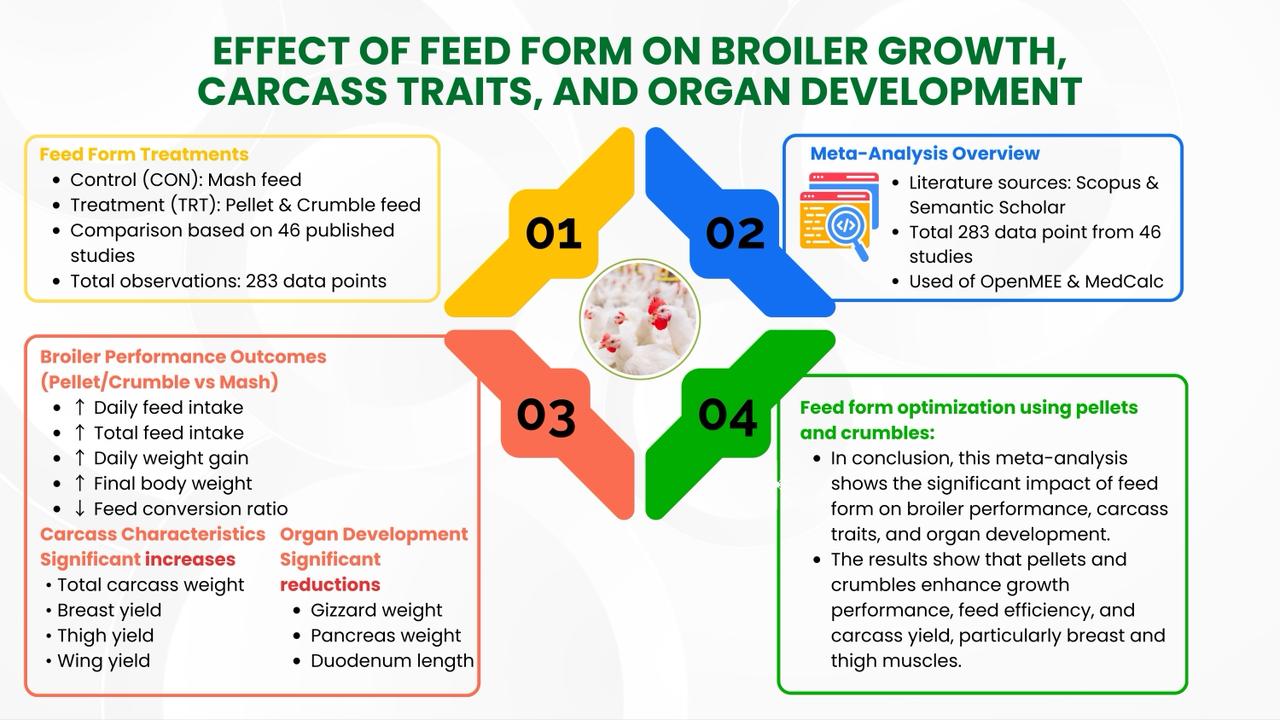
Feed form is an essential factor influencing nutrient use, feeding behavior, and overall efficiency in broilers. Since feed represents the largest portion of production costs, there is a need to select the appropriate feed to improve performance and profitability. Therefore, this meta-analysis aimed to examine the effects of feed form on broiler performance, carcass traits, and organ development using 283 data points from 46 published studies. Data reliability was assessed using a fail-safe number (Nfs), which showed robust parameters for daily feed intake (Nfs > 620) and daily weight gain (Nfs > 1000), while mortality and organ weight had low values. The results showed that feed form significantly improved (P < 0.05) broiler performance, particularly conversion ratio and final body weight. However, high heterogeneity (I² > 80%) showed that differences in diet composition, management, and environmental conditions strongly influenced the outcomes. Carcass traits significantly improved (P < 0.05), with increased weight observed in the total carcass, breast, thigh, and wing. Abdominal fat deposition showed a relatively smaller but significant (p<0.05) reduction. The effect on organ development was variable, with gizzard and pancreas weights decreasing significantly (P < 0.05), indicating low mechanical and enzymatic demands of processed feeds, while liver weight was unaffected. Intestinal morphology showed mixed outcomes, with significant (P < 0.05) reductions in duodenum length and non-significant trends for jejunum and ileum lengths. This indicated that feed form substantially enhanced broiler productivity, carcass quality, and feed efficiency. However, variability across studies showed the need to consider management and environmental factors, indicating the need for future investigation to identify sources of heterogeneity.
Article Details

This work is licensed under a Creative Commons Attribution 4.0 International License.
Publishing an article with open access in Veterinary Integrative Sciences leaves the copyright with the author. The article is published under the Creative Commons Attribution License 4.0 (CC-BY 4.0), which allows users to read, copy, distribute and make derivative works from the material, as long as the author of the original work is cited.
References
Abadi, M.H., Moravej, H., Shivazad, M., Karimi Torshizi, M.A., Kim, W.K., 2019. Effects of feed form and particle size, and pellet binder on performance, digestive tract parameters, intestinal morphology, and cecal microflora populations in broilers. Poult. Sci. 98, 1432–1440.
Abdollahi, M.R., Ravindran, V., Svihus, B., 2014. Influence of feed form on growth performance, ileal nutrient digestibility, and energy utilisation in broiler starters fed a sorghum-based diet. Livest. Sci. 165, 80-86.
Abdollahi, M.R., Ravindran, V., Svihus, B., 2013. Pelleting of broiler diets: An overview with emphasis on pellet quality and nutritional value. Anim. Feed. Sci. Technol. 179, 1-23.
Al-Nasrawi, M.A.M., 2016. The impact of different dietary forms (mash, crumble, and pellets) on some growth traits and carcass characteristics of broilers. J. Anim. Health Prod. 4, 31-36.
Amerah, A.M., Ravindran, V., Lentle, R.G., Thomas, D.G., 2007. Influence of feed particle size and feed form on the performance, energy utilization, digestive tract development, and digesta parameters of broiler starters. Poult. Sci. 86, 2615-2623.
Amirabdollahian, H., Emamzadeh, A.N., Keramati, K., 2014. A comparative effect of mash and pellet feed with different pelleting temperatures on blood metabolites, carcass characteristics, and broiler performance. Int. J. Adv. Biol. Biomed. Res. 2, 141-145.
Amornthewaphat, N., Lerdsuwan, S., Attamangkune, S., 2005. Effect of extrusion of corn and feed form on feed quality and growth performance of poultry in a tropical environment. Poult. Sci. 84, 1640–1647.
Ariyadi, B., Sudaryati, S., Harimurti, S., Wihandoyo, Sasongko, H., Habibi, M.F., Rahayu, D., 2019. Effects of feed form on small intestine histomorphology of broilers. Earth Environ. Sci. 387, 012047.
Attia, Y.A., El-Tahawy, W.S., Abd El-Hamid, A.E.H.E., Hassan, S.S., Nizza, A., El-Kelaway, M.I., 2012. Effect of phytase with or without multienzyme supplementation on performance and nutrient digestibility of young broiler chicks fed mash or crumble diets. Ital. J. Anim. Sci. 11, 303-308.
Azizian, M., Saki, A.A., 2020. Effects of the physical form of diet on growth performance, ascites, and sudden death syndrome incidences in broiler chickens. J. Hellenic Vet. Med. Soc. 71, 2087-2094.
Azizian, M., Saki, A.A., 2021. Effect of mash, pellet, and extruded diet form on ascetic gene expression (Hif-1α mRNA) and heart index in broiler chicken. J. Agric. Sci. Technol. 23, 17-25.
Boazar, E., Salari, S., Erfanimajd, N., Moosavi Fakhr, K., 2021. Effect of mash and pellet diets containing different sources of fiber on the growth performance and cecal microbial population of broiler chickens. J. Livest. Sci. Technol. 9, 9-22.
Brink, M., Janssens, G.P.J., Demeyer, P., Bağci, Ö., Delezie, E., 2022. Reduction of dietary crude protein and feed form: Impact on broiler litter quality, ammonia concentrations, excreta composition, performance, welfare, and meat quality. Anim. Nutr. 9, 291-303.
Cardoso, D.M., Cardeal, P.C., Soares, K.R., Sousa, L.S., Castro, F.L.S., Araújo, I.C.S., Lara, L.J.C., 2022. Feed form and nutritional level for rearing growing broilers in thermoneutral or heat stress environments. J. Therm. Biol. 103, 103159.
Chehraghi, M., Zakeri, A., Taghinejad-Roudbaneh, M., 2013. Effects of different feed forms on performance in broiler chickens. Eur. J. Exp. Biol. 3, 66-70.
Chewning, C.G., Stark, C.R., Brake, J., 2012. Effects of particle size and feed form on broiler performance. J. Appl. Poult. Res. 21, 830-837.
Corzo, A., Mejia, L., McDaniel, C.D., Moritz, J.S., 2012. Interactive effects of feed form and dietary lysine on growth responses of commercial broiler chicks. J. Appl. Poult. Res. 21, 70-78.
Dozier, I.A., Behnke, K.C., Gehring, C.K., Branton, S.L., 2010. Effects of feed form on growth performance and processing yields of broiler chickens during a 42-day production period. J. Appl. Poult. Res. 19, 219-226.
Attia, Y.A., El-Tahawy, W.S., Abd El-Hamid, A E.H.E., Nizza, A., Al-Harthi, M.A., El-Kelway, M.I., Bovera, F., 2014. Effect of feed form, pellet diameter, and enzymes supplementation on carcass characteristics, meat quality, blood plasma constituents, and stress indicators of broilers. Arch. Anim. Breed. 57, 30.
Fasuyi, A.O., Odunayo, O.T., 2015. Particulating broiler feeds into forms and sizes for nutritional and economic benefits (part 1). Afr. J. Food Sci. 9(4), 223–229.
Habibi, M.F., Harimurti, S., Wihandoyo, Sasongko, H., Ariyadi, B., Sudaryati, S., Sekarlangit, K., Putri, Y.S., 2019. The effect of different feed forms on the performance and carcass yield of broiler chickens. IOP Conf. Ser. Earth Environ. Sci. 387, 012050.
Hasania, A., Bouyeha, M., Rahatia, M., Seidavi, A., Makovicky, P., Laudadio, V., Tufarelli, V., 2017. Which is the best alternative for ascites syndrome prevention in broiler chickens? Effect of feed form and rearing temperature conditions. J. Appl. Anim. Res. 46(1), 392–396.
Hossain, M.A., Zulkifli, I., Soleimani, A.F., 2017. Effect of feeding different levels of PKC and physical form of diet on the productivity of broiler chickens under hot and humid tropical conditions. Wayamba J. Anim. Sci. 2012, 1517–1524.
Hosseini, S.M., Afshar, M., 2016. Effects of feed form and xylanase supplementation on performance and ileal nutrients digestibility of heat-stressed broilers fed wheat–soybean diet. J. Appl. Anim. Res. 45(1), 550–556.
Idan, F., Nortey, T.N.N., Paulk, C.B., Beyer, R.S., Stark, C.R., 2020. Evaluating the effect of feeding starters crumbles on the overall performance of broilers raised for 42 days. J. Appl. Poult. Res. 29(3), 692–699.
Jafarnejad, S., Farkhoy, M., Sadegh, M., Bahonar, A.R., 2010. Effect of crumble-pellet and mash diets with different levels of dietary protein and energy on the performance of broilers at the end of the third week. Vet. Med. Int. 2010, 328123.
Jiménez-Moreno, E., De Coca-Sinova, A., González-Alvarado, J.M., Mateos, G.G., 2016. Inclusion of insoluble fiber sources in mash or pellet diets for young broilers. 1. Effects on growth performance and water intake. Poult. Sci. 95(1), 41–52.
Karimirad, R., Khosravinia, H., Parizadian Kavan, B., 2020. Effect of different feed physical forms (Pellet, Crumble, Mash) on the performance and liver health in broiler chicken with and without carbon tetrachloride challenge. J. Anim. Feed Sci. 29(1), 59–66.
Kuleile, N., Molapo, S., 2019. The influence of feed form on broiler production and gastrointestinal tract development. Online J. Anim. Feed Res. 9(1), 38–43.
Lemme, A., Wijtten, P.J.A., van Wichen, J., Petri, A., Langhout, D.J., 2006. Responses of male growing broilers to increasing levels of balanced protein offered as coarse mash or pellets of varying quality. Poult. Sci. 85(4), 721–730.
Lv, M., Yan, L., Wang, Z., An, S., Wu, M., Lv, Z., 2015. Effects of feed form and feed particle size on growth performance, carcass characteristics, and digestive tract development of broilers. Anim. Nutr. 1(3), 252–256.
Massuquetto, A., Durau, J.F., Schramm, V.G., Netto, M.V.T., Krabbe, E.L., Maiorka, A., 2018. Influence of feed form and conditioning time on pellet quality, performance and ileal nutrient digestibility in broilers. J. Appl. Poult. Res. 27(1), 51–58.
Massuquetto, A., Panisson, J.C., Marx, F.O., Surek, D., Krabbe, E.L., Maiorka, A., 2019. Effect of pelleting and different feeding programs on growth performance, carcass yield, and nutrient digestibility in broiler chickens. Poult. Sci. 98(11), 5497–5503.
Massuquetto, A., Panisson, J.C., Schramm, V.G., Surek, D., Krabbe, E.L., Maiorka, A., 2020. Effects of feed form and energy levels on growth performance, carcass yield and nutrient digestibility in broilers. Animal. 14(6), 1139–1146.
Jiménez-Moreno, E., De Coca-Sinova, A., González-Alvarado, J.M., Mateos, G.G., 2016. Inclusion of insoluble fiber sources in mash or pellet diets for young broilers. 1. Effects on growth performance and water intake. Poult. Sci. 95(1), 41–52.
Musa, D., Sa’adu, A., 2021. Assessment of performance of broiler birds fed with different forms of feed (pellet, crumble and mash) In Sokoto State, Nigeria. Quest J. Res. Agric. Anim. Sci. 8, 68-72.
Omede, A.A., Iji, P.A., 2018. Response of broiler chickens to processed soy protein product when offered at different inclusion levels in mash or crumbled prestarter diets. J. Appl. Poult. Res. 27(2), 159–171.
Ommati, MM., Rezvani, MR., Atashi, H., Akhlaghi, A., 2013. Effect of physical form of diet and ambient temperature on performance and carcass attributes in broilers. Arch. Geflügelk. 77, 247–253.
Pirzado, S.A., Samad Mangsi, A., Barham, G.S., Mari, G.M., Pirzado, Z., Kalwar, Q., 2015. Effect of mash and crumbled feed forms on the performance of broiler chickens. IOSR J. Agric. Vet. Sci. 8, 27–30.
Rubio, A.A., Hess, J.B., Berry, W.D., Dozier, W.A., and Pacheco, W.J., 2020. Effects of feed form and amino acid density on productive and processing performance of broilers. J. Appl. Poult. Res. 29(1), 95–105.
Rueda, M.S., Bonilla, S., de Souza, C., Starkey, J.D., Starkey, C.W., Mejia, L., Pacheco, W.J., 2024. Evaluation of particle size and feed form on performance, carcass characteristics, nutrient digestibility, and gastrointestinal tract development of broilers at 39 d of age. Poult. Sci. 103(3), 103437.
Serrano, M.P., Valencia, D.G., Méndez, J., Mateos, G.G., 2012. Influence of feed form and source of soybean meal of the diet on growth performance of broilers from 1 to 42 days of age. 1. Floor pen study. Poult. Sci. 91(11), 2838–2844.
Serrano, M.P., Frikha, M., Corchero, J., Mateos, G.G., 2013. Influence of feed form and source of soybean meal on growth performance, nutrient retention, and digestive organ size of broilers. 2. Battery study. Poult. Sci. 92(3), 693–708.
Skinner-Noble, D.O., McKinney, L.J., Teeter, R.G., 2005. Predicting effective caloric value of nonnutritive factors: III. Feed form affects broiler performance by modifying behavior patterns. Poult. Sci. 84(3), 403–411.
Tavakolinasab, F., Khosravinia, H., Masouri, B., 2020. Physical form of diet influence the liver function, blood biochemistry, and external body measurements in broiler chickens exposed to carbon tetrachloride toxicity. Poult. Sci. J. 8(2), 163–174.
Xu, Y., Stark, C.R., Ferket, P.R., Williams, C.M., Brake, J., 2015. Effects of feed form and dietary coarse ground corn on broiler live performance, body weight uniformity, relative gizzard weight, excreta nitrogen, and particle size preference behaviors. Poult. Sci. 94(7), 1549–1556.
Yousefian Astabeh, I., Camani, M., Mousavi, S.N., Sadeghi, A.A., Amin Afshar, M., 2023. Effects of feed form (pellet or mash), corn particle size, and Bacillus-based probiotic supplementation on performance traits and digestive tract health of broiler chickens. South Afr. J. Anim. Sci. 53(6), 784-796.
Zang, J.J., Piao, X.S., Huang, D.S., Wang, J.J., Ma, X., Ma, Y.X., 2009. Effects of feed particle size and feed form on growth performance, nutrient metabolizability, and intestinal morphology in broiler chickens. Asian-Australas. J. Anim. Sci. 22(1), 107-112.
