Effects of commercial seaweed supplementation on in vitro methane production and milk performance in dairy https://doi.org/10.12982/VIS.2026.064
Article Sidebar
Main Article Content
Abstract
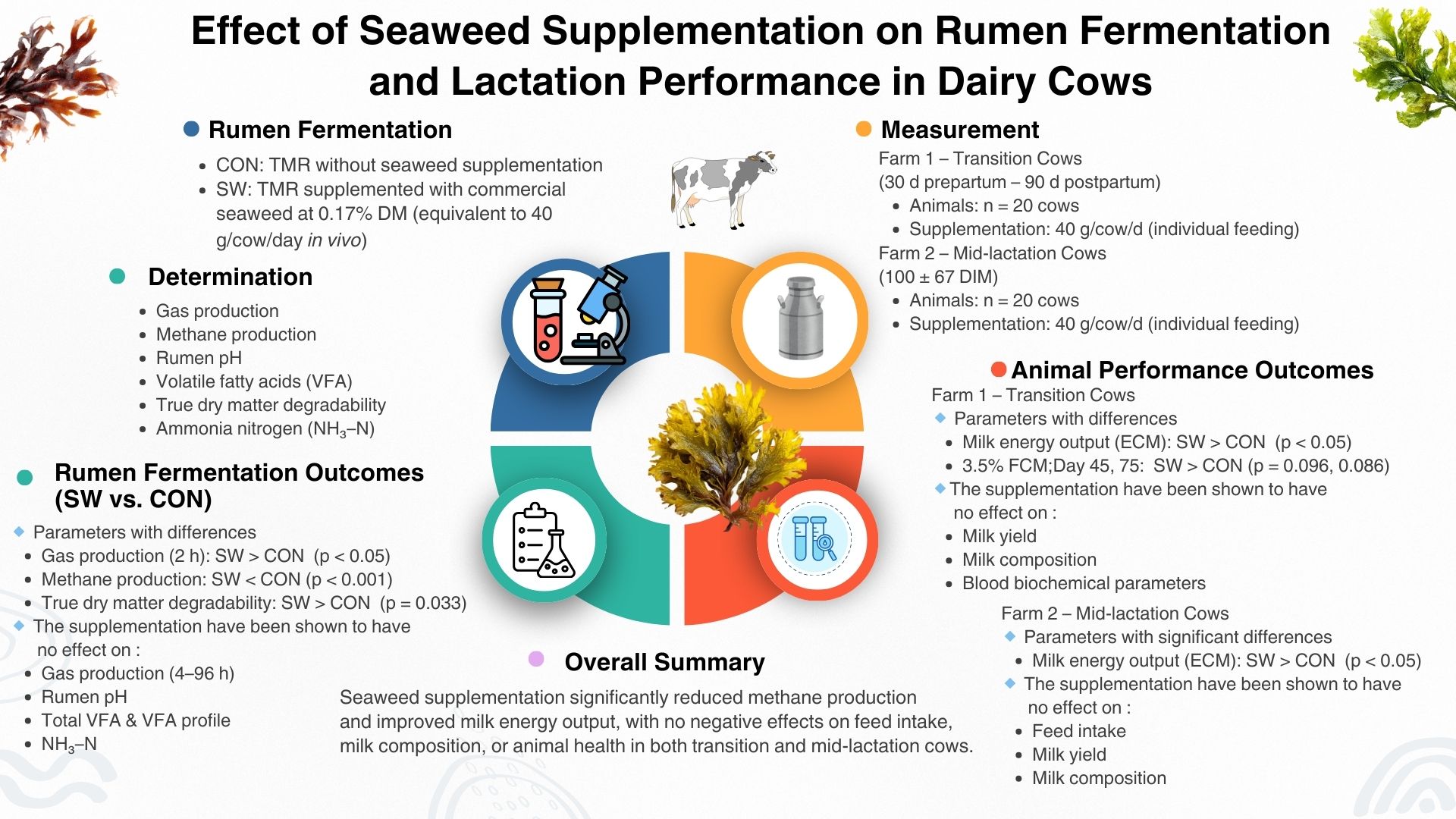
This study aimed to evaluate the effects of commercial seaweed supplementation on ruminal fermentation, methane production, and milk performance in dairy cows during prepartum and postpartum periods. The experiment consisted of two parts. Experiment 1 assessed the impact of seaweed on rumen digestion using the in vitro gas production technique with rumen fluid collected from two Holstein Friesian cows (with an average body weight of 427 ± 10 kg and an average age of 3 years). Total gas, methane, pH, ammonia-nitrogen (NH₃-N), volatile fatty acids (VFA), and microbial biomass yield were analyzed in a completely randomized design. Experiment 2 consisted of on-farm trials conducted at two commercial dairy farms. At Thongsak Farm, twenty prepartum cows (18.16 ± 1.06 kg/day milk yield; 420 ± 25 kg BW) were evaluated from 30 days before to 90 days after calving and assigned to either the control (TMR only) or treatment (TMR + 40 g seaweed/day) group. Feed intake was recorded daily, while blood samples were collected three times and milk samples seven times throughout the experimental period. At Somsak Farm, another twenty postpartum cows (16.5 ± 1.0 kg/day milk yield; 425 ± 25 kg BW; 100.05 ± 67.25 DIM) were evaluated for 30 days using the same treatment structure and sampling protocol as in the prepartum trial, with feed intake and milk production recorded concurrently. In vitro results showed that seaweed supplementation significantly enhanced gas production at 2 hours (7.27 vs 6.61 mL/200 mg DM) and reduced methane production (5.22 vs 2.30 mL/200 mg; p < 0.05). On-farm results showed a tendency toward higher milk yield in the seaweed group, along with increased protein, total solids, and solids-not-fat. Blood profiles remained within normal ranges, indicating no adverse effects. Seaweed supplementation improved rumen fermentation efficiency reduced methane emissions and positively influenced milk yield and composition in dairy cows without compromising animal health.
Article Details

This work is licensed under a Creative Commons Attribution 4.0 International License.
Publishing an article with open access in Veterinary Integrative Sciences leaves the copyright with the author. The article is published under the Creative Commons Attribution License 4.0 (CC-BY 4.0), which allows users to read, copy, distribute and make derivative works from the material, as long as the author of the original work is cited.
References
AOAC, 1990. Official Methods of Analysis, 15th edition. Association of Official Analytical Chemists, Maryland.
Badhan, A., Singh, R., Kumar, P., 2025. Rumen microbiome and energy efficiency: implications for feed utilization and methane mitigation. J. Dairy Sci. 108, 2025–2040.
Bhowmick, S., Phesatcha, K., Babor, D., Nookeo, S., Kimsuk, P., Sripuea, S., Wanapat, M., 2023. Enhancing the productivity of lactating dairy cows with a combination of fermented Asparagopsis taxiformis and rice straw-based diets. Anim. Feed Sci. Technol. 301, 115664.
Blümmel, M., Steingaß, H., Becker, K., 1997. The relationship between in vitro gas production, in vitro microbial biomass yield and ¹⁵N incorporation and its implications for the prediction of voluntary feed intake of roughages. Br. J. Nutr. 77, 911–921.
Choi, Y.J., Lee, S.J., Kim, G.M., 2021. Effects of seaweed supplementation on rumen fermentation characteristics and methane mitigation in dairy cows. J. Dairy Sci. 104, 3452–3463.
DiLorenzo, N., 2025. Methane synthesis as a source of energy loss impacting microbial protein synthesis in ruminants – a review. Methane. 4, 10–25.
Erwin, E.S., Marco, G.J., Emery, E.M., 1961. Volatile fatty acid analyses of blood and rumen fluid by gas chromatography. J. Dairy Sci. 44, 1768–1771.
Fortina, R., Glorio Patrucco, S., Barbera, S., Tassone, S., 2022. Rumen fluid from slaughtered animals: A standardized procedure for sampling, storage and use in digestibility trials. Methods Protoc. 5, 59.
Goff, J.P., 2008. The monitoring, prevention, and treatment of milk fever and subclinical hypocalcemia in dairy cows. Vet. J. 176, 50–57.
Goodland, R., Anhang, J., 2009. Livestock and climate change. World Watch. 22, 10–19.
He, L., Meng, Q., Ren, L., Zhou, Z., 2022. Effects of seaweed extract supplementation on milk production and nutrient utilization in lactating dairy cows. Anim. Feed Sci. Technol. 285, 115198.
Janssen, P.H., Kirs, M., 2008. Structure of the archaeal community of the rumen. Appl. Environ. Microbiol. 74, 3619–3625.
Kinley, R.D., de Nys, R., Vucko, M.J., Machado, L., Tomkins, N.W., 2020. The red macroalgae Asparagopsis taxiformis is a potent natural antimethanogenic that reduces methane production during in vitro fermentation with rumen fluid. Anim. Prod. Sci. 60, 192–197.
Lu, Y., Wang, J., Li, F., 2019. Dietary energy and its effect on rumen microbial protein synthesis in cattle. J. Anim. Sci. 97, 4512–4523.
Machado, L., Magnusson, M., Paul, N.A., de Nys, R., Tomkins, N.W., 2016. Effects of marine macroalgae on in vitro total gas and methane production. PLoS ONE. 11, e0155201.
Maia, M.R.G., Fonseca, A.J.M., Moura, C.S., Portugal, A.V., Fonseca, A.J., 2016. Nutritional value and effects of seaweed inclusion in ruminant diets. Anim. Feed Sci. Technol. 211, 55–64.
McGurrin, A., Maguire, J., Tiwari, B.K., Vaquero, M.G., 2023. Anti-methanogenic potential of seaweeds and seaweed-derived compounds in ruminant feed: Current perspectives, risks and prospects. J. Anim. Sci. Biotechnol. 14, 145.
Menke, K.H., Raab, L., Salewski, A., Steingass, H., Fritz, D., Schneider, W., 1979. The estimation of the digestibility and metabolizable energy content of ruminant feeding stuffs from the gas production when they are incubated with rumen liquor in vitro. J. Agric. Sci. 93, 217–222.
Newton, E.E., Pétursdóttir, Á.H., Ríkharðsson, G., Beaumal, C., Desnica, N., Giannakopoulou, K., Juniper, D., Ray, P., Stergiadis, S., 2021.
Effect of dietary seaweed supplementation in cows on milk macrominerals, trace elements and heavy metal concentrations. Foods, 10, 1526.
Nichols, K., Dijkstra, J.H.V.L., Pacheco, S., Valenberg, H.J.V., Bannink, A., 2019. Energy and nitrogen partitioning in dairy cows at low or high metabolizable protein levels is affected differently by post rumen glucogenic and lipogenic substrates. J. Dairy Sci. 102, 395–412.
Owens, F.N., Secrist, D.S., Hill, W.J., Gill, D.R., 1998. Acidosis in cattle: a review. J. Anim. Sci. 76, 275–286.
Ørskov, E.R., McDonald, I., 1979. The estimation of protein degradability in the rumen from incubation measurements weighted according to rate of passage. J. Agric. Sci. 92, 499–503.
Patra, P.K., Houweling, S., Krol, M., 2011. TransCom model simulations of CH₄ and related species: Linking transport, surface flux and chemical loss with CH₄ variability in the troposphere and lower stratosphere. Atmos. Chem. Phys. 11, 12813–12837.
Roque, B.M., Venegas, M., Kinley, R., de Nys, R., Duarte, T.L., Yang, X., Kebreab, E., 2021. Red seaweed (Asparagopsis taxiformis) supplementation reduces enteric methane by over 80% in beef cattle. PLoS ONE 16, e0247820.
Sjaunja, L.O., Bævre, L., Junkkarinen, L., Pedersen, J., Setälä, J., 1998. A Nordic proposal for an energy corrected milk (ECM) formula. In: Gaillon, P., Chabert, Y. (Eds.), Performance Recording of Animals: State of the Art, 1990. Centre for Agricultural Publishing and Documentation (PUDOC), Wageningen, pp. 156–157.
Stefenoni, H.A., Räisänen, S.E., Cueva, S.F., 2021. Effects of the macroalga Asparagopsis taxiformis and oregano leaves on methane emission, rumen fermentation, and lactational performance of dairy cows. J. Dairy Sci. 104, 4157–4173.
Tyrrell, H.F., Reid, J.T., 1965. Prediction of the energy value of cow’s milk. Journal of Dairy Science, 48, 1215–1223.
Wang, Y., Xu, Z., Bach, S.J., McAllister, T.A., 2021. Effects of seaweed on ruminal fermentation and nutrient digestibility in ruminants: A review. J. Anim. Sci. Biotechnol. 12, 79.
Wingard, J.M., Smith, R.L., Johnson, C.A., 2018. Gas chromatographic analysis of methane in ruminant fermentation studies. J. Dairy Sci. 101, 4562–4573.
Zebeli, Q., Dijkstra, J., Tafaj, M., Steingass, H., Ametaj, B.N., Drochner, W., 2008. Modeling the adequacy of dietary fiber in dairy cows based on the responses of ruminal pH and milk fat production to different dietary fiber levels. J. Dairy Sci. 91, 2046–2066.
