Epidemiological situation of dugong stranding in the Andaman Sea of Thailand, 2019 –2024 https://doi.org/10.12982/VIS.2026.057
Article Sidebar
Main Article Content
Abstract
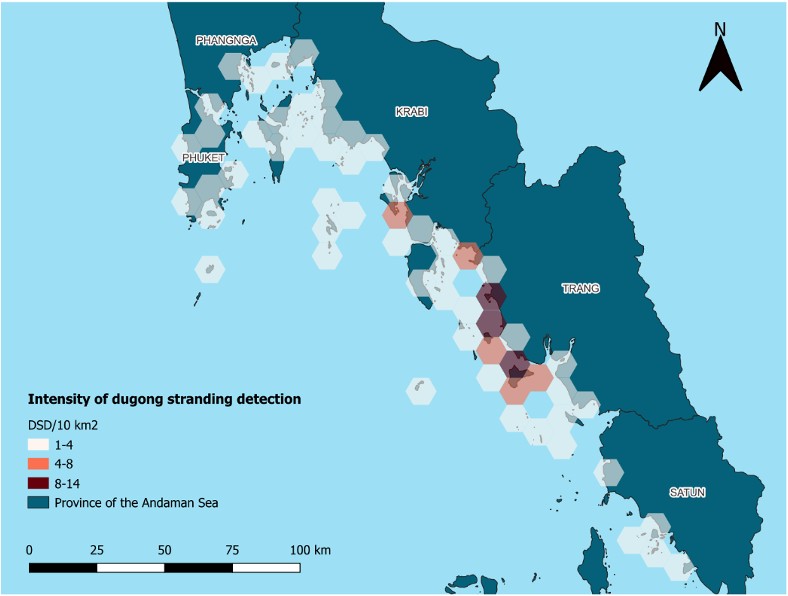
Dugongs (Dugong dugon), as strictly herbivorous marine mammals, play a crucial ecological role dependent on seagrass ecosystems. This cross-sectional study examined the epidemiological situation of dugong strandings across six provinces in the Andaman Sea of Thailand (Ranong, Phang Nga, Phuket, Krabi, Trang, and Satun) from January 2019 to December 2024. Data from the Department of Marine and Coastal Resources (DMCR) database were analyzed using descriptive statistics and chi-square tests. Thailand’s dugong population is estimated at approximately 240 individuals, mostly residing in the Andaman Sea. Over the six-year period, 161 strandings were reported, detected by government officers and public notifications. Temporal trends revealed a seasonal pattern peaking in the monsoon season, particularly from 2023–2024. Findings showed an alarming increase in emaciated dugongs (underweight, with stomach contents <3% body weight), likely linked to the degradation of local seagrass beds since 2019. This study enhances understanding of stranding detection and management within the current system. However, to fully evaluate the causes and develop effective surveillance and solutions, the current reporting system must clearly identify the gaps in the documented causes of dugong strandings and their associated factors.
Article Details

This work is licensed under a Creative Commons Attribution 4.0 International License.
Publishing an article with open access in Veterinary Integrative Sciences leaves the copyright with the author. The article is published under the Creative Commons Attribution License 4.0 (CC-BY 4.0), which allows users to read, copy, distribute and make derivative works from the material, as long as the author of the original work is cited.
References
Alcorn, J.F., 2020. IL-22 plays a critical role in maintaining epithelial integrity during pulmonary infection. Front. Immunol. 11, 1160.
Al-Qahtani, A.A., Alhamlan, F.S., Al-Qahtani, A.A., 2024. Pro-inflammatory and anti-inflammatory interleukins in infectious diseases: a comprehensive review. Trop. Med. Infect. Dis. 9, 13.
Barone, F., Nayara, S., Camposa, J., Cloakea, T., Withers, D.R., Toellner, K.M., Zhang, Y., Fouser, L., Fisher, B., Bowman, S., Rangel-Moreno, J., De La Garcia-Hernandez, M.L., Randall, T.D., Lucchesi, D., Bombardieri, M., Pitzalis, C., Luther, S.A., Buckley, C.D., 2015. IL-22 regulates lymphoid chemokine production and assembly of tertiary lymphoid organs. Proc. Natl. Acad. Sci. U.S.A. 112, 11024–11029.
Blake, D.P., Billington, K.J., Copestake, S.L., Oakes, R.D., Quail, M.A., Wan, K.L., Shirley, M.W., Smith, A.L., 2011. Genetic mapping identifies novel highly protective antigens for an apicomplexan parasite. PLoS Pathog. 7, e1001279.
Castro, F., Cardoso, A.P., Gonçalves, R.M., Serre, K., Oliveira, M.J., 2018. Interferon-gamma at the crossroads of tumor immune surveillance or evasion. Front. Immunol. 9, 847.
Conway, D.P., McKenzie, M.E., 2008. Poultry coccidiosis: diagnostic and testing procedures, 3rd edition. Wiley-Blackwell, Ames, Iowa.
Cronkite, D.A., Strutt, T.M., 2018. The regulation of inflammation by innate and adaptive lymphocytes. J. Immunol. Res. 2018, 1467538.
Dalloul, R.A., Lillehoj, H.S., 2006. Poultry coccidiosis: recent advancements in control measures and vaccine development. Expert Rev. Vaccines. 5, 143–163.
Djeraba, A., Musset, E., Lowenthal, J.W., Boyle, D.B., Chaussé, A.M., Péloille, M., Quéré, P., 2002. Protective effect of avian myelomonocytic growth factor in infection with Marek’s disease virus. J. Virol. 76, 1062–1070.
Eyerich, K., Dimartino, V., Cavani, A., 2017. IL-17 and IL-22 in immunity: driving protection and pathology. Eur. J. Immunol. 47, 607–614.
Fries-Craft, K.A., et al., 2023. Implementing real-time immunometabolic assays and immune profiling during Eimeria maxima challenge in poultry. Front. Vet. Sci. 10, 1179198.
Ho T.D., Nguyen T.H., Nguyen T.T., Le D.P., & Pham H.S.H., 2023. The effects of infectious dosages on endogenous phage and the excretion of Eimeria tenella oocysts of infected chicken. Vet. Integra. Sci. 22(1), 161–170.
Ho, D.T., Pham, H.H.S., Aota, W., Matsubayashi, M., Tsuji, N., Hatabu, T., 2021. Reduction of macrophages by carrageenan decreases oocyst output and modifies local immune reaction in chick cecum with Eimeria tenella. Res. Vet. Sci. 139, 59–66.
Hong, Y.H., Lillehoj, H.S., Lillehoj, E.P., Lee, S.H., 2006. Changes in immune-related gene expression and intestinal lymphocyte subpopulations following Eimeria maxima infection of chickens. Vet. Immunol. Immunopathol. 114, 259–272.
Huang, J., Yin, H., Zhang, Y., Qiao, H., Su, L., Wang, J., 2022. Expression of TGF-β/Smads in cecum and spleen of chicken infected with Eimeria tenella. Braz. J. Poult. Sci. 24, eRBCA-2021-1446.
Hughes, S., Bumstead, N., 2000. The gene encoding the chicken chemokine K60 maps to chromosome 4. Anim. Genet. 31, 418–419.
Ihim, S.A., Abubakar, S.D., Zian, Z., Sasaki, T., Saffarioun, M., Maleknia, S., Azizi, G., 2022. Interleukin-18 cytokine in immunity, inflammation, and autoimmunity: biological role in induction, regulation, and treatment. Front. Immunol. 13, 919973.
Iyer, S.S., Cheng, G., 2012. Role of interleukin-10 transcriptional regulation in inflammation and autoimmune disease. Crit. Rev. Immunol. 32, 23–63.
Kaiser, P., Poh, T.Y., Rothwell, L., Avery, S., Balu, S., Pathania, U.S., Hughes, S., Goodchild, M., Morrell, S., Watson, M., Bumstead, N., Kaufman, J., Young, J.R., 2005. A genomic analysis of chicken cytokines and chemokines. J. Interferon Cytokine Res. 25, 467–484.
Kaňková, Z., Zeman, M., Schwarz, S., Kaspers, B., 2016. Preliminary results on intersexual differences in gene expression of chemokine K203 in mononuclear cells of chicken. Acta Vet. Hung. 64, 54–64.
Kim, W.H., Chaudhari, A.A., Lillehoj, H.S., 2019. Involvement of T cell immunity in avian coccidiosis. Front. Immunol. 10, 2732.
Lee, J.J., Kim, D.H., Lim, J.J., Kim, D.G., Min, W., Kim, G.S., Lee, H.J., Rhee, M.H., Park, H., Kim, S.C., Chang, H.H., Kim, S., 2012. Anticoccidial effect of supplemental dietary Galla Rhois against infection with Eimeria tenella in chickens. Avian Pathol. 41, 403–407.
Lillehoj, H.S., Erik, P.L., 2000. Avian coccidiosis: a review of acquired intestinal immunity and vaccination strategies. Avian Dis. 44, 408–425.
Livak, K.J., Schmittgen, T.D., 2001. Analysis of relative gene expression data using real-time quantitative PCR and the 2−ΔΔCT method. Methods. 25, 402–408.
López-Osorio, S., Chaparro-Gutiérrez, J.J., Gómez-Osorio, L.M., 2020. Overview of poultry Eimeria life cycle and host-parasite interactions. Front. Vet. Sci. 7, 384.
Luckheeram, R.V., Zhou, R., Verma, A.D., Xia, B., 2012. CD4+ T cells: differentiation and functions. Clin. Dev. Immunol. 2012, 925135.
Menon, A.P., Moreno, B., Meraviglia-Crivelli, D., Nonatelli, F., Villanueva, H., Barainka, M., Zheleva, A., van Santen, H.M., Pastor, F., 2023. Modulating T cell responses by targeting CD3. Cancers (Basel). 15, 1189.
Min, W., Lillehoj, H.S., 2004. Identification and characterization of chicken interleukin-16 cDNA. Dev. Comp. Immunol. 28, 153–162.
Min, W., Lillehoj, H.S., 2002. Isolation and characterization of chicken interleukin-17 cDNA. J. Interferon Cytokine Res. 22, 1123–1128.
Obeagu, E.I., 2024. Role of cytokines in immunomodulation during malaria clearance. Ann. Med. Surg. 86, 2873.
Ouyang, W., Valdez, P., 2008. IL-22 in mucosal immunity. Mucosal Immunol. 1, 335–338.
Pham, H.H.S., Hatabu, T., 2021. Eimeria tenella infection modulates the expression levels of intestinal epithelial barrier-related genes in chicken. J. Environ. Sci. Sustain. Soc. 10, 13–16.
Pham, H.H.S., Matsubayashi, M., Tsuji, N., Hatabu, T., 2021. Relationship between Eimeria tenella-associated early clinical signs and molecular changes in intestinal barrier function. Vet. Immunol. Immunopathol. 240, 110321.
Powell, M.D., Read, K.A., Sreekumar, B.K., Jones, D.M., Oestreich, K.J., 2019. IL-12 signaling drives the differentiation and function of a TH1-derived TFH1-like cell population. Sci. Rep. 9, 50614.
Rasquinha, M.T., Sur, M., Lasrado, N., Reddy, J., 2021. IL-10 as a Th2 cytokine: differences between mice and humans. J. Immunol. 207, 2205–2215.
Read, L.R., Cumberbatch, J.A., Buhr, M.M., Bendall, A.J., Sharif, S., 2005. Cloning and characterization of chicken stromal cell derived factor-1. Dev. Comp. Immunol. 29, 143–152.
Rothwell, L., Young, J.R., Zoorob, R., Whittaker, C.A., Hesketh, P., Archer, A., Smith, A.L., Kaiser, P., 2004. Cloning and characterization of chicken IL-10 and its role in the immune response to Eimeria maxima. J. Immunol. 173, 2675–2682.
Sanjabi, S., Oh, S.A., Li, M.O., 2017. Regulation of the immune response by TGF-β: from conception to autoimmunity and infection. Cold Spring Harb. Perspect. Biol. 9, a022236.
Sanjabi, S., Zenewicz, L.A., Kamanaka, M., Flavell, R.A., 2009. Anti- and pro-inflammatory roles of TGF-β, IL-10, and IL-22 in immunity and autoimmunity. Curr. Opin. Pharmacol. 9, 447–453.
Schneider, K., Puehler, F., Baeuerle, D., Elvers, S., Staeheli, P., Kaspers, B., Weining, K.C., 2004. cDNA cloning of biologically active chicken interleukin-18. J. Interferon Cytokine Res. 20, 879–883.
Shini, S., Huff, G.R., Shini, A., Kaiser, P., 2010. Understanding stress-induced immunosuppression: exploration of cytokine and chemokine gene profiles in chicken peripheral leukocytes. Poult. Sci. 89, 841–851.
Sick, C., Schneider, K., Staeheli, P., Weining, K.C., 2000. Novel chicken CXC and CC chemokines. Cytokine. 12, 181–186.
Skovdahl, H.K., Damås, J.K., Granlund, A.B., Østvik, A.E., Doseth, B., Bruland, T., Mollnes, T.E., Sandvik, A.K., 2018. C-C motif ligand 20 (CCL20) and C-C motif chemokine receptor 6 (CCR6) in human peripheral blood mononuclear cells: dysregulated in ulcerative colitis and a potential role for CCL20 in IL-1β release. Int. J. Mol. Sci. 19, 3257.
Varmuzova, K., Faldyna, M., Havlickova, H., 2016. Immune protection of chickens conferred by a vaccine: aerosol vaccination stimulates systemic immunity, oral vaccination stimulates local gut immunity. Vet. Res. 47, 1–12.
Venkatas, J., Adeleke, M.A., 2019. A review of Eimeria antigen identification for the development of novel anticoccidial vaccines. Parasitol. Res. 118, 1701–1710.
Yun, C.H., Lillehoj, H.S., Lillehoj, E.P., 2000. Intestinal immune responses to coccidiosis. Dev. Comp. Immunol. 24, 303–324.
