Comparative observation of the organ development and health of the tropical oyster Crassostrea belcheri (Sowerby, 1871) in hatchery and wild farming sites https://doi.org/10.12982/VIS.2026.066
Article Sidebar
Main Article Content
Abstract
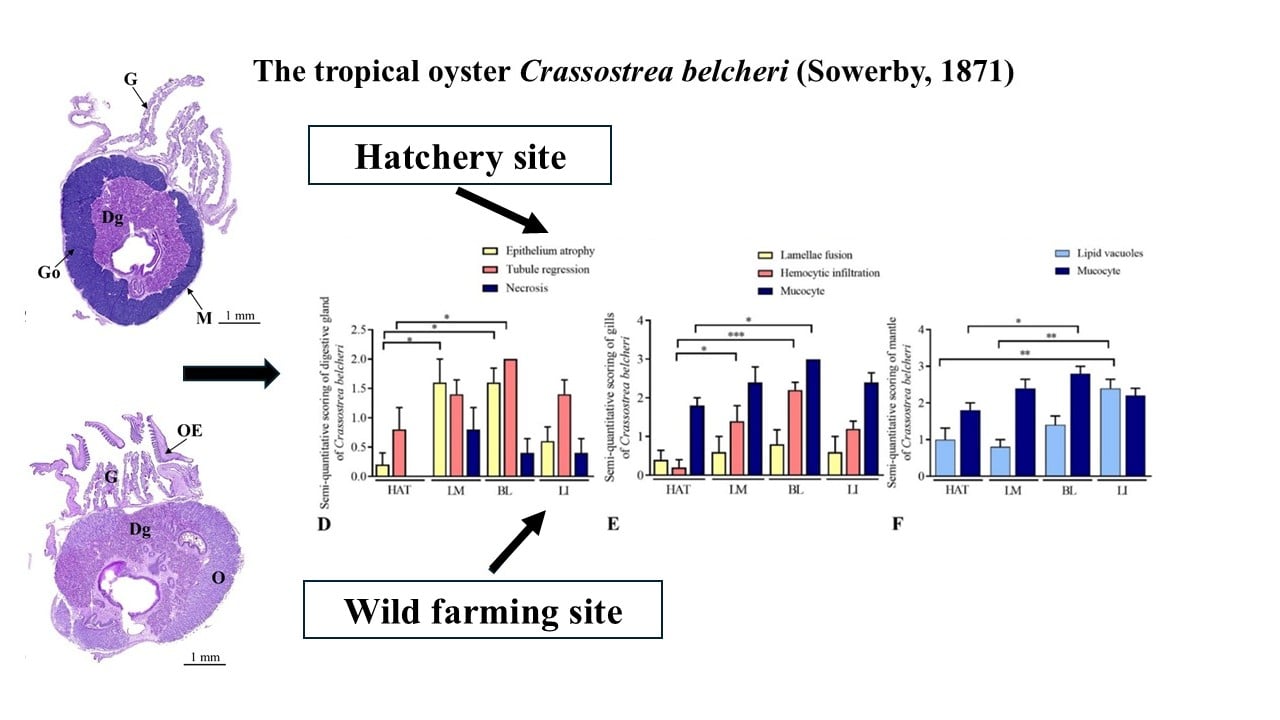
The tropical oyster, Crassostrea belcheri, is an important, high-value seafood in aquaculture in Thailand. Understanding the development and physiological responses of C. belcheri in different rearing conditions is essential for sustainable production. This study compared the histological structures, mucus-secreting cell (MSC) distributions, and gonadal development of C. belcheri sampled from a hatchery (HAT) and three open-sea farming sites. The sampled oysters were classified into five categories based on shell height: 1.0–2.5 cm, 2.6–4.1 cm, 4.2–5.7 cm, 5.8–7.3 cm, and 7.4–8.8 cm. Size- and site-dependent differences in organ morphology were observed. In the largest HAT oysters, the average gill lamella length was 128.8 ± 7.3 µm; average mantle epithelium thickness 14.1 ± 1.0 µm and average digestive tubule diameter 86.5 ± 2.2 µm. All three morphometrics differed significantly across the four sites (p < 0.05). Four MSC morphotypes were observed. Gonadal development followed a protandric pattern, with male gametogenesis observed in oysters smaller than 5.8 cm and female oogenesis being dominant in larger individuals (> 5.8 cm). Oocyte maturation across sites was consistent rather than site dependent. Histopathological evaluation using the Health Assessment Index (HAI) revealed sublethal tissue alterations, including epithelial atrophy, digestive tubule regression and gill lamellar fusion, with a mean HAI score of 3.7 ± 1.2 for wild-farmed oysters compared with 1.8 ± 0.9 for HAT samples. These findings underscore strong associations between oyster size, environmental conditions and organ development, and the potential of MSC density and histopathological lesions as reliable biomarkers for aquaculture monitoring and health management in C. belcheri
Article Details

This work is licensed under a Creative Commons Attribution 4.0 International License.
Publishing an article with open access in Veterinary Integrative Sciences leaves the copyright with the author. The article is published under the Creative Commons Attribution License 4.0 (CC-BY 4.0), which allows users to read, copy, distribute and make derivative works from the material, as long as the author of the original work is cited.
References
Adams, S.M., Brown, A.M., Goede, R.W., 1993. A quantitative health assessment index for rapid evaluation of fish condition in the field. Trans. Am. Fish. Soc. 122, 63–73.
Allam, B., Carden, W.E., Ward, J.J., Ralph, G.M., Winnicki, S.M., Espinosa, E.P., 2013. Early host-pathogen interactions in marine bivalves: Evidence that the alveolate parasite Perkinsus marinus infects through the oyster mantle during rejection of pseudofeces. J. Invertebr. Pathol. 113, 26–34.
Al-Hashem, M.A., 2017. Gill histopathological effects of PAHs on adult pearl oyster, Pinctada radiata at Al-Khiran coast in Kuwait. J. Environ. 8, 109–119.
Au, D., 2004. The application of histo-cytopathological biomarkers in marine pollution monitoring: a review. Mar. Pollut. Bull. 48, 817–834.
Basset, A., Sangiorgio, F., Pinna, M., 2004. Monitoring with benthic macroinvertebrates: advantages and disadvantages of body size descriptors. Aquat. Conserv. 14, 43–58.
Bourassa, N., Morin, A., 1995. Relationships between size structure of invertebrate assemblages and trophy and substrate composition in streams. J. N. Am. Benthol. Soc. 14, 393–403.
Camp, E.V., Pine III, W.E., Havens, K., Kane, A.S., Walters, C.J., Irani, T., Lindsey, A.B., Morris, J.R.J.G., 2015. Collapse of a historic oyster fishery: Diagnosing causes and identifying paths toward increased resilience. Ecol. Soc. 20, 45.
Castilho Westphal, G.G., Magnani, F.P., Ostrensky, A., 2015. Gonad morphology and reproductive cycle of the mangrove oyster Crassostrea brasiliana (Lamarck, 1819) in the Baía de Guaratuba, Paraná, Brazil. Acta Zool. 96, 99–107.
Chalermwat, K., Szuster, B.W., Flaherty, M., 2003. Shellfish aquaculture in Thailand. Aquacult. Econ. Manag. 7, 249–261.
Costa, P.M., Carreira, S., Costa, M.H., Caeiro, S., 2013. Development of histopathological indices in a commercial marine bivalve (Ruditapes decussatus) to determine environmental quality. Aquat. Toxicol. 126, 442–454.
Davenel, A., González, R., Suquet, M., Quellec, S., Robert, R., 2010. Individual monitoring of gonad development in the European flat oyster Ostrea edulis by in vivo magnetic resonance imaging. Aquaculture. 307, 165–169.
Di, G., Ni, J., Zhang, Z., You, W., Wang, B., Ke, C., 2012. Types and distribution of mucous cells of the abalone Haliotis diversicolor. Afr. J. Biotechnol. 11, 9127–9140.
Espinosa, E.P., Koller, A., Allam, B., 2016. Proteomic characterization of mucosal secretions in the eastern oyster, Crassostrea virginica. J. Proteomics. 132, 63–76.
Ferreira, M., Paixão, L., Alcântara Neto, C., Santos, S., Rocha, R., 2006. Morphological and morphometric aspects of Crassostrea rhizophorae (Guilding, 1828) oocytes in three stages of the gonadal cycle. Int. J. Morphol. 24, 437–442.
Fey Hofstede, F., Meesters, H., 2007. Indicators for the “Convention on Biodiversity 2010”. Exploration of the usefulness of the Marine Trophic Index (MTI) as an indicator for sustainability of marine fisheries in the Dutch part of the North Sea. Available online: https://edepot.wur.nl/40022.
Freitas, E.T.F., Moreira, A.M.S., de Paula, R.S., Andrade, G.R., de Carvalho, M.D., Assis, P.S., Jorge, E.C., Cardoso, A.V., 2022. Ultrastructure of the gill ciliary epithelium of Limnoperna fortunei (Dunker 1857), the invasive golden mussel. BMC Zool. 7, 6.
Gamain, P., Gonzalez, P., Cachot, J., Pardon, P., Tapie, N., Gourves, P.Y., Morin, B., 2016. Combined effects of pollutants and salinity on embryo larval development of the Pacific oyster, Crassostrea gigas. Mar. Environ. Res. 113, 31–38.
Gomes, C., Silva, F., Lopes, G., Melo, C., 2014. The reproductive cycle of the oyster Crassostrea gasar. Braz. J. Biol. 74, 967–976.
Hinton, D.E., Baumann, P.C., Gardner, G.R., Hawkins, W.E., Hendricks, J.D., Murchelano, R.A., 1992. Histopathologic biomarkers. In: Huggett, R.J. (Ed.), Biomarkers: Biochemical, Physiological, and Histological Markers of Anthropogenic Stress. CRC Press, Boca Raton, pp. 155–209.
Hong, T.K., Bobby, G., Addis, S.N.K., Musa, N., Wahid, M.E.A., Zainathan, S.C., 2017. Histopathology conditions of cultured oyster, Crassostrea iredalei from southern and east Malaysia. Aquacult. Aquarium Conserv. Legis. 10, 445–454.
Howard, D.W., Lewis, E.J., Keller, B.J., Smith, C.S., 2004. Histological techniques for marine bivalve mollusks and crustaceans. Available online: http://hdl.handle.net/ 1834/30812.
Jabbour Zahab, R., Chagot, D., Blanc, F., Grizel, H., 1992. Mantle histology, histochemistry and ultrastructure of the pearl oyster Pinctada margaritifera (L.). Aquat. Living Resour. 5, 287–298.
Joshy, A., Sharma, S.R.K., Mini, K.G., Gangadharan, S., Pranav, P., 2022. Histopathological evaluation of bivalves from the southwest coast of India as an indicator of environmental quality. Aquat. Toxicol. 243, 106076.
Kandeel, K.E., Mohammed, S.Z., Mostafa, A.M., Abd Alla, M.E., 2013. Reproductive biology of the cockle Cerastoderma glaucum (Bivalvia: Cardiidae) from Lake Qarun, Egypt. Egypt. J. Aquat. Res. 39, 249–260.
Kang, C.K., Park, M.S., Lee, P.Y., Choi, W.J., Lee, W.C., 2000. Seasonal variation in condition, reproductive activity, and biochemical composition of the Pacific oyster, Crassostrea gigas (Thunberg) in suspended culture in two coastal bays of Korea. J. Shellfish Res. 19, 771–778.
Klinbunga, S., Ampayup, P., Tassanakajon, A., Jarayaband, P., Yoosukh, W., 2000. Development of species-specific markers of the tropical oyster (Crassostrea belcheri) in Thailand. Mar. Biotechnol. 2, 476–484.
Kongthong, K., Senarat, S., Inchan, A., Kaneko, G., Lda, A., Phoungpechara, P., Charoenphon, N., 2023a. Size distribution and organ development of the hooded oyster, Saccostrea cucullata (Born, 1778) from Libong Island, Thailand. Sci. Asia. 49, 918–926.
Kongthong, K., Charoenphon, N., Thaochan, N., Boonyoung, P., Jeamah, A., Imsonpang, S., Wongkamhaeng, K., Kongtueng, P., Senarat, S., 2023b. A histological method for marine invertebrates. Vet. Integr. Sci. 21, 251–263.
Knowles, G., Handlinger, J., Jones, B., Moltschaniwskyj, N., 2014. Hemolymph chemistry and histopathological changes in Pacific oysters (Crassostrea gigas) in response to low salinity stress. J. Invertebr. Pathol. 121, 78–84.
Latchere, O., Mehn, V., Gaertner Mazouni, N., Le Moullac, G., Fievet, J., Belliard, C., Cabral, P., Saulnier, D., 2018. Influence of water temperature and food on the last stages of cultured pearl mineralization from the black lip pearl oyster Pinctada margaritifera. PLoS One. 13, e0193863.
Leary, S.L., Underwood, W., Anthony, R., Cartner, S., Corey, D., Grandin, T., Greenacre, C., Gwaltney Brant, S., McCrackin, M., Meyer, R., 2013. AVMA guidelines for the euthanasia of animals: 2013 edition. Available online: https://www.cabidigitallibrary. org/doi/full/10.5555/20133099337.
Lee, J.S., Joo, J.Y., Park, J.J., 2007. Histology and ultrastructure of the mantle epidermis of the equilateral venus, Gomphina veneriformis (Bivalvia: Veneridae). J. Shellfish Res. 26, 413–421.
Lobo da Cunha, A., Alves, Â., Oliveira, E., Calado, G., 2022. Functional histology and ultrastructure of the digestive tract in two species of chitons (Mollusca, Polyplacophora). J. Mar. Sci. Eng. 10, 160.
Loor, A., Sonnenholzner, S., 2016. Reproductive cycle of the rock oyster, Striostrea prismatica (Gray, 1825) from two locations on the southern coast of Ecuador. Aquac. Res. 47, 1432–1442.
Lopes Lima, M., Moura, G., Pratoomchat, B., Machado, J., 2006. Correlation between the morpho cytohistochemistry of the outer mantle epithelium of Anodonta cygnea with seasonal variations and following pollutant exposure. Mar. Freshwater Behav. Physiol. 39, 235–243.
Morad, M., Fol, M.F., Gamil, I.S., Mansour, R.M., 2018. Gonad variation and development of freshwater mussel Chambardia rubens Lamarck, 1819 (Bivalvia: Mutelidae) from the River Nile in Egypt. J. Biosci. Appl. Res. 4, 495–506.
Mouillot, D., Spatharis, S., Reizopoulou, S., Laugier, T., Sabetta, L., Basset, A., Chi, T., 2006. Alternatives to taxonomic based approaches to assess changes in transitional water communities. Aquat. Conserv. 16, 469–482.
Otegui, M.B.P., Fiori, S.M., Menechella, A.G., dos Santos, E.P., Giménez, J., 2024. Histological characterization and morphological alterations in gill and digestive gland in non native bivalve from the Province of Buenos Aires: Spatial and seasonal evaluation. Zool. Anz. 312, 11–19.
Reizopoulou, S., Nicolaidou, A., 2007. Index of size distribution (ISD): a method of quality assessment for coastal lagoons. In: Lagoons and Coastal Wetlands in the Global Change Context: Impacts and Management Issues. Selected papers of the International Conference “CoastWetChange”, Venice, 26–28 April 2004.
Rodríguez Jaramillo, C., Hurtado, M., Romero Vivas, E., Ramírez, J., Manzano, M., Palacios, E., 2008. Gonadal development and histochemistry of the tropical oyster, Crassostrea corteziensis (Hertlein, 1951) during an annual reproductive cycle. J. Shellfish Res. 27, 1129–1141
Saavedra, C., Milan, M., Leite, R.B., Cordero, D., Patarnello, T., Canela, M.L., Bargelloni, L., 2017. A microarray study of carpet shell clam (Ruditapes decussatus) shows common and organ specific growth related gene expression differences in gills and digestive gland. Front. Physiol. 8, 943.
Sagulsawasdipan, K., Chooseangjaew, S., Kosiyachinda, P., Charoenphon, N., Senarat, S., 2025. Health evaluation of the sexually mature Crassostrea belcheri (G.B. Sowerby II, 1871) in an enclosed rearing condition. Sci. Asia. 51(1), 1–7.
Sampantamit, T., Ho, L., Lachat, C., Sutummawong, N., Sorgeloos, P., Goethals, P., 2020. Aquaculture production and its environmental sustainability in Thailand: Challenges and potential solutions. Sustainability. 12, 2010.
Sarinsky, G., Carroll, M.A., Nduka, E., Catapane, E.J., 2005. Growth and survival of the American oyster Crassostrea virginica in Jamaica Bay, New York. In Vivo. 27, 15.
Schrank, C.S., Cormier, S.M., Blazer, V.S., 1997. Contaminant exposure, biochemical, and histopathological biomarkers in white suckers from contaminated and reference sites in the Sheboygan River, Wisconsin. J. Gt. Lakes Res. 23, 119–130.
Shin, Y.J., Rochet, M.J., Jennings, S., Field, J.G., Gislason, H., 2005. Using size based indicators to evaluate the ecosystem effects of fishing. ICES J. Mar. Sci. 62, 384–396.
Tanyaros, S., Anan, K., Kitt, L.D., 2008. Nursing and grow out of hatchery reared big oyster (Crassostrea belcheri Sowerby 1871) in the intertidal mangrove area. Agric. Nat. Resour. 42, 495–502.
Trayanova, A.T., 2008. Application of body size descriptors of benthic macrofauna as innovative approach for assessment of the ecological status of transitional waters. Acta Zool. Bulg. Suppl. 2, 293–298.
Winstead, J.T., 1995. Digestive tubule atrophy in Eastern oyster, Crassostrea virginica (Gmelin, 1971) exposed to salinity and starvation stress. J. Shellfish Res. 14, 105–111.
Xiuzhen, S., Wenbin, Z., Sulian, R., 2003. Structure and function of the digestive system of Solen grandis Dunker. J. Ocean Univ. China. 2, 155–159.
Yonge, C.M., 1928. Structure and function of the organs of feeding and digestion in the septibranchs, Cuspidaria and Poromya. Philos. Trans. R. Soc. Lond. B 216(431–439), 221–263.
Zannella, C., Mosca, F., Mariani, F., Franci, G., Folliero, V., Galdiero, M., Tiscar, P.G., Galdiero, M., 2017. Microbial diseases of bivalve mollusks: infections, immunology and antimicrobial defense. Mar. Drugs. 15, 182.
Zhang, Y., Qin, Y., Ma, L., Zhou, Z., Xiao, S., Ma, H., Yu, Z., 2019. Gametogenesis from the early history life stages of the kumamoto oyster Crassostrea sikamea and their breeding potential evaluation. Front. Physiol. 10, 1–8.
