Cross-sectional study of camelpox virus in the western and southern regions of Kazakhstan in 2021-2022 https://doi.org/10.12982/VIS.2026.075
Article Sidebar
Main Article Content
Abstract
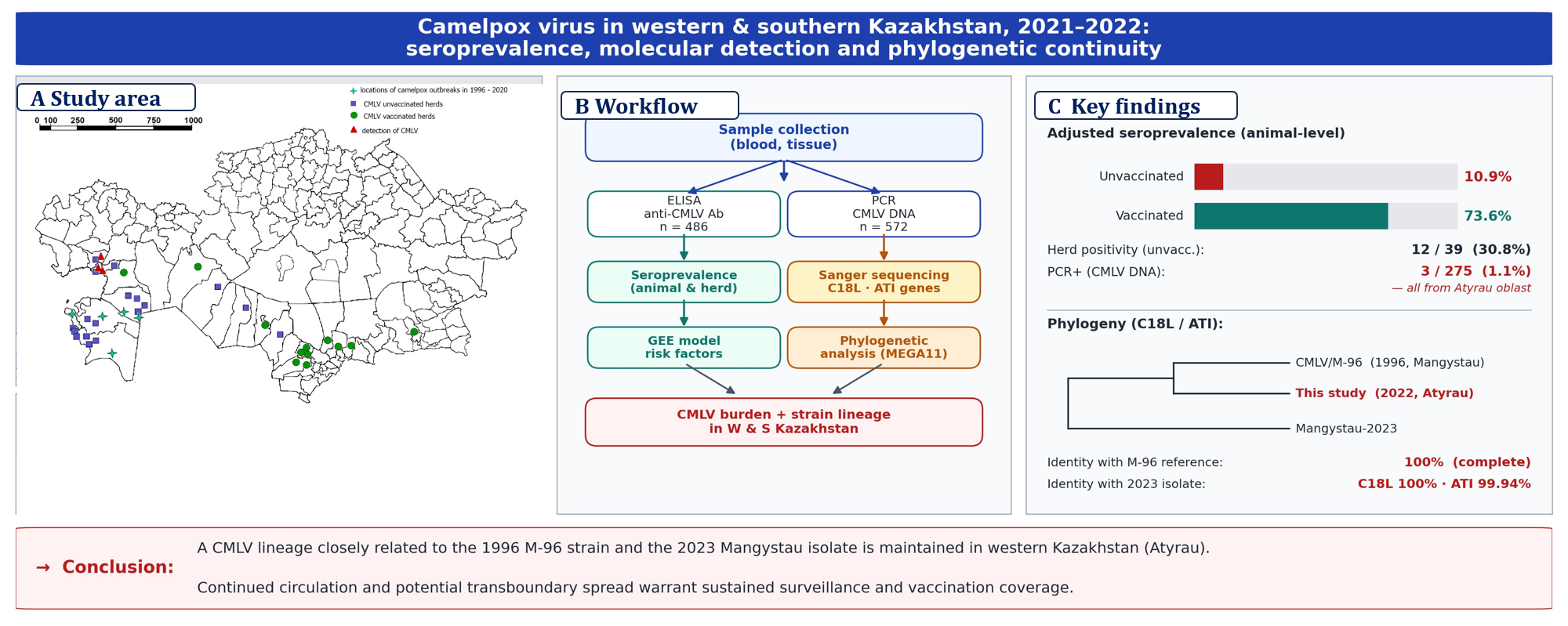
Camelpox is a contagious disease of Old World camelids with limited prevalence data in Kazakhstan. This study determined camelpox virus (CMLV) prevalence and vaccination coverage in western and southern Kazakhstan in 2021-2022. Overall, 572 camels from 63 herds were sampled. Serum samples were tested for anti-CMLV antibodies by ELISA, blood and tissue samples were tested for CMLV DNA by PCR with sequencing of PCR-positive amplicons. The true adjusted animal-level seroprevalence in unvaccinated and vaccinated camels was 10.9% and 73.6%, respectively. All seropositive unvaccinated camels were from Atyrau oblast, where 30.8% (12/39; 95% CI: 17.0–47.6%) of unvaccinated herds contained at least one seropositive animal. CMLV DNA was detected in three (1.1%) unvaccinated seropositive camels from Atyrau oblast. Analysis of the complete C18L and ATI gene sequences revealed homology with the reference CMLV strain M-96 and high nucleotide identity (100% and 99.94%, respectively) with the CMLV strain isolated in Mangystau oblast in 2023. The findings indicate that a CMLV lineage – identical or closely related to strains documented in 1996 and again in 2023 in Mangystau oblast – was circulating in Atyrau oblast during 2021-2022. This suggests continued maintenance of the virus in western Kazakhstan and raises concerns about potential transboundary spread
Article Details

This work is licensed under a Creative Commons Attribution 4.0 International License.
Publishing an article with open access in Veterinary Integrative Sciences leaves the copyright with the author. The article is published under the Creative Commons Attribution License 4.0 (CC-BY 4.0), which allows users to read, copy, distribute and make derivative works from the material, as long as the author of the original work is cited.
References
Abou El-Naga, T.R., Mahmoud, M.A., Abo-Elnag, T.R., Osman, W.A., Bassiouny, A.I., Goda, A.S., 2012. Epidemiology and characterization of camelpox virus in northwest coastal area of Egypt. Glob. Vet. 9(6), 738–744.
Akhmetsadykova, S.H., Konuspayeva, G., Akhmetsadykov, N., 2022. Camel breeding in Kazakhstan and future perspectives. Anim. Front. 12, 71–77.
Azwai, S.M., Carter, S.D., Woldehiwet, Z., Wernery, U., 1996. Serology of Orthopoxvirus cameli infection in dromedary camels: Analysis by ELISA and Western blotting. Comp. Immunol. Microbiol. Infect. Dis. 19(1), 65–78.
Balamurugan, V., Bhanuprakash, V., Hosamani, M., Jayappa, K.D., Venkatesan, G., Chauhan, B., Singh, R.K., 2009. A polymerase chain reaction strategy for the diagnosis of camelpox. J. Vet. Diagn. Invest. 21(2), 231–237.
Bulatov, Y., Kozhabergenov, N., Amanova, Z., Sametova, Z., Kondybaeva, Z., Abitayev, R., Ussembay, A., Kurmasheva, A., Toktyrova, D., Mazbayeva, D., Zhugunissov, K., Mambetaliyev, M., Usserbayev, B., Turyskeldy, S., 2025. Camelpox virus in western Kazakhstan: Isolation and phylogenetic analysis of a new strain. Viruses. 17(9), 1229.
Bulatov, Y., Mamadaliyev, S., Mambetaliyev, M., Bitanov, N., 2010. Circulation of camelpox virus in the latent form in Mangystau oblast of Kazakhstan. Act. Quest. Vet. Biol. 7(3), 10–13. (In Russian)
Bulatov, Y., Turyskeldy, S., Abitayev, R., Usembai, A., Sametova, Z., Kondybayeva, Z., Kurmasheva, A., Mazbayeva, D., Kyrgyzbayeva, A., Shorayeva, K., Amanova, Z., Toktyrova, D., 2024. Camelpox virus in western Kazakhstan: assessment of the role of local fauna as reservoirs of infection. Viruses. 16(10), 1626.
Bureau of National Statistics of the Agency for Strategic Planning and Reforms of the Republic of Kazakhstan. Statistics of Agriculture, Forestry, Hunting and Fisheries. 2025. Available online: https://stat.gov.kz/ru/industries/business-statistics/stat-forrest-village-hunt-fish/publications/280810.
Chouhan, C.S., Parvin, M.S., Ali, M.Y., Sadekuzzaman, M., Chowdhury, M.G.A., Ehsan, M.A., Islam, M.T., 2022. Epidemiology and economic impact of lumpy skin disease of cattle in Mymensingh and Gaibandha districts of Bangladesh. Transbound. Emerg. Dis. 69(6), 3405-3418.
Committee for Veterinary Control and Supervision of the Ministry of Agriculture of the Republic of Kazakhstan, 2023. Available online: https://www.gov.kz/memleket/ entities/vetcontrol.
Cormack, R.M., Scheaffer, R.L., Mendenhall, W., Ott, L., 1991. Elementary survey sampling. Biometrics. 47(2), 790–791.
Dahiya, S.S., Kumar, S., Mehta, S.C., Narnaware, S.D., Singh, R., Tuteja, F.C., 2016. Camelpox: a brief review on its epidemiology, current status and challenges. Acta Trop. 158, 32–38.
Dohoo, I., Martin, W., Stryhn, H., 2014. Veterinary Epidemiologic Research, 2nd edition. VER Inc., Charlottetown.
Fergana News, 2018. Human cases of camelpox infection in Turkmenistan. Available online: https://fergana.news/news/103147/.
Housawi, F.M.T., 2007. Screening of domestic ruminants sera for the presence of anti-camelpox virus neutralizing antibodies. Assiut Vet. Med. J. 53, 101–105.
Israeli, O., Cohen-Gihon, I., Zvi, A., Shifman, O., Melamed, S., Paran, N., Laskar-Levy, O., Beth-Din, A., 2019. Complete genome sequence of the first camelpox virus case diagnosed in Israel. Microbiol. Resour. Announc. 8(34), e00773–19.
Khalafalla, A.I., Abdelazim, F., 2017. Human and dromedary camel infection with camelpox virus in Eastern Sudan. Vector Borne Zoonotic Dis. 17, 281–284.
Khalafalla, A.I., Mohamed, M.E.H., 1996. Clinical and epizootiological features of camelpox in Eastern Sudan. J. Camel Pract. Res. 3(2), 99–102.
Khalafalla, A.I., Mohamed, M.E.H., Agab, H., 1998. Serological survey in camels of the Sudan for prevalence of antibodies to camelpox virus using ELISA technique. J. Camel Pract. Res. 5, 197–200.
Knoll, E.M., Burger, P., 2012. The encounter between Bactrian and dromedary camels in Central Asia. In: Faye, B., Konuspayeva, G. (Eds.), Camels in Asia and North Africa: interdisciplinary perspectives on their past and present significance. Austrian Academy of Sciences Press, Vienna, pp. 27–33.
Kriz, B., 1982. A study of camelpox in Somalia. J. Comp. Pathol. 92(1), 1–8.
Kumar, S., Stecher, G., Suleski, M., Sanderford, M., Sharma, S., Tamura, K., 2024. Molecular evolutionary genetics analysis version 12 for adaptive and green computing. Mol. Biol. Evol. 41, 1–9.
Liang, K.Y., Zeger, S.L., 1986. Longitudinal data analysis using generalized linear models. Biometrika. 73(1), 13–22.
Maikhin, K.T., Berdikulov, M.A., Musayeva, G.K., Pazylov, Y.K., Zhusambayeva, S.I., Shaimbetova, A.K., Sarmanov, A.M., 2022. Epizootological situation of camelpox worldwide and in Kazakhstan. Int. J. Humanit. Nat. Sci. 7, 158–165. (In Russian)
Monique, É., Couacy-Hymann, E., 2022. Manual of diagnostic tests and vaccines for terrestrial animals. World Organization for Animal Health (WOAH), Paris.
News Agency in Kazakhstan (Tengrinews.kz), 2012. A mass death of camels occurred in the Mangystau region. Available online: https://tengrinews.kz/events/massovyiy-padej-verblyudov-proizoshel-mangistauskoy-oblasti-210597/.
Nubgan, A., Al-Saadi, M., 2023. Crimean-Congo hemorrhagic fever favouring factors virus transmission: Special focus on Iraq and neighbouring countries. Vet. Integr. Sci. 21(3), 865–877.
Otte, J., Gumm, I. 1997. Intra-cluster correlation coefficients of 20 infections calculated from the results of cluster-sample surveys. Prev. Vet. Med. 31, 147–150.
Rogan, W.J., Gladen, B., 1978. Estimating prevalence from the results of a screening test. Am. J. Epidemiol. 107(1), 71–76.
Roslyakov, A., 1969. Electron microscopic study of camelpox virus. Almaty Zooveterinary Institute, Alma-Ata. (In Russian).
Tito, M.H., Hoor-E-Jannat, M., Afrose, M., Saha, B., Das, T.K., Jihad, A.I., Das, P., Hossain, M.A., Maruf, S.M., Mira, R.J., Mofid, M.U.B., Harun, A.B., Karim, M.R., 2026. Exploring the risk factors and impact of lumpy skin disease in cattle: An epidemiological and economic analysis in Bangladesh. Vet. Integr. Sci. 24(2), e2026043.
Wernery, U., Kinne, J., Schuster, R.K., 2014. Camelid infectious disorders, 3rd edition. World Organization for Animal Health (WOAH), Paris.
Zhigailov, A.V., Mashzhan, A.S., Bissenbay, A.O., Ostapchuk, Y.O., Perfilyeva, Y.V., Maltseva, E.R., Naizabayeva, D.A., Berdygulova, Z., Skiba, Y., 2022. Analysis of the risks of the spread of camelpox in Kazakhstan. Eurasian J. Ecol. 71(2), 94–102. (In Russian).
