Epidemiological characteristics and predictors of malignancy in canine neoplasms from Songkhla province Thailand: A retrospective study (2017–2024) https://doi.org/10.12982/VIS.2026.078
Article Sidebar
Main Article Content
Abstract
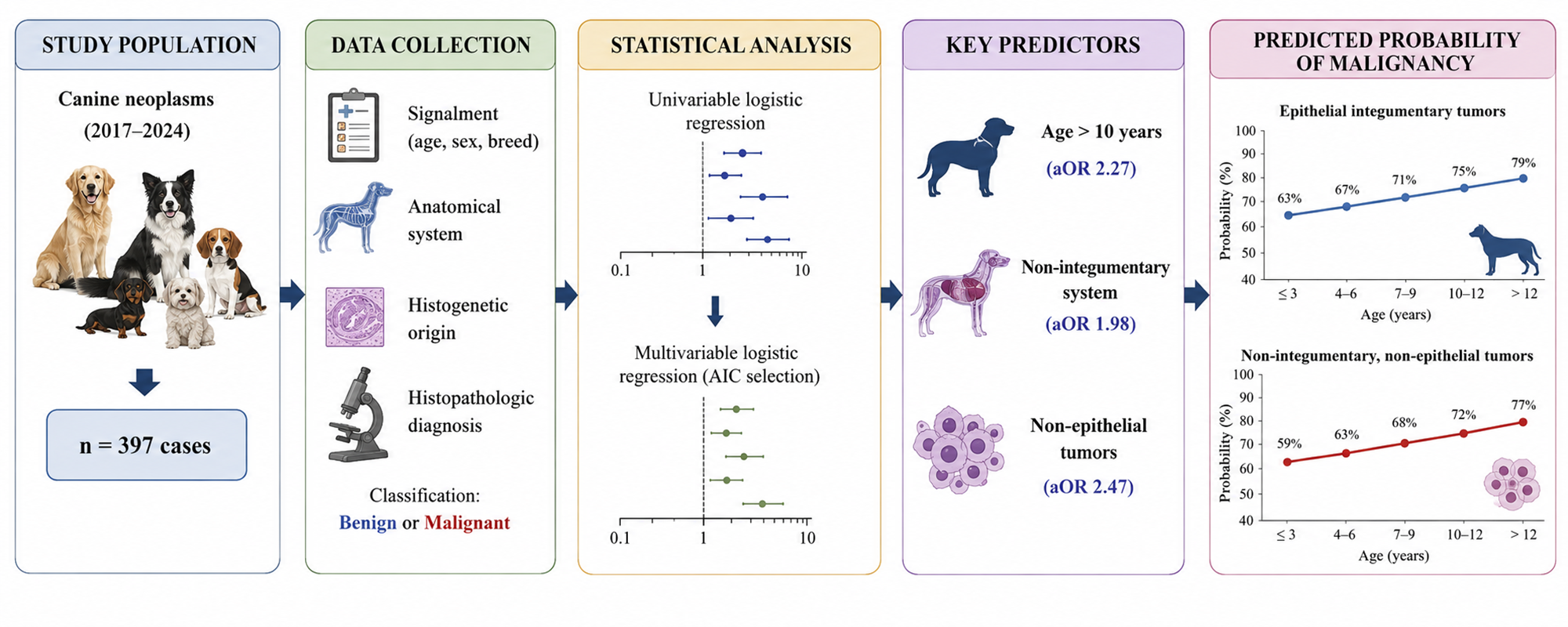
Canine neoplasms are a major cause of morbidity and mortality in dogs, with tumor malignancy influenced by demographic and biological factors. However, integrated epidemiological analyses incorporating risk factor modeling and malignancy prediction remain limited in Southern Thailand. This study aimed to describe the epidemiological characteristics of canine neoplasms in Songkhla province and to identify factors associated with tumor malignancy. A retrospective analysis was conducted on 397 canine neoplastic cases diagnosed between 2017 and 2024 at the Faculty of Veterinary Science, Prince of Songkla University. Tumors were classified as benign or malignant and categorized by anatomical system and histogenetic origin. Associations between malignancy and age, sex, breed, anatomical system, and tumor group were evaluated using univariable and multivariable logistic regression analyses, with model selection based on Akaike Information Criterion. Predicted probabilities of malignancy were estimated from the final multivariable model. Of the tumors analyzed, 259 (65.2%) were malignant. Epithelial tumors were the most common, followed by round cell, mesenchymal, and germ cell tumors. In the multivariable model, age, anatomical system, and tumor group were independent predictors of malignancy. Dogs older than 10 years had higher odds of malignant tumors (adjusted OR 2.27, 95% CI 1.39–3.71). Tumors from non-integumentary systems (adjusted OR 1.98, 95% CI 1.26–3.10) and non-epithelial tumors (adjusted OR 2.47, 95% CI 1.59–3.85) were also associated with increased malignancy risk. Predicted probability analysis demonstrated an age-related increase in malignancy risk, rising from 63% to 79% in epithelial integumentary tumors and from 59% to 77% in non-integumentary, non-epithelial tumors. These findings highlight the combined influence of age, anatomical origin, and tumor histogenesis in malignancy risk stratification.
Article Details

This work is licensed under a Creative Commons Attribution 4.0 International License.
Publishing an article with open access in Veterinary Integrative Sciences leaves the copyright with the author. The article is published under the Creative Commons Attribution License 4.0 (CC-BY 4.0), which allows users to read, copy, distribute and make derivative works from the material, as long as the author of the original work is cited.
References
Adams,V.J., Evans K.M., Sampson J., Wood, J.L., 2010. Methods and mortality results of a health survey of purebred dogs in the UK. J. Small. Anim. Pract. 51(10), 512–524.
Baioni, E., Scanziani, E., Vincenti, M.C., Leschiera, M., Bozzetta, E., Pezzolato, M., Desiato, R., Bertolini, S., Maurella, C., Ru, G., 2017. Estimating canine cancer incidence: findings from a population-based tumour registry in northwestern Italy. BMC Vet. Res. 13(1), 203.
Bostock, D., 1986. Neoplasms of the skin and subcutaneous in dogs and cats. Br. Vet. J. 142(1), 1-19.
Brodey, R.S., 1970. Canine and feline neoplasia. Adv. Vet. Sci. Comp. Med. 14, 309-354.
Brønden, L., Nielsen, S., Toft, N., Kristensen, A., 2010. Data from the Danish Veterinary cancer registry on the occurrence and distribution of neoplasms in dogs in Denmark. Vet. Rec. 166(19), 586-590.
Dobson J.M., 2013. Breed-Predispositions to Cancer in Pedigree Dogs. ISRN. Vet. Sci. 2013(1), 941275.
Er, J., Sutton, R., 1989. A survey of skin neoplasms in dogs from the Brisbane region. Aust. Vet. J. 66(7), 225-227.
Finnie, J., Bostock, D., 1979. Skin neoplasia in dogs. Aust. Vet. J. 55, 602-604.
Fonti, N., Parisi, F., Lachi, A., Dhein, E.S., Guscetti, F., Poli, A., Millanta, F., 2024. Age at tumor diagnosis in 14,636 canine cases from the pathology-based UNIPI Animal Cancer Registry, Italy: one size doesn’t fit all. Vet. Sci. 11(10), 485.
Freeman, A.M., Matto, P., 2023. Lymphadenopathy. Available online: https://www.ncbi. nlm.nih.gov/books/NBK513250/
García-Reynoso, I.C., Flores-Dueñas, C.A., Castro-Del Campo, N., Jácome-Ibarra, M., Herrera-Ramírez, J.C., Gómez-Gómez, S.D., Rodríguez-Gaxiola, M.Á., Gaxiola-Camacho, S.M., 2025. Risk factors for the occurrence of cutaneous neoplasms in dogs: a retrospective study by cytology reports, 2019–2021. Animals (Basel). 15(14), 2069.
Hanahan, D., 2026. Hallmarks of cancer—then and now, and beyond. Cell. 189, 2254–2277.
Juodžiukynienė, N., 2025. Retrospective analysis of prevalence of tumors in dogs and cats in Lithuania. Vet. Sci. 12(11), 1038.
Kok, M.K., Chambers, J.K., Tsuboi, M., Nishimura, R., Tsujimoto, H., Uchida, K., Nakayama, H., 2019. Retrospective study of canine cutaneous tumors in Japan, 2008–2017. J. Vet. Med. Sci. 81(8), 1133–1143.
Kukolj, V., Nesic, S., Marinković, D., Aleksić-Kovačević, S., 2021. Prevalence and distribution of canine neoplastic and non-neoplastic cutuneous lesions in serbia: a retrospective study of 2432 cases (2011-mid 2021). Acta Vet. Beogr. 71(4), 403-416.
Laconi, E., Marongiu, F., DeGregori, J., 2020. Cancer as a disease of old age: changing mutational and microenvironmental landscapes. Br. J. Cancer. 122(7), 943-952.
Machado, G.A., Fontes, T.N., Larangeira, D.F., Estrela-Lima, A., Moreira, E.L., Ribeiro, L.S., Pinto, M.P., Peixoto, T.C., 2018. Incidence of skin tumors in dogs in Salvador, Bahia state, Brazil (2007-2016). Pesqui. Vet. Bras. 38(11), 2139-2145.
Mamom, T., 2009. Prevalence of canine cutaneous, subcutaneous, and soft tissue neoplasms in Eastern Suburban Areas of Bangkok Metropolis during 1997 to 2009. J. Mahanakorn. Vet. Med. 4(2), 32-45.
Mariean, C.R., Tiucă, O.M., Mariean, A., Cotoi, O.S., 2023. Cancer cachexia: new insights and future directions. Cancers (Basel). 15(23), 5590.
Martins, A.L., Canadas-Sousa, A., Mesquita, J.R., Dias-Pereira, P., Amorim, I., Gärtner, F., 2022. Retrospective study of canine cutaneous tumors submitted to a diagnostic pathology laboratory in Northern Portugal (2014–2020). Canine. Genet. Epidemiol. 9(1), 2.
McCoy, B.M., Mariner, B.L., Cheng, C.F., Silkas, E., Adjangba, C., Greenier, A., Brassington, L., Marye, A., Harrison, B.R., Partida-Aguilar, M., 2024. Aging at scale: younger dogs and larger breeds from the dog aging project show accelerated epigenetic aging. bioRxiv. 2024, 2024.10.03.616519.
Meesuwan, S., Sreta, D., Uppaicha, R., Ketpun, D., 2023. Histopathologic prevalence of benign and malignant canine neoplasms in small animal hospital, Rajamangala University of Technology Tawan-Ok, Chonburi, Thailand: a retrospective study. Vet. Integr. Sci. 21(1), 239-250.
Meuten, D.J., 2017. Tumors in domestic animals, 5th edition. Wiley-Blackwell, Ames, Iowa.
Napang, T., Metchasompop, C., Liwcharoensakkul, T., Manonom, N., Laoharatchathanin, T., Boonsriroj, H., Pavasutthipaisit, S., 2024. Prevalence of canine cutaneous, subcutaneous, and soft tissue neoplasms in Nong Chok, Bangkok, Thailand (2018–2023). In Proceedings of the 15th MUT Veterinary Annual Conference 2024. Bangkok, Thailand, 8-9 November 2024, pp. 16–27.
Ogilvie, G.K., LaRue, S.M., 1992. Canine and feline nasal and paranasal sinus tumors. Vet. Clin. North Am. Small Anim. Pract. 22(5), 1133–1144.
R Core Team, 2023. R: a language and environment for statistical computing. R Foundation for Statistical Computing, Vienna.
Rafalko, J.M., Kruglyak, K.M., McCleary-Wheeler, A.L., Goyal, V., Phelps-Dunn, A., Wong, L.K., Warren, C.D., Brandstetter, G., Rosental, M.C., DiMarzio, L., MCLennan, L.M., O’Kell, A.L., Cohen, T.A., Grosu, D.S., Chibuk, J., Tsui, D.W.Y., Chorny, I., Flory, A., 2023. Age at cancer diagnosis by breed, weight, sex, and cancer type in a cohort of more than 3,000 dogs: Determining the optimal age to initiate cancer screening in canine patients. PLoS. One. 18(2), e0280795.
Rothwell, T.L.W., Howlett, C.R., Middleton, D.J., Griffiths, D.A., Duff, B.C., 1987. Skin neoplasms of dogs in Sydney. Aust. Vet. J. 64(6), 161-164.
Rungsipipat, A., Sunyasootcharee, B., Ousawaphlangchai, L., Sailasuta, A., Thanawongnuwech, R., Teankum, K., 2003. Neoplasm of dogs in Bangkok. Thai. J. Vet. Med. 33(1), 59-66.
Sarver, A.L., Makielski, K.M., DePauw, T.A., Schulte, A.J., Modiano, J.F., 2022. Increased risk of cancer in dogs and humans: a consequence of recent extension of lifespan beyond evolutionarily-determined limitations?. Aging. Cancer. 3(1), 3-19.
Schwartz, S.M., Urfer, S.R., White, M., Megquier, K., Shrager, S., Ruple, A., 2022. Lifetime prevalence of malignant and benign tumours in companion dogs: Cross-sectional analysis of Dog Aging Project baseline survey. Vet. Comp. Oncol. 20(4), 797-804.
Śmiech, A., Bulak, K., Łopuszyński, W., Puła, A., 2023. Incidence and the risk of occurrence of benign and malignant canine skin tumours in Poland – a five-year retrospective study. J. Vet. Res. 67(3), 437-446.
Vail, D.M., Withrow, S.J., 1996. Tumour of the skin and subcutaneous tissues. In: Withrow, S.J., MacEwen, E.G. (Eds.), Small Animal Oncology, 2nd edition. Saunders, Philadelphia, W.B., pp. 167-191.
Vail, D.M., Russell, D.S., Powers, B.E., 2020. Small animal clinical oncology, 6th edition. Elsevier, Philadelphia, PA.
Vakil, E., Jimenez, C.A., Faiz, S.A., 2018. Pleural effusions in hematologic malignancies and their management with indwelling pleural catheters. Curr. Opin. Pulm. Med. 24(4), 384–391.
Villamil, J.A., Henry, C.J., Bryan, J.N., Ellersieck, M., Schultz, L., Tyler, J.W., Hahn, A.W., 2011. Identification of the most common cutaneous neoplasms in dogs and evaluation of breed and age distributions for selected neoplasms. J. Am. Vet. Med. Assoc. 239(7), 960-965.
Watters, C., Brar, S., Pepper, T., 2024. Cancer of the oral mucosa. Available online: https://www.ncbi.nlm.nih.gov/books/NBK565867/.
Zachary, J.F., 2022. Pathologic basis of veterinary disease, 7th edition. Elsevier, Missouri.
Zinger, A., Cho, W.C., Ben-Yehuda, A., 2017. Cancer and aging - the inflammatory connection. Aging. Dis. 8(5), 611-627.
