Improving diagnostic success in stranded dugong necropsy investigations https://doi.org/10.12982/VIS.2026.072
Article Sidebar
Main Article Content
Abstract
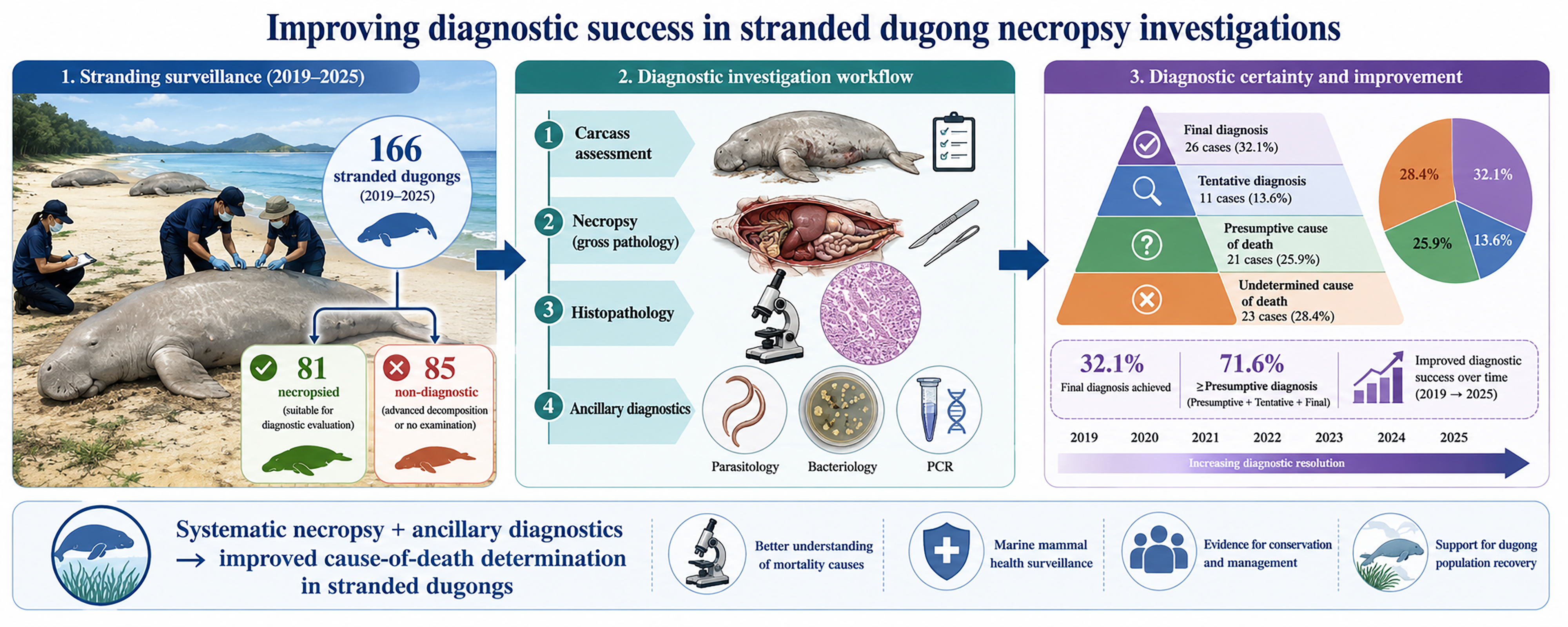
Stranding events of dugongs (Dugong dugon) provide important opportunities to investigate causes of mortality and population health in the wild. However, successful determination of the cause of death is often constrained by carcass condition and the availability of diagnostic investigations. This study aimed to evaluate factors influencing diagnostic success in stranded dugongs recovered along the Andaman Sea coastline of southern Thailand. A retrospective analysis was conducted using data from a centralized stranding database covering the period 2019 to 2025. A total of 166 stranding records were reviewed, of which 81 carcasses met the criteria for necropsy based diagnostic evaluation after excluding cases lacking examination or affected by advanced decomposition. Necropsy findings, histopathological results, and ancillary diagnostic investigations, including parasitological examination, bacteriological culture, and molecular detection of infectious agents, were compiled for each case. Diagnostic outcomes were categorized into four levels of certainty: undetermined cause of death, presumptive cause of death, tentative diagnosis, and final diagnosis. Overall, 26 cases (32.1%) achieved a final diagnosis, while 11 cases (13.6%) were classified as tentative diagnoses, 21 cases (25.9%) as presumptive causes of death, and 23 cases (28.4%) remained undetermined. Diagnostic resolution improved in later years of the study, with a declining proportion of undetermined cases. Trauma, parasitic disease, infectious disease, and systemic disorders represented the major pathological categories identified. Statistical analysis showed that mild to moderate carcass autolysis and detection of infectious agents tended to increase diagnostic success, whereas female sex and higher body condition score showed the opposite trend, although none of these associations were statistically significant. These findings highlight the importance of carcass condition, systematic necropsy procedures, and ancillary diagnostic investigations in improving cause of death determination in stranded dugongs and supporting effective conservation and health surveillance efforts
Article Details

This work is licensed under a Creative Commons Attribution 4.0 International License.
Publishing an article with open access in Veterinary Integrative Sciences leaves the copyright with the author. The article is published under the Creative Commons Attribution License 4.0 (CC-BY 4.0), which allows users to read, copy, distribute and make derivative works from the material, as long as the author of the original work is cited.
References
Arbelo, M., Los Monteros, A.E., Herráez, P., Andrada, M., Sierra, E., Rodríguez, F., Fernández, A., 2013. Pathology and causes of death of stranded cetaceans in the Canary Islands (1999–2005). Dis. Aquat. Organ. 103(2), 87–99.
Bonde, R., Mignucci-Giannoni, A., Bossart, G., 2012. Sirenian pathology and mortality assessment. In: Hines, R., Aragones, L., Mignucci-Giannoni, A., Marmontel, M. (Eds.), Sirenian conservation: issues and strategies in developing countries. University Press of Florida, Florida, pp. 148–156.
Brooks, J.W., 2016. Postmortem changes in animal carcasses and estimation of the postmortem interval. Vet. Pathol. 53(5), 929–940.
Chan, D.K.P., Tsui, H.C.L., Kot, B.C.W., 2017. Database documentation of marine mammal stranding and mortality: current status review and future prospects. Dis. Aquat. Organ. 126, 247–256.
Cunha Ramos, H.G., Colosio, A.C., Marcondes, M.C.C., Lopez, R.P.G., Michalski, B.E., Ghisolfi, R.D., Bovendorp, R.S., 2024. Postmortem interval applied to cetacean carcasses: observations from laboratory and field studies with the Abrolhos Bank region, Brazil. Forensic Sci. Int. Anim. Environ. 5, 100082.
Daochai, C., Sornying, P., Keawchana, N., Manmoo, S., Khumraksa, P., Kaewmong, P., Ninwat, S., Upanoi, T., Sukkarun, P., Suyapoh, W., 2024. Investigation into the causes of mortality in cetaceans and sirenian populations in the Andaman Sea, Thailand: a retrospective analysis spanning 2018–2023. Vet. World. 17(12), 2889–2898.
Department of Marine and Coastal Resources, 2013. Dugong necropsy manual in Thailand. Department of Marine and Coastal Resources, Bangkok. (In Thai)
Díaz-Delgado, J., Fernández, A., Sierra, E., Sacchini, S., Andrada, M., Vela, A.I., Arbelo, M., 2018. Pathologic findings and causes of death of stranded cetaceans in the Canary Islands (2006–2012). PLoS One. 13(10), e0204444.
Díaz-Santana, P., Fernández, A., Díaz-Delgado, J., Suárez-Santana, C., Quesada-Canales, Ó., Martin, V., Arbelo, M., 2026. Pathology and cause of death in stranded kogiids: a retrospective study from the Canary Islands (1999–2018). Animals. 16(4), 594.
Eiamcharoen, P., Khumraksa, P., Ninwat, S., Suttiboon, T., Keawchana, N., Sornying, P., Suyapoh, W., 2025. Novel insight into dugong mortality: first report of systemic Achromobacter xylosoxidans infection, disseminated intravascular coagulation, and associated pathogenesis. Animals. 15(16), 2441.
Eros, C., Marsh, H., Bonde, R., O’Shea, T., Beck, C., Recchia, C., Dobbs, K., Turner, M., Lemm, S., Pears, R., Bowater, R., 2007. Procedures for the salvage and necropsy of the dugong (Dugong dugon), 2nd edition. Great Barrier Reef Marine Park Authority, Queensland.
Esposito, E., Oliviero, M., Iaccarino, D., Paduano, G., Serra, F., Levante, M., Di Nocera, F., 2025. Postmortem findings of cetaceans stranded along the Campania coast from 2016 to 2022. Animals. 15(12), 1812.
Faber, J., Fonseca, L.M., 2014. How sample size influences research outcomes. Dent. Press J. Orthod. 19(4), 27–29.
Geraci, J.R., Lounsbury, V.J., Yates, N., 2005. Marine mammals ashore: a field guide for strandings, 2nd edition. National Aquarium in Baltimore, Baltimore.
IUCN, 2025. The IUCN Red List of Threatened Species Version 2025–1. The IUCN Red List, Cambridge.
Kaewmong, P., Kittiwattanawong, K., Brown, J., Khumraksa, P., Rattanapan, K., Wirachwong, P., Chen, W.Y., Nganvongpanit, K., Piboon, P., 2026. The plight of dugongs in Thailand: a race against extinction. Vet. Integr. Sci. 24(2), e2026054.
Kaewnoi, D., Jantrakajorn, S., Sornying, P., Keawchana, N., Khumraksa, P., Ruangpoon, S., Ninwat, S., Inthacho, N., Daochai, C., Suyapoh, W., 2025. Pulmonicola cochleotrema in dugongs from the Andaman Sea, Thailand—morphological and molecular characterization with pathological implications. Vet. Integr. Sci. 24(2), 1–17.
Kayanne, H., Hara, T., Arai, N., Yamano, H., Matsuda, H., 2022. Trajectory to local extinction of an isolated dugong population near Okinawa Island, Japan. Sci. Rep. 12(1), 6151.
Keawchana, N., Manmoo, S., Indoung, S., Khumraksa, P., Ninwat, S., Suyapoh, W., Jantrakajorn, S., 2026. Bacterial infections and antibiotic resistance in stranded dugongs (Dugong dugon) from the Andaman Sea, Thailand. Vet. Integr. Sci. 24(2), e2026052.
Khumraksa, P., Ninwat, S., Kaewmong, P., Kittiwattanawong, K., Homkong, P., Lekcharoen, P., 2026. Epidemiological situation of dugong stranding in the Andaman Sea of Thailand, 2019–2024. Vet. Integr. Sci. 24(2), e2026057.
Khumraksa, P., Ninwat, S., Suyapoh, W., 2026. Field-based body condition scoring system for dugongs (Dugong dugon): development using morphometric indices and blubber thickness. Vet. Integr. Sci. 24(2), e2026051.
King, J.M., Roth-Johnson, L., Newson, M.E., 2007. The necropsy book, 5th edition. The Charles Louis Davis, D.V.M. Foundation location, Gurnee, IL.
Lanyon, J.M., Wong, A., Long, T., Woolford, L., 2015. Serum biochemistry reference intervals of live wild dugongs (Dugong dugon) from urban coastal Australia. Vet. Clin. Pathol. 44(2), 234–242.
Lennon, R.L., Williams, R.S., Allan, K.J., Ten Doeschate, M.T.I., Davison, N.J., Babayan, S.A., Brownlow, A.C., 2025. An approach to using stranding data to monitor cetacean population trends and guide conservation strategies. Sci. Rep. 15(1), 28417.
Lopes, A.S.P., 2018. Improvement of data quality on the underlying cause of death from external causes using database linkage in the State of Rio de Janeiro, Brazil, 2014. Epidemiol. Serv. Saude. 27(4), e2018058.
Makki, J.S., 2016. Diagnostic implication and clinical relevance of ancillary techniques in clinical pathology practice. Clin. Med. Insights Pathol. 9, 5–11.
Marsh, H., Grech, A., McMahon, K., 2018. Seagrasses of Australia: structure, ecology and conservation. Springer, Cham.
Marsh, H., O’Shea, T.J., Reynolds, J.E., 2011. Ecology and conservation of the Sirenia: dugongs and manatees. Cambridge Univ. Press, Cambridge.
Orakpoghenor, O., Terfa, A., 2024. Necropsy as an important diagnostic step in veterinary pathology: the past, present, and future perspectives. Res. Vet. Sci. Med. 4, 1–4.
Panyawai, J., Prathep, A., 2022. A systematic review of the status, knowledge, and research gaps of dugong in Southeast Asia. Aquat. Mamm. 48, 203–222.
Peltier, H., Authier, M., Dabin, W., Dars, C., Demaret, F., Doremus, G., Ridoux, V., 2020. Can modelling the drift of bycaught dolphin stranded carcasses help identify involved fisheries? an exploratory study. Glob. Ecol. Conserv. 21, e00843.
Pietroluongo, G., Centelleghe, C., Baini, M., Cocumelli, C., Casalone, C., Corazzola, G., Mazzariol, S., 2025. Assessment of marine litter interaction in cetaceans stranded along the Italian coastline and the Adriatic Sea. Front. Mar. Sci. 12, 1-14.
Pugliares-Bonner, K., Bogomolni, A., Touhey, K., Herzig, S., Harry, C., Moore, M., 2007. Marine mammal necropsy: an introductory guide for stranding responders and field biologists. Woods Hole Oceanographic Institution, Woods Hole, Massachusetts.
Raghunathan, C., Venkataraman, K., Rajan, P.T., 2012. Status of sea cow, dugong (Dugong dugon) in Andaman and Nicobar Islands. Nat. Environ. Pollut. Technol. 11, 105–112.
Santos, B., Kaplan, D., Friedrichs, M., Barco, S., Mansfield, K., Manning, J., 2018. Consequences of drift and carcass decomposition for estimating sea turtle mortality hotspots. Ecol. Indic. 84, 319–336.
Silas, O.A., Adoga, A.A., Manasseh, A.N., Echejoh, G.O., Mandong, B.M., Olu-Silas, R., 2009. The role of necropsy in diagnostic dilemmas as seen in a tertiary hospital in north central Nigeria. J. Trop. Med. 2009, 718984.
Sornying, P., Kaewnoi, D., Keawchana, N., Khumraksa, P., Ruangpoon, S., Ninwat, S., Sukkarun, P., Arnuphapprasert, A., Suyapoh, W., 2025. The hidden burden: morphological, histological, and pathological features of Paradujardinia halicoris in dugongs (Dugong dugon) from the Andaman coast of Thailand. Vet. Integr. Sci. 24(2), e2026042.
Souter, R., Chaber, A.-L., Möller, L., Woolford, L., 2025. Understanding causes of morbidity and mortality in Southern Hemisphere small odontoceti: a scoping review. Mammal Rev. 55(2), e12371.
Sukkarun, P., Arnuphapprasert, A., Khumraksa, P., Daochai, C., Jantrakajorn, S., Keawchana, N., Suyapoh, W., 2025. Identification and pathological assessment of Mycobacterium spp. infections in wild marine mammals from the Andaman Sea, Thailand. In Proceedings of the 26th Khon Kaen Veterinary Annual International Conference (KVAC 2025), Khon Kaen, Thailand, 16-17 July 2025.
Van Bressem, M.F., Duignan, P.J., Banyard, A., Barbieri, M., Colegrove, K.M., De Guise, S., Wellehan, J.F., 2014. Cetacean morbillivirus: current knowledge and future directions. Viruses. 6(12), 5145–5181.
Woolford, L., Franklin, C., Whap, T., Loban, F., Lanyon, J.M., 2015. Pathological findings in wild harvested dugongs (Dugong dugon) of central Torres Strait, Australia. Dis. Aquat. Organ. 113(2), 89–102.
Zachary, J.F., 2022. Pathologic basis of veterinary disease, 7th edition. Elsevier, St. Louis.
