Intra-rectal ozone therapy for the control of low back pain in equines https://doi.org/10.12982/VIS.2026.079
Article Sidebar
Main Article Content
Abstract
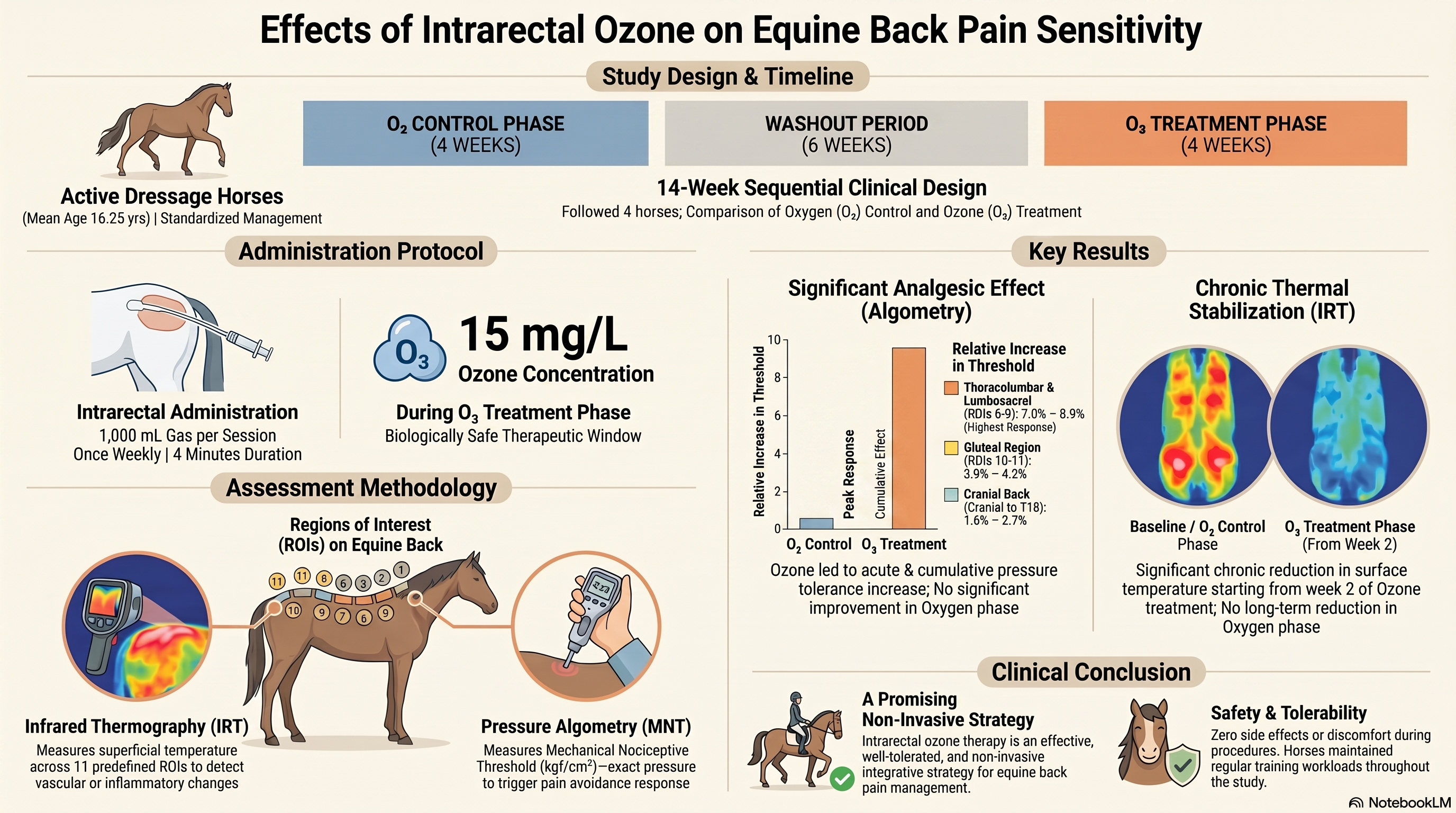
Ozone therapy has been commonly used as an integrative approach for pain management, despite limited scientific evidence in equine medicine. The aim of this study was to evaluate the effects of intra-rectal ozone administration on back sensitivity in healthy dressage horses using infrared thermography and pressure algometry. Four horses, clinically fit to work, were included in a sequential clinical design consisting of a four-week control phase with intra-rectal oxygen administration, a six-week washout period and a four-week treatment phase with intra-rectal ozone. Ozone was administered at a dose of 15 mg per session (1000 mL at 15 mg/L). Assessments were performed weekly before and after each administration at predefined thoracolumbar regions. Thermography did not show significant changes in superficial temperature following ozone administration. In contrast, pressure algometry revealed a significant increase in the mechanical nociceptive threshold after ozone treatment, as well as a cumulative effect throughout the treatment period. Our results suggest that the intra-rectal ozone therapy may have analgesic potential for the control of equine dorsal, objectively assessed by pressure algometry, despite the absence of detectable thermographic changes.
Article Details

This work is licensed under a Creative Commons Attribution 4.0 International License.
Publishing an article with open access in Veterinary Integrative Sciences leaves the copyright with the author. The article is published under the Creative Commons Attribution License 4.0 (CC-BY 4.0), which allows users to read, copy, distribute and make derivative works from the material, as long as the author of the original work is cited.
References
Ballardini, E., 2005. Oxygen-ozone therapy for spinal muscle. Riv. Ital. Ossigeno-Ozonoterapia. 4, 70–73.
Barstow, A., Dyson, S., 2015. Clinical features and diagnosis of sacroiliac joint region pain in 296 horses: 2004–2014. Eq. Vet. Educ. 27, 637–647.
Biazzo, A., Corriero, A.S., Confalonieri, N., 2018. Intramuscular oxygen-ozone therapy in the treatment of low back pain. Acta Biomed. 89, 41–46.
Bocci, V., 2011. Ozone: a new medical drug. Springer, Netherland.
Button, K.S., Ioannidis, J.P.A., Mokrysz, C., Nosek, B.A., Flint, J., Robinson, E.S.J., Munafò, M.R., 2013. Power failure: why small sample size undermines the reliability of neuroscience. Nat. Rev. Neurosci. 14, 365–376.
Coelho, C.S., Bernadi, W.A., Ginelli, A.M., Spagnol, T., Gardel, L.S., Souza, C.S., 2015. Use of ozone therapy in chronic laminitis in a horse. J. Ozone Therap. 1, 1-6.
De Heus, P., Van Oossanen, G., Van Dierendonck, M.C., Back, W., 2010. A Pressure Algometer Is a Useful Tool to Objectively Monitor the Effect of Diagnostic Palpation by a Physiotherapist in Warmblood Horses. J. Eq. Vet. Sci. 30, 310–321.
Denoix, J.-M., Dyson, S.J., 2011. Thoracolumbar Spine. In: Ross, M.W., Dyson, S.J. (Eds.), Diagnosis and Management of Lameness in the Horse, (2nd edition). Elsevier, New York, pp. 592–605.
Figueiredo, R.P., Vilela, L.F., Prazeres, H.G.R.D., Domingues, L.F., Lourenço, F.D.S., Silveira, V.C.D., Anzolin, A.P., Furini, A.A.D.C., 2025. Effects of ozone therapy on pain relief in patients with low back pain: case series. Braz. J. Implantol. Health Sci. 7, 1065–1081.
Galiè, M., Costanzo, M., Nodari, A., Boschi, F., Calderan, L., Mannucci, S., Covi, V., Tabaracci, G., Malatesta, M., 2018. Mild ozonisation activates antioxidant cell response by the Keap1/Nrf2 dependent pathway. Free Radic. Biol. Med. 124, 114–121.
Haussler, K.K., 2020. Pressure algometry for the detection of mechanical nociceptive thresholds in horses. Animals. 10, 2195.
Haussler, K.K., Erb, H.N., 2006. Mechanical nociceptive thresholds in the axial skeleton of horses. Eq. Vet. J. 38, 70–75.
Jaramillo, F.M., Vendruscolo, C.P., Fülber, J., Seidel, S.R.T., Barbosa, A.P., Baccarin, R.Y.A., 2020. Effects of transrectal medicinal ozone in horses—Clinical and laboratory aspects. Arq. Bras. Med. Vet. Zootec. 72, 56–64.
Jeffcott, L.B., Dalin, G., 1980. Natural rigidity of the horse’s backbone. Eq. Vet. J. 12, 101–108.
Jeffcott, L.B., 1980. Disorders of the thoracolumbar spine of the horse—A survey of 443 cases. Eq. Vet. J. 12, 197–210.
Llombart-Blanco, R., Mariscal, G., Cordón, V., Barrios, C., Benlloch, M., Llombart-Ais, R., 2024. The effectiveness of ozone infiltration on patient-reported outcomes in low back pain: a systematic review and meta-analysis. Life. 14, 1406.
Masko, M., Krajewska, A., Zdrojkowski, L., Domino, M., Gajewski, Z., 2019. An application of temperature mapping of horse’s back for leisure horse‐rider‐matching. Anim. Sci. J. 90, 1396–1406.
Masko, M., Borowska, M., Domino, M., Jasinski, T., Zdrojkowski, L., Gajewski, Z., 2021. A novel approach to thermographic images analysis of equine thoracolumbar region: The effect of effort and rider’s body weight on structural image complexity. BMC Vet. Res. 17, 99.
Meehan, L., Dyson, S., Murray, R., 2009. Radiographic and scintigraphic evaluation of spondylosis in the equine thoracolumbar spine: A retrospective study. Eq. Vet. J. 41, 800–807.
Melo, U.P.D., Ferreira, C., 2021. Multimodal therapy for treatment of equine back pain: a report of 15 cases. Braz. J. Vet. Med. 43, e003321.
Murray, R.C., Walters, J.M., Snart, H., Dyson, S.J., Parkin, T.D.H., 2010. Identification of risk factors for lameness in dressage horses. Vet. J. 184, 27–36.
Pongratz, U., Licka, T., 2017. Algometry to emasure pain threshold in the horse’s back – An in vivo and in vitro study. BMC Vet. Res. 13, 80.
Re, L., Martínez-Sánchez, G., Bordicchia, M., Malcangi, G., Pocognoli, A., Angel Morales-Segura, M., Rothchild, J., Rojas, A., 2014. Is ozone pre-conditioning effect linked to Nrf2/EpRE activation pathway in vivo? A preliminary result. Eur. J. Pharmacol. 742, 158–162.
Re, L., Mawsouf, M.N., Menéndez, S., León, O.S., Sánchez, G.M., Hernández, F., 2008. Ozone therapy: clinical and basic evidence of its therapeutic potential. Arch. Med. Res. 39, 17–26.
Sagai, M., Bocci, V., 2011. Mechanisms of action involved in ozone therapy: is healing induced via a mild oxidative stress?. Med. Gas Res. 1, 29.
Sampaio, N.D.R., Cruz, L.R.O., Medrado, A.P., 2018. Ozonetherapy in the treatment of Low Back Pain associated to Lumbar Disk Herniation – A systematic review. Rev. Pesqui. Fisioter. 8, 579–587.
Sciorsci, R.L., Lillo, E., Occhiogrosso, L., Rizzo, A., 2020. Ozone therapy in veterinary medicine: A review. Res. Vet. Sci. 130, 240–246.
Seyam, O., Smith, N., Reid, I., Gandhi, J., Jiang, W., Khan, S., 2018. Clinical utility of ozone therapy for musculoskeletal disorders. Med. Gas Res. 8, 103.
Soroko-Dubrovina, M., Morel, M.C.G.D., 2016. Equine thermography in practice, 2nd edition. CABI, Oxfordshire.
Tsuzuki, N., Endo, Y., Kikkawa, L., Korosue, K., Kaneko, Y., Kitauchi, A., Katamoto, H., Hidaka, Y., Hagio, M., Torisu, S., 2015. Effects of ozonated autohemotherapy on the antioxidant capacity of Thoroughbred horses. J. Vet. Med. Sci. 77, 1647–1650.
Turner, T., 2018. Thermography. In: Henson, F.M.D. (Ed.), Equine Neck and Back Pathology: Diagnosis and Treatment. John Wiley & Sons, New Jersey, pp. 165–174.
