Effects of supplementing of protease and hydrolyzed tannin on growth performance, meat yield and coccidia infection of Japanese quail https://doi.org/10.12982/VIS.2026.090
Article Sidebar
Main Article Content
Abstract
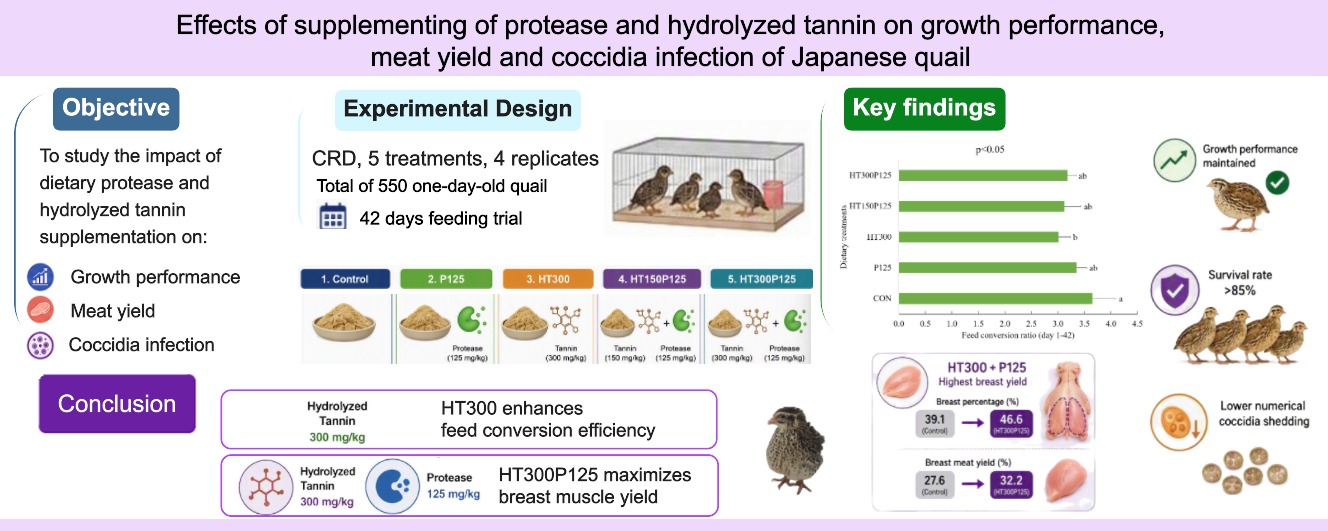
This study investigated the impact of dietary protease and hydrolyzed tannin supplementation on growth performance, meat yield and coccidia infection in Japanese quail. A total of 550 one-day-old quail were randomly assigned to five dietary treatments, with each treatment replicated four times (27-28 birds/replicate). The treatments included: a control (basal diet only); the basal diet supplemented with P125 (125 mg protease/kg feed), HT300 (300 mg tannin/kg feed), HT150P125 (150 mg tannin/kg feed + 125 mg protease/kg feed), and HT300P125 (300 mg tannin/kg feed + 125 mg protease/kg feed). Survival rates were numerically higher in the HT300 and HT150P125 groups than in the control and HT300P125 groups (p>0.05). While body weight, average daily gain, and feed intake did not significantly differ among treatments (p>0.05), the feed conversion ratio was significantly affected from 1 to 42 days (p<0.05). Supplementation with combined additives significantly increased relative breast percentage and breast meat yield (p>0.05), reaching peak values of 46.6% and 32.2%, respectively, in the HT300P125 group. Fecal oocyst shedding showed non-significant numerical reductions in the P125, HT150P125, and HT300P125 groups compared to the control (p > 0.05). In conclusion, dietary supplementation with hydrolyzed tannin at 300 mg/kg enhances feed conversion efficiency, whereas co-supplementation with 300 mg/kg hydrolyzed tannin and 125 mg/kg protease synergistically maximizes breast muscle yield in Japanese quail.
Article Details

This work is licensed under a Creative Commons Attribution 4.0 International License.
Publishing an article with open access in Veterinary Integrative Sciences leaves the copyright with the author. The article is published under the Creative Commons Attribution License 4.0 (CC-BY 4.0), which allows users to read, copy, distribute and make derivative works from the material, as long as the author of the original work is cited.
References
Ajayi, H.I., 2015. Effect of protease supplementation on performance and carcass weights of broiler chickens fed low protein diets. Nigerian J. Agri. Food Environ. 11(1), 29-32.
Cardinal, K.M., Moraes, M.L.D., Andretta, I., Schirmann, G.D., Belote, B.L., Barrios, M.A., Santin, E., Ribeiro, A.M.L., 2019. Growth performance and intestinal health of broilers fed a standard or low-protein diet with the addition of a protease. Revista Brasil. Zootecnia. 48.
Choi, J., Kim, W.K., 2020. Dietary application of tannins as a potential mitigation strategy for current challenges in poultry production: a review. Animals. 10(12), 2389.
Chung, K.T., Lu, Z., Chou, M.W., 1998. Mechanism of inhibition of tannic acid and related compounds on the growth of intestinal bacteria. Food Chem. Toxic. 36(12), 1053-1060.
Diana, T.F., Pinheiro, S.R.F., Dalólio, F.S., Dourado, L.R.B., Santos, A.S., Bonafé, C.M., Valentim, J.K., 2020. Protease in low-protein diets for meat-type quails containing feather meal. Arquivo Brasil. Med. Vet. Zootecnia. 72, 1487-1496.
Ding, X., Zhang, X., Zhang, J., Li, J., Zhang, Y., 2016. Effects of dietary crude protein levels and exogenous protease on performance, nutrient digestibility, trypsin activity and intestinal morphology in broilers. Livest. Sci. 193, 26-31.
Fang, L.L., Zulkifli, I., Soleimani, F.A., Liang, J.B., Awad, E.A., 2019. Effects of protease supplementation of low protein and/or energy diets on growth performance and blood parameters in broiler chickens under heat stress condition. Itali. J. Anim. Sci. 18(1), 679-689.
Freitas, D.M., Vieira, S.L., Angel, C.R., Favero, A., Maiorka, A., 2011. Performance and nutrient utilization of broilers fed diets supplemented with a novel monocomponent protease. J. Appl. Poult. Res. 20(3), 322-334.
Fru-Nji, F., Kluenter, A.M., Fischer, M., Pontoppidan, K., 2011. A feed serine protease improves broiler performance and increases protein and energy digestibility. J. Poult. Sci. 48(4), 239-246.
Imad Abdulsahib Al-Shammari, K., 2023. Alleviating the oxidative stress in Japanese quails fed L- carnitine and creatine monohydrate through impacts on productive performance, ileal microflora, digestibility and redox system. Vet. Integr. Sci. 21(1), 081-098.
Jamroz, D., Wiliczkiewicz, A., Skorupińska, J., Orda, J., Kuryszko, J., Tschirch, H., 2009. Effect of sweet chestnut tannin (SCT) on the performance, microbial status of intestine and histological characteristics of intestine wall in chickens. Bri. Poult. Sci. 50(6), 687-699.
Khang, N.T.K, Suong, N.T.M., Takahashi, M., 2024. Impact of heat stress on blood physiological parameters, body temperature, respiratory frequency, antioxidant status, carcass quality, production performance, and egg quality of Japanese quail. Vet. Integr. Sci. 22(3), 831-846.
Khang, N.T.K., Hiep, H.L., Truyen, N.V., Phuong, L.T., 2022. The effect of protease enzyme supplementation at different levels on carcass performance, meat quality and laying performance of Noi female chickens. J. Anim. Husb. Sci. Tech. 279, 44-49. (In VNese)
Marzoni, M., Castillo, A., Franzoni, A., Nery, J., Fortina, R., Romboli, I., Schiavone, A., 2020. Effects of dietary Quebracho tannin on performance traits and parasite load in an Italian slow-growing chicken (White Livorno Breed). Animals. 10(4), 684.
Min, B.R., Hart, S.P., 2003. Tannins for suppression of internal parasites. J. Anim. Sci. 81, e102-109.
National Research Council (NRC), 1994. Nutrient requirements of poultry, 9th Revised edition. Academies Press, Washington, DC.
Park, S.Y., Kim, H.J., Lee, J.H., Kim, Y.H., 2020. Effects of exogenous protease supplementation on growth performance and nutrient digestibility in broiler chickens. Anim. Feed Sci. Technol. 263, 114468.
Peek, H.W., Van der Klis, J.D., Vermeulen, B., Landman, W.J.M., 2009. Dietary protease can alleviate negative effects of a coccidiosis infection on production performance in broiler chickens. Anim. Feed Sci. Technol. 150(1-2), 151-159.
Scalbert, A., 1991. Antimicrobial properties of tannins. Phytochem. 30(12), 3875–3883.
Schiavone, A., Guo, K., Tassone, S., Gasco, L., Hernandez, E., Denti, R., Zoccarato, I., 2008. Effects of a natural extract of chestnut wood on digestibility, performance traits, and nitrogen balance of broiler chicks. Poult. Sci. 87(3), 521-527.
Tosi, G., Massi, P., Antongiovanni, M., Bosi, P., Casini, L., 2013. Efficacy test of a hydrolysable tannin extract against necrotic enteritis in challenged broiler chickens. Itali. J. Anim. Sci. 12(3), e62.
Tran, N.H.B., Khang, N.T.K., Tien, L.A., Tien, N.T.M., Chuc, N.T., Hung, N.H., 2025. First report of morphological identification and prevalence of Eimeria species in Japanese quails (Coturnix coturnix japonica) in Mekong Delta of Vietnam. Pak. Vet. J. 45(4), 2126-2129.
Zhang, Z., Xu, P., Liu, C., Chen, J., Ren, B., Du, E., Guo, S., Li, P., Li, L., Ding, B., 2024. Effect of tannic acid on antioxidant function, immunity, and intestinal barrier of broilers co-infected with coccidia and Clostridium perfringens. Animals. 14(6), 955.
