Investigation of the in vitro anti-Toxoplasma gondii activity of the citrus-derived flavonoids hesperetin and naringin https://doi.org/10.12982/VIS.2026.084
Article Sidebar
Main Article Content
Abstract
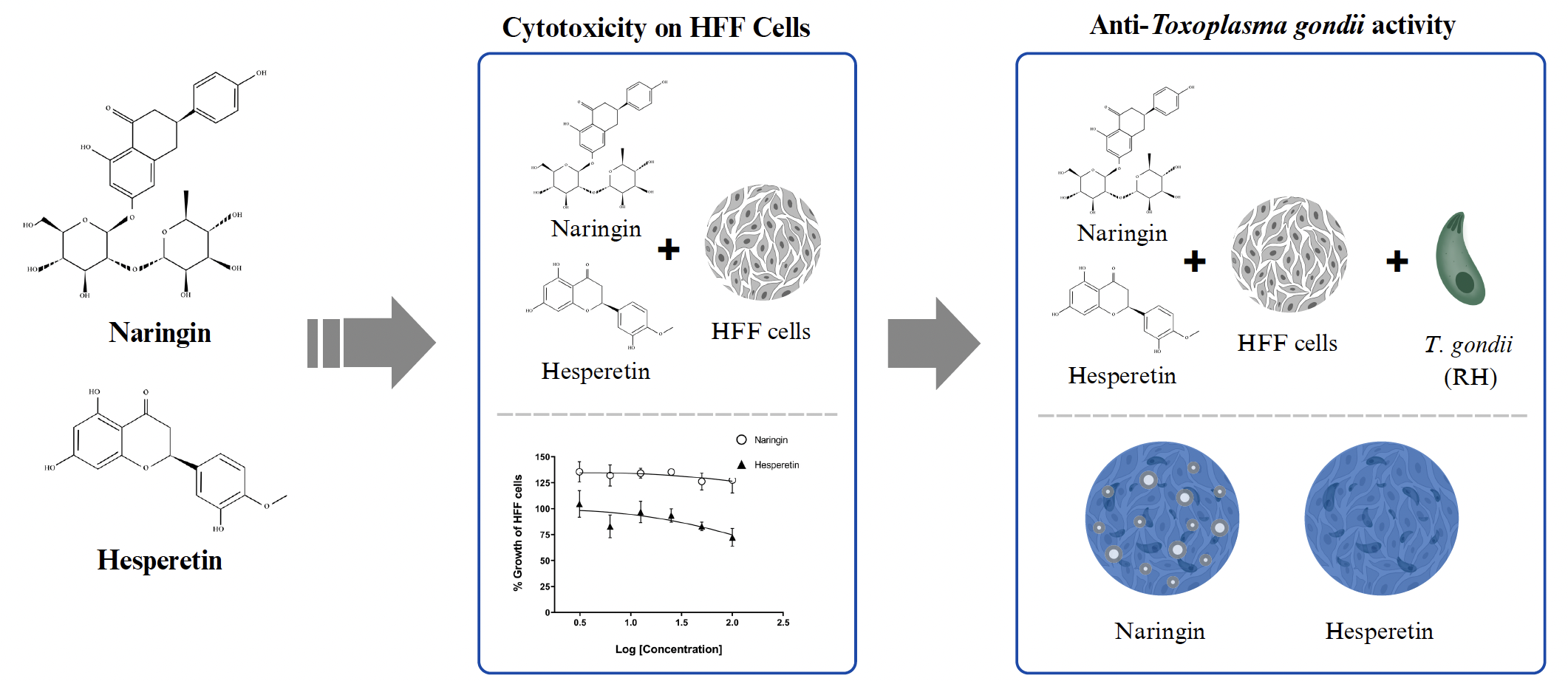
Toxoplasma gondii is an important intracellular parasite that poses a substantial public health concern worldwide, particularly among immunocompromised individuals and pregnant women. Pyrimethamine and sulfadiazine are the standard treatments for toxoplasmosis. However, these drugs can cause adverse effects and teratogenicity, potentially leading to treatment failure. These limitations highlight the need to explore new drugs as alternative therapeutic agents. Hesperetin and naringin are citrus-derived flavonoids known to exhibit antiparasitic activity. However, evidence regarding their effects against T. gondii remains limited. This study evaluated their cytotoxicity against human foreskin fibroblast cells using the 3-(4,5-dimethylthiazol-2-yl)-2,5-diphenyltetrazolium bromide (MTT) assay and assessed their anti-T. gondii (RH strain) activity using a plaque assay. Both hesperetin and naringin exhibited low cytotoxicity, with CC50 values exceeding 100 µg/mL. Interestingly, hesperetin completely inhibited T. gondii plaque formation at 100 µg/mL, and this effect was comparable to that of the reference drug pyrimethamine. In contrast, naringin showed no inhibitory effect on plaque formation compared with the untreated group. Although hesperetin and naringin belong to the same chemical class, they demonstrated a clear difference in antiparasitic activity. In conclusion, hesperetin derived from citrus plants exhibited anti-T. gondii activity with low cytotoxicity in vitro. Further studies are required to elucidate its mechanism of action and evaluate its potential therapeutic applications.
Article Details

This work is licensed under a Creative Commons Attribution 4.0 International License.
Publishing an article with open access in Veterinary Integrative Sciences leaves the copyright with the author. The article is published under the Creative Commons Attribution License 4.0 (CC-BY 4.0), which allows users to read, copy, distribute and make derivative works from the material, as long as the author of the original work is cited.
References
Ahmadi, V., Nie, C., Mohammadifar, E., Achazi, K., Wedepohl, S., Kerkhoff, Y., Block, S., Osterrieder, K., Haag, R., 2021. One-pot gram-scale synthesis of virucidal heparin-mimicking polymers as HSV-1 inhibitors. Chem Commun. 57, 11948–11951
Baeza-Jiménez, R., González-Aguilar, G.A., López Martínez, L.X., 2026. Flavonoids in plants: diversity, importance, and applications. In: Guleria, P., Kumar, V., Taheri, P. (Eds.), Flavonoids for plant development and stress tolerance, Academic Press, London, pp. 3–17.
Bhatt, D., Washimkar, K.R., Kumar, S., Mugale, M.N., Pal, A., Bawankule, D.U., 2024. Naringin and chloroquine combination mitigates chloroquine-resistant parasite-induced malaria pathogenesis by attenuating the inflammatory response. Phytomedicine. 133, 155943.
Chemoh, W., Sawangjaroen, N., Siripaitoon, P., Andiappan, H., Hortiwakul, T., Sermwittayawong, N., Charoenmak, B., Nissapatorn, V., 2015. Toxoplasma gondii - prevalence and risk factors in HIV-infected patients from Songklanagarind Hospital, southern Thailand. Front Microbiol. 6, 1304.
Farhab, M., Aziz, M.W., Shaukat, A., Cao, M.X., Hou, Z., Huang, S.Y., Li, L., Yuan, Y.G., 2025. Review of toxoplasmosis: what we still need to do. Vet. Sci. 12(8),772
Gruber, S., Nickel, A., 2023. Toxic or not toxic? The specifications of the standard ISO 10993-5 are not explicit enough to yield comparable results in the cytotoxicity assessment of an identical medical device. Front Med. Technol. 5, 1195529.
Guo, M., Dubey, J.P., Hill, D., Buchanan, R.L., Gamble, H.R., Jones, J.L., Pradhan, A.K., 2015. Prevalence and risk factors for Toxoplasma gondii infection in meat animals and meat products destined for human consumption. J Food Prot. 78, 457–476.
Jittapalapong, S., Inpankaew, T., Pinyopanuwat, N., Chimnoi, W., Kengradomkij, C., Wongnarkpet, S., Maruyama, S., Lekkla, A., Sukthana, Y., 2010. Epidemiology of Toxoplasma gondii infection of stray cats in Bangkok, Thailand. Southeast Asian J. Trop. Med. Public Health. 41, 13–18.
Mahmood, M.A., Abd, A.H., Kadhim, E.J., 2023. Assessing the cytotoxicity of phenolic and terpene fractions extracted from Iraqi Prunus arabica against AMJ13 and SK-GT-4 human cancer cell lines. F1000Res. 12, 433.
Manach, C., Williamson, G., Morand, C., Scalbert, A., Rémésy, C., 2005. Bioavailability and bioefficacy of polyphenols in humans. I. Review of 97 bioavailability studies. Am. J. Clin. Nutr. 81, 230S–242S.
McLeod, R., Cohen, W., Dovgin, S., Finkelstein, L., Boyer, K.M., 2020. Human Toxoplasma infection. In: Weiss, L.M., Kim, K. (Eds.), Toxoplasma gondii, 3rd edition. Academic Press, London, pp. 117–227.
Molan, A., Nosaka, K., Hunter, M., Wang, W., 2019. Global status of Toxoplasma gondii infection: systematic review and prevalence snapshots. Trop. Biomed. 36, 898–925.
Namiecińska, E., Sadowska, B., Więckowska-Szakiel, M., Dołęga, A., Pasternak, B., Grazul, M., Budzisz, E., 2019. Anticancer and antimicrobial properties of novel η6-p-cymene ruthenium(II) complexes containing a N,S-type ligand, their structural and theoretical characterization. RSC Adv. 9, 38629–38645.
Parente Rocha, S.I., Fernandes, V.B., Barbosa Da Silva, W.M., Frota, L.S., Garcia, A.R., Schulze Spíndola, F.F., Alexandre Roberto, C.H., Rodrigues De Souza, V.M., Antonio Da Franca Rodrigues, K., De Almeida Rodrigues, I., Marinho, E.S., Marinho, M.M., Vila-Nova, N.S., Maia De Morais, S., 2025. Antileishmanial activity of hesperetin on Leishmania donovani, in vitro and in silico inhibition of acetylcholinesterase and investigation of the targets sterol C-24 reductase and N-myristoyltransferase. Exp. Parasitol. 270, 108903.
Qiu, Y., Wang, W., Wang, Q., Lin, H., Bai, Y., Zhang, J., 2025. Effect of the flavonoid compound glabridin on tachyzoites and bradyzoites of Toxoplasma gondii. Parasit. Vectors. 18, 56.
Ramachandran, D., May, W.W., Abdul Majeed, A.B., Ruhi, S., Jayasingh Chellammal, H.S., 2025. Traditional wisdom to modern science: Hesperetin and naringenin as emerging traditional Chinese medicine-based treatments for Alzheimer’s disease. Pharmacol. Res. Mod. Chin. Med. 17, 100718.
Sanchez, S.G., Besteiro, S., 2021. The pathogenicity and virulence of Toxoplasma gondii. Virulence. 12, 3095 –3114.
Shapiro, K., Bahia-Oliveira, L., Dixon, B., Dumètre, A., de Wit, L.A., Vanwormer, E., Villena, I., 2019. Environmental transmission of Toxoplasma gondii: Oocysts in water, soil and food. Food Waterborne Parasitol. 15, e00049.
Walana, W., Odai, S.A., Tamomh, A.G., 2026. Prevalence, risk factors, diagnosis and outcomes of Toxoplasma gondii infection in pregnancy: a review. Parasitol Int. 110, 103143.
Xue, J.C., Yuan, S., Meng, H., Hou, X.T., Li, J., Zhang, H.M., Chen, L.L., Zhang, C.H., Zhang, Q.G., 2023. The role and mechanism of flavonoid herbal natural products in ulcerative colitis. Biomed Pharmacother. 158, 114086.
Zandi, K., Teoh, B.T., Sam, S.S., Wong, P.F., Mustafa, M.R., Abubakar, S., 2011. Antiviral activity of four types of bioflavonoid against dengue virus type-2. Virol. J. 8, 560.
Zhang, H., Hassan, Y.I., Liu, R., Mats, L., Yang, C., Liu, C., Tsao, R., 2020. Molecular mechanisms underlying the absorption of aglycone and glycosidic flavonoids in a Caco-2 BBe1 cell model. ACS Omega. 5, 10782–10793.
