Detection of Clostridium algidicarnis in beef in Thailand and comparison of their characteristics with strains from Central Europe https://doi.org/10.12982/VIS.2027.008
Article Sidebar
Main Article Content
Abstract
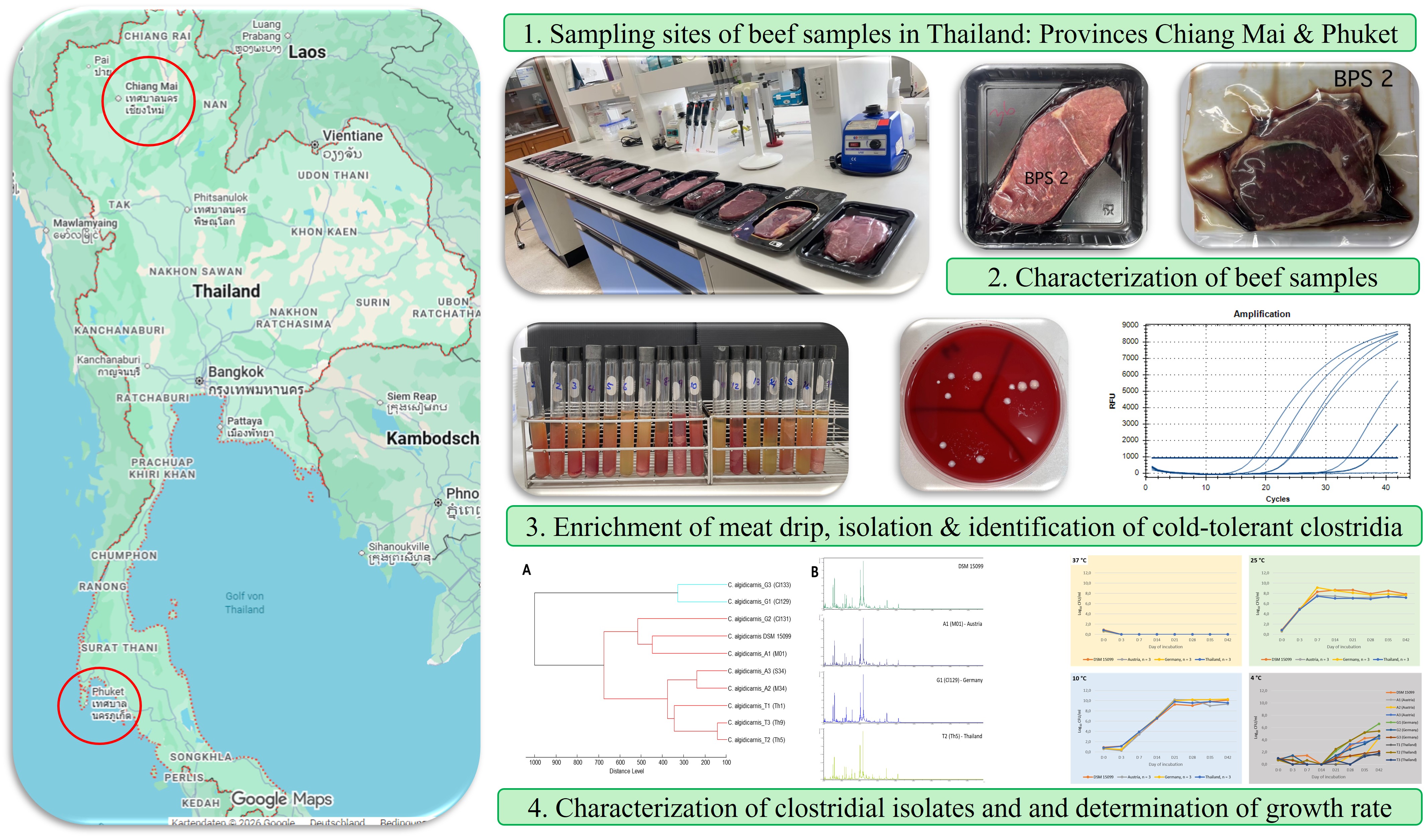
Cold-tolerant clostridia are important, albeit largely unexplored, spoilage microorganisms of vacuum-packed beef. Studies on these bacteria mainly take place in regions with a temperate climate, with very few conducted in the tropical countries. As beef consumption in Thailand is constantly increasing, this study aimed to investigate whether these bacteria exist in meat sold in the country. Vacuum-packed beef samples (n = 40) were collected from various supermarkets in two different provinces. Overall, 40.0% of samples tested positive for clostridia by PCR and 22.5% by culture. Of these, 14 samples were positive for Clostridium algidicarnis, while the other two samples were positive for C. perfringens. No correlation was found between positive beef samples and the level of gas production in meat packs. When compared with Austrian and German strains, all tested strains (n = 10) grew well in PYGS broth at 10°C and 25°C, grew slowly at 4°C, but showed no growth at 37°C. A low sporulation rate was observed during cultivation in pure media. Similarity in the MALDI-TOF-MS spectrum between the Thai and Austrian strains was observed. Although the detection rate is considered preliminary due to the small sample size, the results show that the cold-tolerant C. algidicarnis is present in vacuum-packed beef sold in Thailand.
Article Details

This work is licensed under a Creative Commons Attribution 4.0 International License.
Publishing an article with open access in Veterinary Integrative Sciences leaves the copyright with the author. The article is published under the Creative Commons Attribution License 4.0 (CC-BY 4.0), which allows users to read, copy, distribute and make derivative works from the material, as long as the author of the original work is cited.
References
Angerer, J., Casarin, S., Schwaiger, K., Dorn-In, S., 2025. Cold-tolerant Clostridium spp. in beef and in the beef production chain in Austria – occurrence and species identification. Int. J. Food Microbiol. 443, 111410.
Abdrabou, A.M.M., Sy, I., Bischoff, M., Arroyo, M.J., Becker, S.L., Mellmann, A., von Müller, L., Gärtner, B., Berger, F.K., 2023. Discrimination between hypervirulent and non-hypervirulent ribotypes of Clostridioides difficile by MALDI-TOF mass spectrometry and machine learning. Eur. J. Clin. Microbiol. Infect. Dis. 42, 1373-1381.
Adam, K.H., Flint, S.H., Brightwell, G., 2010. Psychrophilic and psychrotrophic clostridia: sporulation and germination processes and their role in the spoilage of chilled, vacuum-packaged beef, lamb and venison. Int. J. Food Sci. Technol. 45, 1539-1544.
Bano, L., Drigo, I., Tonon, E., Pascoletti, S., Puiatti, C., Anniballi, F., Auricchio, B., Lista, F., Montecucco, C., Agnoletti, F., 2017. Identification and characterization of Clostridium botulinum group III field strains by matrix-assisted laser desorption-ionization time-of-flight mass spectrometry (MALDI-TOF MS). Anaerobe. 48, 126-134.
BfR (Bundesinstitut fuer Risikobewertung), 2010. Clostridium estertheticum in vakuumverpacktem Rindfleisch: Ein gesundheitliches Risiko durch den Verzehr ist unwahrscheinlich. Available online: https://www.bfr.bund.de/cm/343/clostridium _estertheticum_in_vakuumverpacktem_rindfleisch_ein_gesundheitliches_risiko_durch_den_verzehr_ist_unwahrscheinlich.pdf (Accessed on January 25, 2025).
Boerema, J.A., Broda, D.M., Penney, N., Brightwell, G., 2007. Influence of peroxyacetic acid-based carcass rinse on the onset of “blown pack” spoilage in artificially inoculated vacuum-packed chilled beef. J. Food Prot. 70, 1434-1439.
Bolton, D.J., Carroll, J., Walsh, D., 2015. A four-year survey of blown pack spoilage Clostridium estertheticum and Clostridium gasigenes on beef primal cuts. Lett. Appl. Microbiol. 61, 153-157.
Bonke, R., Drees, N., Gareis, M., 2016. Detection of psychrophilic and psychrotolerant Clostridium spp. in chilled fresh vacuum-packed meat using different PCR methods. FEMS Microbiol. Lett. 363, 1-7.
Broda, D.M., Boerema, J.A., Brightwell, G., 2009. Sources of psychrophilic and psychrotolerant clostridia causing spoilage of vacuum-packed chilled meats, as determined by PCR amplification procedure. J. Appl. Microbiol. 107, 178-186.
Broda, D.M., DeLacy, K.M., Bell, G.R., Braggins, T.J., Cook, R.L., 1996. Psychotrophic Clostridium spp. associated with “blown pack” spoilage of chilled vacuum-packed red meats and dog rolls in gas-impermeable plastic casings. Int. J. Food Microbiol. 29, 335-352.
Dainty, R.H., Edwards, R.A., Hibbard, C.M., 1989. Spoilage of vacuum-packed Beef by a Clostridium sp. J. Sci. Food Agric. 49, 473-486.
Dorn-In, S., Zand, V., Angerer, J., Özbek, K., Eibl, Schwaiger, K., 2025. Cold-tolerant Clostridium spp. related to meat spoilage in cattle farms in Austria. Food Microbiol. 132, 104838.
Kalchayanand, N., Ray, B., Field, R.A., Johnson, M.C., 1989. Spoilage of vacuum packaged refrigerated beef by Clostridium. J. Food Prot. 52, 424-426.
Lawson, P., Dainty, R.H., Kristiansen, N., Berg, J., Collins, M.D., 1994. Characterization of a psychrotrophic Clostridium causing spoilage in vacuum-packed cooked pork: description of Clostridium algidicarnis sp. nov. Lett. Appl. Microbiol. 19, 153-157.
Lund, B.M., Graham, A.F., George, S.M., Brown, G.D., 1990. The combined effect of incubation temperature, pH and sorbic acid on the probability of growth of non-proteolytic type B Clostridium botulinum. J. Appl. Microbiol. 69, 481-492.
Mang, S., Schwaiger, K., Lindner, R., Gareis, M., Dorn-In, S., 2021. High incidence of cold-tolerant Clostridium frigoriphilum and C. algidicarnis in vacuum-packed beef on retail sale in Germany. Int. J. Food Microbiol. 340, 1-8.
MLA (Meat & Livestock Australia), 2024. Beef and sheep meat, Thailand. MLA Industry Insights. Available online: https://www.mla.com.au/contentassets/301bbb5fd351 490fa0f8f328efb0fb84/thailand-2023-mla-mi-market-snapshot_290124-1.pdf (Accessed on February 7, 2025)
Moschonas, G., Bolton, D.J., Sheridan, J.J., McDowell, D.A., 2009. Isolation and sources of blown pack spoilage clostridia in beef abattoirs. J. Appl. Microbiol. 7, 616-624.
Silva, A.R., Paulo, E.N., Sant´Ana, A.S., Chaves, R.D., Massaguer, P.R., 2011. Involvement of Clostridium gasigenes and C. algidicarnis in ‘blown pack’ spoilage of Brazilian vacuum-packed beef. Int. J. Food Microbiol. 148, 156-163.
USDA, 2021. Thailand: Thailand's beef market. Available online: https://www.fas.usda. gov/data/thailand-thailands-beef-market (Accessed on March 23, 2022)
Wambui, J., Püntener, S., Corti, S., Cernela, N., Stephan, R., 2020. Detection of psychrophilic Clostridium spp. causing “blown pack” spoilage in meat juice samples from chilled vacuum-packed beef and lamb meat imported from different countries to Switzerland. J. Food Prot. 83, 56-59.
Yang, X., Gill, C.O., Balamurugan, S., 2009. Effects of temperature and pH on the growth of bacteria isolated from blown packs of vacuum-packaged beef. J. Food Prot. 72, 2380-2385.
Zhang, P., Ward, P., McMullen, L.M., Yang, X., 2020. A case of ‘blown pack’ spoilage of vacuum-packaged pork likely associated with Clostridium estertheticum in Canada. Lett. Appl. Microbiol. 70, 13–20.
