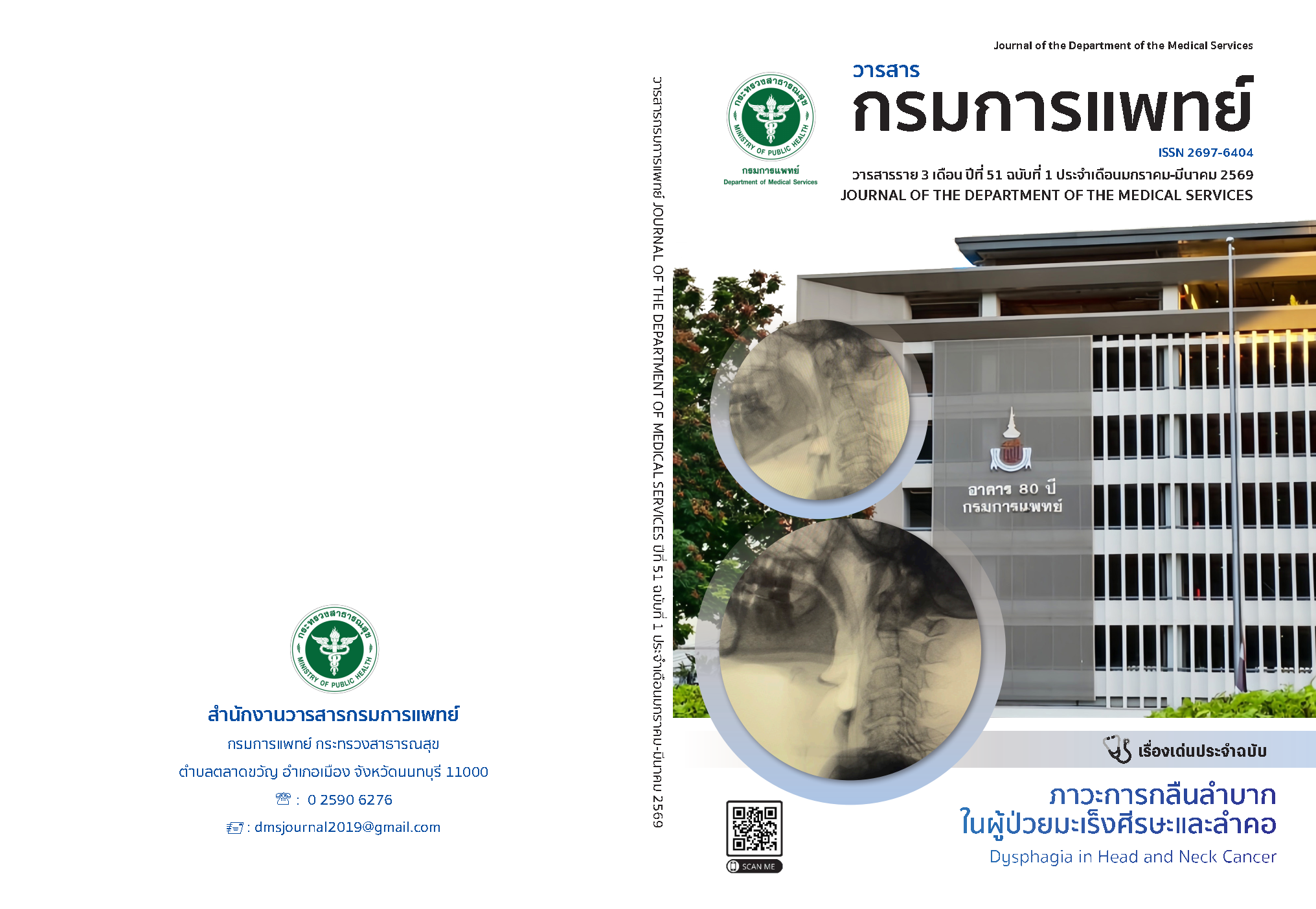
Dysphagia in Head and Neck Cancer
Abstract
มะเร็งศีรษะและลำคอ (Head and Neck Cancer: HNC) เป็นกลุ่มโรคทางมะเร็งวิทยาที่มีพยาธิสรีรวิทยาซับซ้อนและมีลักษณะเฉพาะตัวสูง เนื่องจากตัวเนื้องอกเกิดขึ้นในตำแหน่งที่มีความสำคัญต่อระบบทางเดินหายใจส่วนต้นการสื่อสาร และการกลืน ภาวะกลืนลำบาก (dysphagia) จึงไม่ได้เป็นเพียงผลข้างเคียงชั่วคราว แต่เป็นภาวะทุพพลภาพเรื้อรังที่ส่งผลกระทบอย่างรุนแรง ต่อคุณภาพชีวิตของผู้ป่วย1 แม้ความก้าวหน้าทางการรักษา เช่น การผ่าตัดด้วยความแม่นยำสูง (precision surgery) และการฉายรังสีแบบปรับความเข้ม (IMRT) จะช่วยให้อัตราการรอดชีวิตสูงขึ้น แต่กลับพบประชากรผู้รอดชีวิตต้องเผชิญกับภาวะกลืน ลำบากเพิ่มมากขึ้น ผู้ป่วยจึงต้องดำรงชีวิตอยู่กับความบกพร่องของกลไกการกลืนเป็นเวลานาน ซึ่งนำไปสู่ภาวะทุพโภชนาการภาวะขาดน้ำ และความเสี่ยงสูงสุดคือปอดอักเสบจากการสำลัก (aspiration pneumonia)1, 2
References
Karasik D, Michaelson G, Cabrera CI, Nahra A, Zhao NW. Disparities in dysphagia care among head and neck cancer patients: a retrospective cohort study. OTO Open 2025;9(2):e70090.
Gulati A, Patel N, Kidane J, Perrin CE, Chan JW, Crosby TW, et al. Prevalence of long-term dysphagia in head and neck cancer survivors not receiving dysphagia treatment. Laryngoscope 2026;136(2):688-93.
Hutcheson KA, Nurgalieva Z, Zhao H, Gunn GB, Giordano SH, Bhayani MK, et al. Two-year prevalence of dysphagia and related outcomes in head and neck cancer survivors: An updated SEER-Medicare analysis. Head Neck 2019;41(2):479-87.
Aylward A, Abdelaziz S, Hunt JP, Buchmann LO, Cannon RB, Lloyd S, et al. Rates of dysphagia-related diagnoses in long-term survivors of head and neck cancers. Otolaryngol Head Neck Surg 2019;161(4):643-51.
Florie MGMH, Wieland MWM, Pilz W, Partoens R, Winkens B, Hoeben A, et al. Prevalence and risk factors of oropharyngeal dysphagia in newly diagnosed head-and-neck cancer patients. Cancers (Basel) 2024;17(1):9.
King SN, Dunlap NE, Tennant PA, Pitts T. Pathophysiology of radiation-induced dysphagia in head and neck cancer. Dysphagia 2016;31(3):339-51.
Ramia P, Bodgi L, Mahmoud D, Mohammad MA, Youssef B, Kopek N, et al. Radiation-induced fibrosis in patients with head and neck cancer: a review of pathogenesis and clinical outcomes. Clin Med Insights Oncol 2022;16:11795549211036898.
Govender R, Gilbody N, Simson G, Haag R, Robertson C, Stuart E. Post-radiotherapy dysphagia in head and neck cancer: current management by speech-language pathologists. Curr Treat Options Oncol 2024;25(6):703-18.
Wall LR, Ward EC, Cartmill B, Hill AJ. Physiological changes to the swallowing mechanism following (chemo) radiotherapy for head and neck cancer: a systematic review. Dysphagia 2013;28(4):481-93.
Hutcheson KA, Barrow MP, Lisec A, Barringer DA, Gries K, Lewin JS. What is a clinically relevant difference in MDADI scores between groups of head and neck cancer patients? Laryngoscope 2016;126(5):1108-13.
Tuomi L, Fransson P, Wennerberg J, Finizia C. A longitudinal study of the Swedish MD Anderson Dysphagia Inventory in patients with oral cancer. Laryngoscope Investig Otolaryngol 2020;5(6):1125-32.
Clain AE, Samia N, Davidson K, Martin-Harris B. Characterizing physiologic swallowing impairment profiles: a large-scale exploratory study of head and neck cancer, stroke, chronic obstructive pulmonary disease, dementia, and parkinson's disease. J Speech Lang Hear Res 2024;67(12):4689-713.
Gitto M, Mozzanica F, Porpiglia V, Morelli L, Ninfa A, Selvagio A, et al. Fiberoptic Endoscopic Evaluation of Swallowing (FEES) in head and neck cancer patients with late radiation-associated dysphagia: swallowing safety, efficacy, and dysphagia phenotype. Curr Oncol 2025;32(4):233.
Fattori B, Giusti P, Mancini V, Grosso M, Barillari MR, Bastiani L, et al. Comparison between videofluoroscopy, fiberoptic endoscopy and scintigraphy for diagnosis of oro-pharyngeal dysphagia. Acta Otorhinolaryngol Ital 2016;36(5):395-402.
Goepfert RP, Lewin JS, Barrow MP, Warneke CL, Fuller CD, Lai SY, et al. Grading dysphagia as a toxicity of head and neck cancer: differences in severity classification based on MBS DIGEST and clinical CTCAE grades. Dysphagia 2018;33(2):185-91.
Matko Š, Knauseder C, Riedl D, Grote V, Fischer MJ, Vorbach SM, et al. The role of dysphagia on head and neck cancer patients' quality of life, functional disabilities and psychological distress: outcomes of cancer rehabili- tation from an observational single-center study. Curr Oncol 2025;32(4):220.
Geiss C, Hoogland Al, Arredondo B, Rodriguez Y, Bryant C, Chung CH, et al. Psychosocial consequences of head and neck cancer symptom burden after chemoradiation: a mixed-method study. Support Care Cancer 2024;32(4):254.
Carnaby-Mann G, Crary MA, Schmalfuss I, Amdur R. "Pharyngocise": randomized controlled trial of preventative exercises to maintain muscle structure and swallowing function during head-and-neck chemoradiotherapy. Int J Radiat Oncol Biol Phys 2012;83(1):210-9.
Baudelet M, Van den Steen L, Duprez F, Goeleven A, Nuyts S, Nevens D, et al. Prophylactic swallowing therapy during head-and-neck cancer radiotherapy: effect of service-delivery mode and overall adherence level on swallowing function and muscle strength-the PRESTO trial. Dysphagia 2024;39(2):267-81.
Carnaby GD, LaGorio L, Silliman S, Crary M. Exercise-based swallowing intervention (McNeill Dysphagia Therapy) with adjunctive NMES to treat dysphagia post-stroke: a double-blind placebo-controlled trial. J Oral Rehabil 2020;47(4):501-10.
Massonet H, Goeleven A, Van den Steen L, Vergauwen A, Baudelet M, Van Haesendonck G, et al. Home-based intensive treatment of chronic radiation-associated dysphagia in head and neck cancer survivors (HIT-CRAD trial). Trials 2022;23(1):893.
Langmore SE, McCulloch TM, Krisciunas GP, Lazarus CL, Van Daele DJ, Pauloski BR, et al. Efficacy of electrical stimulation and exercise for dysphagia in patients with head and neck cancer: a randomized clinical trial. Head Neck 2016;38 Suppl 1(Suppl 1):E1221-31.
Wang S, Shi Z, Wu T, Li C, Huang C, Sun D. Comparative efficacy of combined and single neuromuscular electrical stimulation and traditional swallowing training for neurogenic dysphagia: a network meta-analysis. Front Neurol 2025;16:1700317.
McMillan H, Barbon CEA, Cardoso R, Sedory A, Buoy S, Porsche C, et al. Manual therapy for patients with radiation-associated trismus after head and neck cancer. JAMA Otolaryngol Head Neck Surg 2022;148(5):418-25.
Krisciunas GP, Vakharia A, Lazarus C, Taborda SG, Martino R, Hutcheson K, et al. Application of manual therapy for dysphagia in head and neck cancer patients: a preliminary national survey of treatment trends and adverse events. Glob Adv Health Med 2019;8:2164956119844151.
Cichero JA, Lam P, Steele CM, Hanson B, Chen J, Dantas RO, et al. Development of international terminology and definitions for texture-modified foods and thickened fluids used in dysphagia management: the IDDSI framework. Dysphagia 2017;32(2):293-314.
Serani S. FDA grants RMAT designation to novel therapy for dysphagia following head and neck cancer treatment. [internet] Targeted Oncology; 2023. [cited 2026 Feb 27] Available from: https://www.targetedonc.com/view/ fda-grants-rmat-designation-to-novel-therapy-for-dysphagia-following-head-and-neck-cancer-treatment.
Sattar T, Nazir I, Jabbar M, Malik J, Afzal S, Hanif S, et al. Current innovations in head and neck cancer: from diagnostics to therapeutics. Oncol Res 2025;33(5):1019-32.
Downloads
Published
How to Cite
Issue
Section
License
Copyright (c) 2026 Department of Medical Services, Ministry of Public Health

This work is licensed under a Creative Commons Attribution-NonCommercial-NoDerivatives 4.0 International License.
บทความที่ได้รับการตีพิมพ์เป็นลิขสิทธิ์ของกรมการแพทย์ กระทรวงสาธารณสุข
ข้อความและข้อคิดเห็นต่างๆ เป็นของผู้เขียนบทความ ไม่ใช่ความเห็นของกองบรรณาธิการหรือของวารสารกรมการแพทย์


