
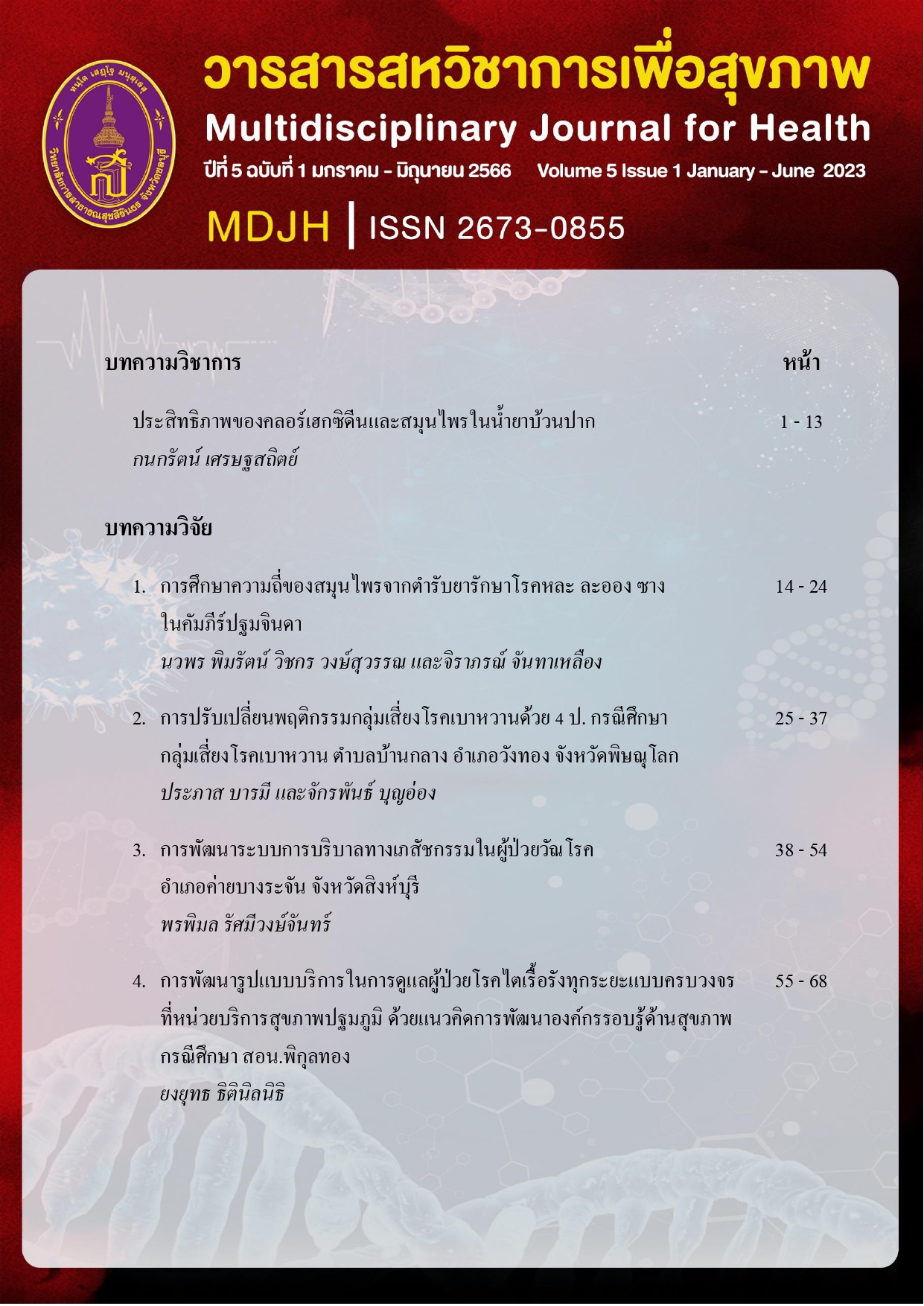
A study of herbal frequencies used in medicine formulations for Lha, La-ong, and Shang treatment based on Khamphi Prathomchinda
Keywords:
Herbal flavors, Child's disease, Khamphi PrathomchindaAbstract
Khamphi Prathomchinda (KP), a scripture of childhood diseases, describes the illnessesof children from newborn to 12 years old including 'Lha La-ong Sang' as well as Thai traditional medicine recipes for treatment. However, there is no articles clearly describing the herbal selection principlefor treatment. Therefore, this study, was aimed to categorize the herbal medicine for 'Lha La-ong Sang' treatment based on the 3rd attachment in chapter 1 and chapter 2 of KP into 4 categories: 1) type of natural ingredients (plants, animals and minerals), 2) herb flavors (the first taste of herb), 3) route ofadministration, and 4) herb and solvent.
It was found that among the 231 medicinal recipes of Lha La-ong Sang treatment can be defined as1) the highest use of natural ingredients were plants (73.23%), animals (14.13%), and minerals (12.63%), respectively; 2) the highest use of herb flavors were bitter flavor (25.09%), astringent flavor (23.06%), and hot flavor (16.42%), respectively; 3) the most frequent route of administration were oral medicine (65.80%), external medicine (25.90%), and topical medicine (25.50%), respectively; and 4) the most common used herbs and solvents were alcohol, Curcuma zedoaria, Sodium tetraborate pentahydrate (purified borax), Ocimum tenuiflorum leaves, and Pogostemon cablin.
Almost all the herbs mentioned in KP exhibit an immunomodulatory, anti-inflammatory, antimicrobial, and antiviral activities which are related to the herbs’properties. In this regard, future research should focus on drug formulations from Thai traditional medicine texts, along with a systematic review of bioactivities.
References
กระทรวงสาธารณสุข. กรมการแพทย์แผนไทยและการแพทย์ทางเลือก. สำนักงานราชบัณฑิตยสภา. พจนานุกรมศัพท์แพทย์และเภสัชกรรมแผนไทย ฉบับราชบัณฑิตสภา พ.ศ. 2559. นนทบุรี: โรงพิมพ์สำนักงานพระพุทธศาสนาแห่งชาติ; 2560.
มูลนิธิฟื้นฟูส่งเสริมการแพทย์ไทยเดิมฯและโรงเรียนอายุรเวทธำรง. ตำราแพทย์ไทยเดิม (แพทย์ศาสตร์สงเคราะห์ ฉบับอนุรักษ์) เล่มที่ 1. พิมพ์ครั้งที่ 2. กรุงเทพฯ: ศุภวนิชการพิมพ์; 2552.
กระทรวงสาธารณสุข. กรมควบคุมโรค. สถานการณ์โรคมือเท้าปากเปื่อย (HFM) [อินเทอร์เน็ต]. [เข้าถึงเมื่อ13 กันยายน 2565]. เข้าถึงได้จาก: https://ddc.moph.go.th/disease_detail.php?d=11.
ชยันต์ พิเชียรสุนทร, แม้นมาส ชวลิต, วิเชียร จีรวงศ์. คำอธิบายตำราโอสถพระนารายณ์. พิมพ์ครั้งที่ 2. กรุงเทพฯ: อมรินทร์และมูลนิธิภูมิปัญญา; 2548.
หอพระสมุดวชิรญาณ. ลัทธิธรรมเนียมต่างๆ ภาคที่ 4 เรื่องวิชาแพทย์ไทย. พิมพ์แจกในงานศพ นายเชย ชยากร. พระนคร: โรงพิมพ์โสภณพิพรรฒธนากร; 2462.
Yan Y, Li X, Zhang C, Lv L, Gao B, Li M. Research progress on antibacterial activities and mechanisms of natural alkaloids: a review. Antibiotics. 2021; 10: 318.
Agyare C, Beko EO, Boakye YD, Dapaah SO, Appiah T, Bekoe SO. Medicinal plants and natural products with demonstrated wound healing properties London. In Tech. 2016; 483-530.
Bugno A, Nicoletti MA, AlmodÓvar AAB, Pereira TC, Auricchio MT. Antimicrobial efficacy of Curcuma zadoaria extract as assessed by linear regression compared with commercial mouth rinses. Brazilian J. Microbiol. 2007; 38: 440-500.
Gharge S, Hiremath SI, Kagawad P, Jivaje K, Palled MS, Suryawanshi SS. Curcuma zedoaria Rosc (Zingiberaceae): a review on its chemical, pharmacological and biological activities. Futur J Pharm Sci. 2021; 7: 166.
Ali H, Dixit S. In vitro antimicrobial activity of flavanoids of Ocimum sanctum with synergistic effect of their combined form. Asian Pac. J. Trop. Dis. 2012: 396-398.
Ullah HM, Zaman S, Juhara F, Akter L, Tareq SM, Masum EH, Bhattacharjee R. Evaluation of antinociceptive, in-vivo & in-vitro anti-inflammatory activity of ethanolic extract of Curcuma zedoaria rhizome. BMC Complement Altern. Med. 2014; 14: 346.
Kumar A, Agarwal K, Maurya AK, Shanker K, Bushra U, Tandon S, Bawankule DU. Pharmacological and phytochemical evaluation of Ocimum sanctum root extracts for its anti-inflammatory, analgesic and antipyretic activities. Pharmacogn. Mag. 2015; 11: 217-24.
Goel A, Singh DK, Kumar S, Bhatia AK. Immunomodulating property of Ocimum sanctum by regulating the IL-2 production and its mRNA expression using rat's splenocytes. Asian Pac. J. Trop. Med. 2010; 3: 8-12.
Ravishankar AG, Mahesh TS. Tankana Bhasma Kavala in Chronic Tonsillitis. Unique J. Ayurvedic Herb. Med. 2013; 1: 41-44.
Bhagat L, Gayathri B, Roga S. A. Comparative clinical study on the efficacy of Palasha Kshara and Tankana in Karnini Yoni Vyapat. Int. J. Ayurveda Res. ISSN: 2347-6362. 2017; 3: 684-692.
Lachenmeier, D. W. Safety evaluation of topical applications of ethanol on the skin and inside the oral cavity. J. Occup. Med. Toxicol. 2008; 3:1: 1-16.
Downloads
Published
Issue
Section
License
Copyright (c) 2023 Multidisciplinary for Health Journal

This work is licensed under a Creative Commons Attribution-NonCommercial-NoDerivatives 4.0 International License.


