
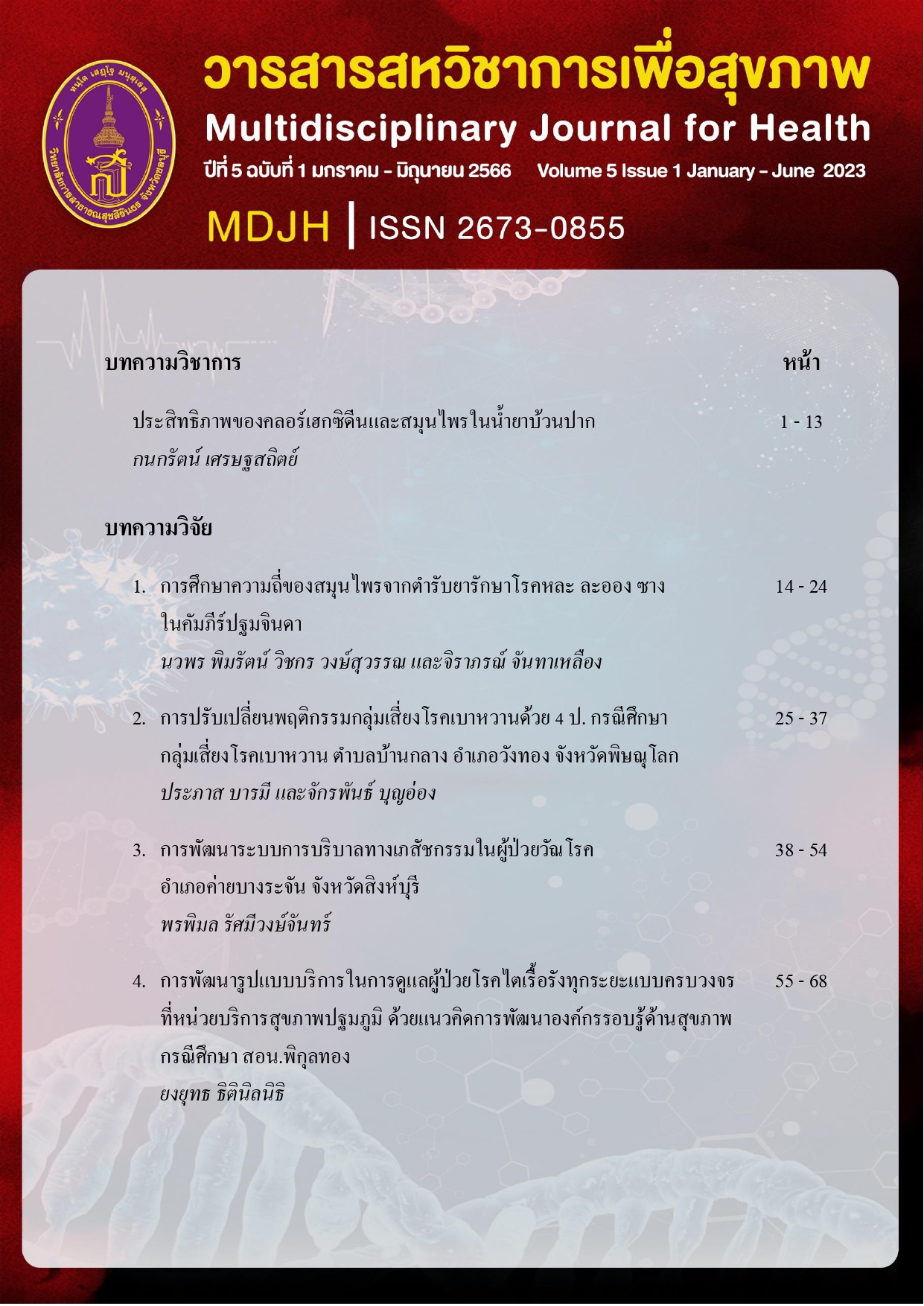
Efficacy of Chlorhexidine and Herbs in Mouthwashes
Keywords:
Mouthwashes, Chlorhexidine, Herb, PlagueAbstract
Mouthwash is one of oral health product that is used by many people. Aim of mouthwashes using is to reduce oral malodor, antibacterial and anti-plague. Mouthwash can becolor or non-color liquid. Active ingredients are the mixture of many substances. Fundamental substances in mouthwashes are chemicals such as chlorhexidine, or herbs such as green tea. Nevertheless, chlorhexidine and herb may cause certain side effects. For example, chlorhexidine can cause stains, swelling of parotid gland, and ulcer whereas herbs can reduce taste, dizziness, and stains on teeth. However, stains from herbal mouthwashes can cause less stains than chlorhexidine mouthwashes, and some herbal mouthwashes do not cause stain.
References
Joiner A. The Cleaning of Teeth. Handbook for cleaning/decontamination of surfaces. (2007).
สุจินมนต์ พรหมประดิษฐ์. ยาสีฟันและน้ำยาบ้วนปากเป็นตัวช่วยป้องกันโรคเหงือกได้จริงหรือไม่. วิทยาสารทันตสาธารณสุข. 2556; 18(1) : 9-18.
American Dental Association. Mouthrinse (Mouthwash). Department of Scientific Information, ADA Science Institute. Accessed on 1 December 2021.
กิตติโชติ วรโชติกำจร. น้ำยาบ้วนปาก. (บทความวิชาการ) ศูนย์การศึกษาต่อเนื่องทางเภสัชศาสตร์. คณะเภสัชศาสตร์ มหาวิทยาลัยสงขลานครินทร์; 2562.
Balsam MS, Sagarin MM. Cosmetic and Technology 1972; 3(1). Wiley-interscience, New York.
Löe H, Schiøtt CR. The effect of mouthrinses and topical application of chlorhexidine on the development of dental plaque and gingivitis in mas. J Preiodontal Res 1970; 5(2).
Rölla G, Melsen B. On the mechanism of the plaque inhibition by chlohexidine. J Dent Res 1975; 54: 57-62.
Gjermo P, Bonesvoll P, Rölla G. Relationship between plaque-innibiting effect and retention of chlorhexidine in the human oral cavity. Arch Oral 1974; 19(11).
Bonesvoll P, Lökken P, Rölla G, Paus PN. Retention of chlorhexidine in the human oral cavity after mouth rines. Arch Oral Biol 1974; 19(3).
Quirynen M, Avontroodt P, Peeters W, Pauwels M, Coucke W, Van Steenberghe D. Effect of different chlorhexidine formulations in mouthrinse on de novo plaque formation. J Clin Periodontol 2001; 28(12): 1127-36.
Cheung HY, Wong MMK, Cheung SH, Liang LY, Lam YW, Chiu SK. Differential actions of chlorhexidine on the cell wall of bacillus subtilis and Escherichia coli. PLoSOne 2012; 7(5): e36659.
James P, Worthington H., Parnell C, Harding M, Lamont T, Cheung A. Chlorhexidine mouthrinse as an adjunctive treatment for gingival health Cochrane Database Syst Rev 2017; 3(3): CD0008676.
Kampf G, Todt D, Pfaender S, Steinmann E. Pesistence of coronaviruses on inanimate surface and their inactivation with biocidal agents. J Hosp Infect 2020; 104(3).
Yoon JG, Yoon J, Song JY, Yoon SY, Lim CS, Seong H. Clinical significance of a highSAR-Cov-2 viral load in the saliva. J Korean Med Sci 2020; 35(20): e125.
Chin AWH, Chu JTS, Perera MRA, Hui KPY, Yen HL, Chan MCW. Stability of SARA-CoV-2 in different environmental conditions. Lancet Microbe 2020;1(1): e10.
Carey MC, Yagudayev A, Fon K. Effect of Temperature on Tooth Staining by 0.12% Chlorhexidine Gluconate. Front Dent Med 2021; 2: 1-11.
Weijden GA, Ten HJM, Slot DE, Rosema NA, Van der velden U. Parotid gland swelling following mouthrinse use. Int J Dent Hyg 2010;8(4): 276-279.
Plantinga NL, Wittekamp BHJ, Leleu K, Depydt P, Van den Abeele AM, Brun-Buisson C. Oral mucosal adverse events with chlohexidine 2% mouthwash in ICU. Intensive CareMed 2016; 42(4).
Fernandes M, Lourenco T, Lopes A, Spinola SA, Pereira SMC, Pereira BM. Chlorhexidine: a hidden life-threatening allergen. Asia Pac Allergy 2019;9(4): e29.
Nagasri M, Madhulatha M, Musalaiah AVVS, Kumar PA, Krishna CHM, Kumar PM. Efficacy of curcumin as as adjunct to scaling and root planning in chronic periodontitis patients: Aclinical and microbiological study. Journal of Pharmacy &Bioallied Sciences 2015; 7; S554-S558.
Sarin S, Marya C, Nagpal R, Oberoi SS, Rekhi A. Preliminary Clinical Evidence of the Antiplaque, Antigingivitis Efficacy of a Mouthwash Containing 2% Green Tea – A Randomised Clinical Trial. Oral Health Prev Dent 2015; 13(3): 197-203.
สุวิมล ทวีชัยศุภพงษ์, โสพิศ วงศ์คำ, อาริยา รัตนทองคำ, สุภาภรณ์ สิงหรา, เทียมหทัย ชูพันธ์, สำราญ สุภาษี. ผลของการใช้น้ำยาบ้วนปากผสมสารสกัดจากใบข่อยต่อการอักเสบของเหงือกและการเกิดคราบจุลินทรีย์. วารสารทันตะ 2545; 52(6): 383-391.
วันทนี สว่างอารมณ์, พาฝัน จันทร์เล็ก. การเปรียบเทียบผลของสารสกัดจากสมุนไพรต่อการยับยั้งเชื้อแบคทีเรีย Staphylococcus aureus และ Escherichia coli. วารสารก้าวทันโลกวิทยาศาสตร์ 2555; 12(2):1-11.
Radafshar G, Ghotbizadeh M, Saadat F,Mirfarhad N. Effects of green tea (Camellia sinensis) mouthwash containing 1% tannin on dental plaque and chronic gingivitis: a double-blinded, randomized, controlled trial. J. Oral Maxillaofac Surg 2014:43:1394-1398.
Shahakbari R, Eshghpour M, Rajeal A, Rezaei NM, Golfakhrabadi P, Nejat A. Effectiveness of green tea mouthwash in comparison to chlorhexidine mouthwash in patients with acute pericoronitis: a randomized clinical trial. J. Oral Maxillofac. Surg. 2014; 43:1394-1398.
Ratika S, Mamata H, Anil V, Ankola VM, Sindhu, JS. Effect of Two Herbal Mouthwashes on Gingival Health of School Children. Journal of Traditional and Complementary Medicine 2014, 4(4): 272-278.
ธีระ ผิวเงิน, วัลลภ จันทร์สว่าง. การลดการติดคราบจุลินทรีย์ของน้ำยาบ้วนปากใบฝรั่งในผู้ป่วยเบาหวาน. วารสารเภสัชศาสตร์อีสาน 2562; 15(3): 95-103.
Downloads
Published
Issue
Section
License
Copyright (c) 2023 Multidisciplinary for Health Journal

This work is licensed under a Creative Commons Attribution-NonCommercial-NoDerivatives 4.0 International License.


