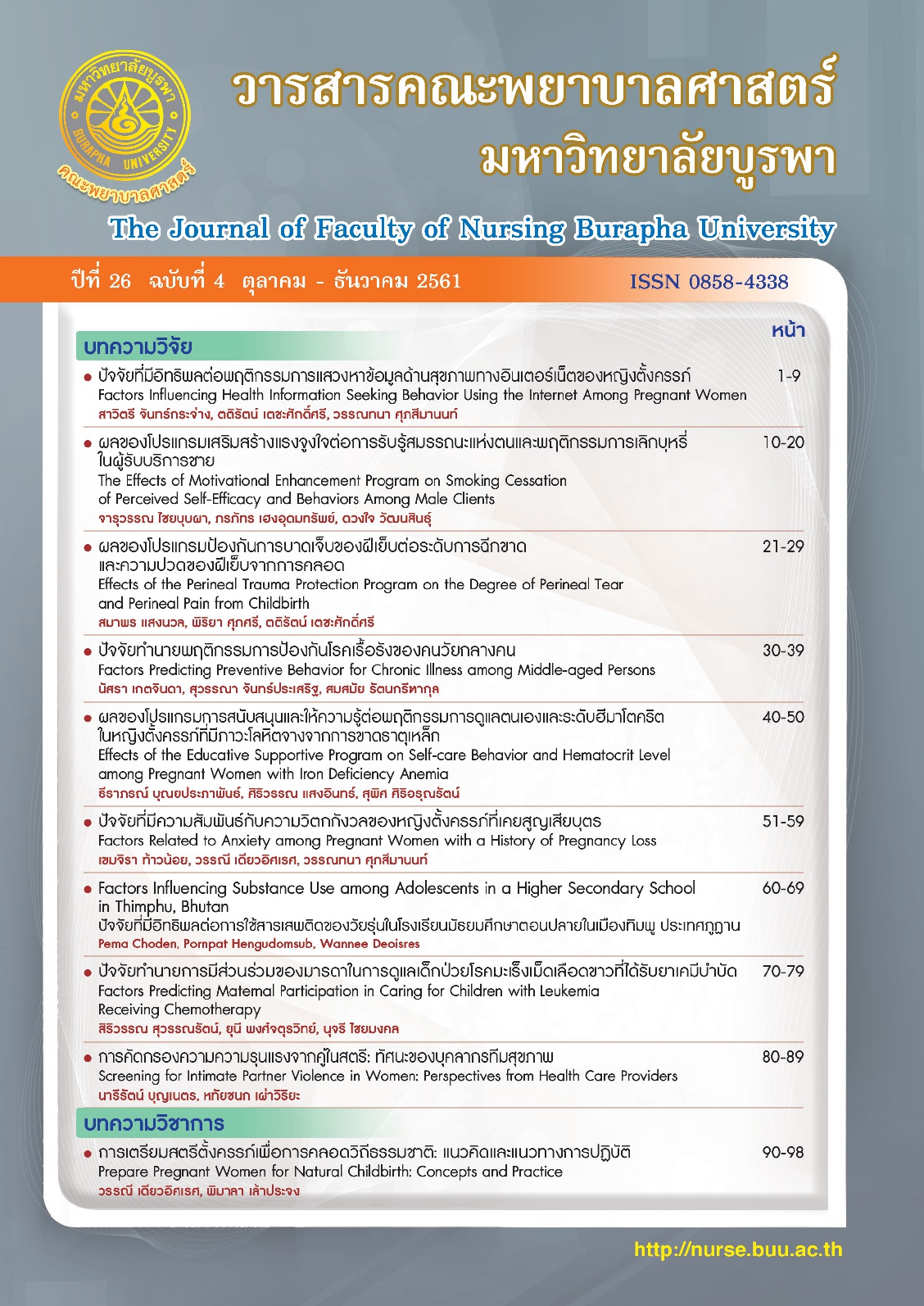
การคัดกรองความความรุนแรงจากคู่ในสตรี: ทัศนะของบุคลากรทีมสุขภาพ
คำสำคัญ:
การคัดกรอง, ความรุนแรงจากคู่, สตรี, บุคลากรทีมสุขภาพ, วิจัยเชิงคุณภาพบทคัดย่อ
บทคัดย่อ
การวิจัยนี้มีวัตถุประสงค์เพื่อบรรยายการคัดกรองความรุนแรงจากคู่ในสตรีจากมุมมองของบุคลากรทีมสุขภาพ รูปแบบการวิจัยเชิงคุณภาพแบบพรรณณา คัดเลือกผู้เข้าร่วมวิจัยแบบเฉพาะเจาะจงตามคุณสมบัติที่กำหนด คือ มีความเชี่ยวชาญและ/หรือมีประสบการณ์ในการคัดกรองความรุนแรงจากคู่ในสตรี อย่างน้อย 5 ปี จำนวน 10 ราย ในโรงพยาบาลที่มีบริการ “ศูนย์พึ่งได้” ในการช่วยเหลือสตรีที่ถูกกระทำความรุนแรง จากคู่ เก็บรวบรวมข้อมูลโดยการสัมภาษณ์เชิงลึก วิเคราะห์ข้อมูลโดยการวิเคราะห์เนื้อหา ผลการวิจัยพบว่า การคัดกรองความความรุนแรงจากคู่ในสตรีในมุมมองของบุคลากรทีมสุขภาพ สรุปได้เป็น 3 ประเด็นหลัก ประกอบด้วย 1) การคัดกรองไม่ครอบคลุม 2) ขัดต่อความเชื่อ และ 3) ไม่พร้อมเปิดเผยข้อมูลความรุนแรง จากคู่ จากผลการศึกษามีข้อเสนอแนะว่า บุคลากรทีมสุขภาพทุกคนควรได้รับการอบรมและพัฒนาทักษะ การคัดกรองความรุนแรงจากคู่ในสตรี เพื่อให้สามารถนำไปใช้ประโยชน์ในการปฏิบัติงาน และขจัดหรือลดอุปสรรคในการคัดกรอง นำไปสู่การให้การช่วยเหลือสตรีที่ถูกกระทำความรุนแรงจากคู่ได้อย่างเหมาะสมและทันท่วงที
เอกสารอ้างอิง
Al-Natour, A., Gillespie, G. L., Felblinger, D., & Wang, L. L. (2014). Jordanian nurses’ barriers to screening for intimate partner violence. Violence Against Women, 20(12), 1473-1488.
Al-Natour, A., Qandil, A., & Gillespie, G. L. (2016). Nurses' roles in screening for intimate partner violence: A phenomenological study. International Nursing Review, 63(3), 422-428.
Boonnate, N., & Phaowiriya, H. (2018). Prevention intimate partner violence against women. The Journal of Faculty of Nursing, Burapha University, 26(3), 102-111.
Chepuka, L., Taegtmeyer, M., Chorwe-Sungani, G., Mambulasa, J., Chirwa, E., & Tolhurst, R. (2014). Perceptions of the mental health impact of intimate partner violence and health service responses in Malawi. Global Health Action, 7, 10.3402/gha.v7.24816. http://doi.org/10.3402/gha.v7.24816
Colarossi, L., Breitbart, V., & Betancourt, G. (2010). Barriers to screening for intimate partner violence: A mixed-methods study of providers in family planning clinics. Perspectives on Sexual & Reproductive Health, 42(4), 236-243.
DeBoer, M., Bsn, R. N., Kothari, R., Kothari, C., Koestner, A., Msn, R. N., & Rohs, T. (2013). What are barriers to nurses screening for intimate partner violence? Journal of Trauma Nursing, 20(3), 155-160.
Department of Women’s Affairs and Family Development. (2016). An annual report displaying the number of domestic violence cases for section 17 of Victims of Domestic Violence Protection Act B.E. 2550. Retrieved from http://www.violence.in.th/publicweb/pdf/M17/M172559.pdf. [In Thai]
Devries, K. M., Mak, J. Y., Bacchus, L. J., Child, J. C., Falder, G., Petzold, M., Astbury, J., Watts, C. H. (2013). Intimate partner violence and incident depressive symptoms and suicide attempts: A systematic review of longitudinal studies. PLoS Medicine, 10(5), e1001439. http://doi.org/10.1371/journal.pmed.1001439
Hogarth, K. M., Beattie, J., & Morphet, J. (2016). Nurses’ attitudes towards the reporting of violence in the emergency department. Australasian Emergency Nursing Journal, 19(2), 75-81.
Kiely, M., El-Mohandes, A. A. E., El-Khorazaty, M. N., & Gantz, M. G. (2010). An integrated intervention to reduce intimate partner violence in pregnancy: A randomized controlled trial. Obstetrics & Gynecology, 115(2), 273-283.
Oweis, A., Gharaibeh, M., Al-Natour, A., & Froelicher, E. (2008). Violence against women: Unveiling the suffering of women with a low income in Jordan. Journal of Transcultural Nursing, 20(1), 69-76.
Ravitch, S. M., & Carl, N. M. (2016). Qualitative research: Bridging the conceptual, theoretical, and methodological. Thousand Oaks, CA: Sage Publications.
Sawangchareon, K., Wattananukulkiat, S., Phalasri, A., Nanakorn, S., Doasodsai, S., Takemoto, H., & Ross, R. (2013). Develop nurses’ competency on screening and helping women who had experienced intimate partner violence (IPV). Journal of Nursing Science & Health, 36(3), 95-105. [In Thai]
Stöckl, H., Devries, K., Rotstein, A., Abrahams, N., Campbell, J., Watts, C., & Moreno, C. G. (2013). The global prevalence of intimate partner homicide: A systematic review. The Lancet, 382(9895), 859-865. doi:https://doi.org/10.1016/S0140-6736(13)61030-2
Vranda, M. N., Kumar, C. N., Muralidhar, D., Janardhana, N., & Sivakumar, P. T. (2018). Barriers to disclosure of intimate partner violence among female patients availing services at tertiary care psychiatric hospitals: A Qualitative Study. Journal of Neurosciences in Rural Practice, 9(3), 326-330. doi:10.4103/jnrp.jnrp_14_18
Waalen, J., Goodwin, M. M., Spitz, A. M., Petersen, R., & Saltzman, L. E. (2000). Screening for intimate partner violence by health care providers: Barriers and interventions. American Journal of Preventive Medicine, 19(4), 230-237.
World Health Organization. (2013). Global and regional estimates of violence against women: prevalence and health effects of intimate partner violence and non-partner sexual violence. Retrieved from http://apps.who.int/iris/bitstream/handle/ 10665/ 85239/9789241564625_eng.pdf;jsessionid=421523F5954DAE5ADECFA32CEE1E3947?sequence=1
Zhang Y, & Wildemuth B. M. (2009). Qualitative Analysis of Content. In: B. M. Wildemuth, Ed., Applications of social research methods to questions in information and library science, libraries (pp. 308–319). Santa Barbara, CA: Greenwood.