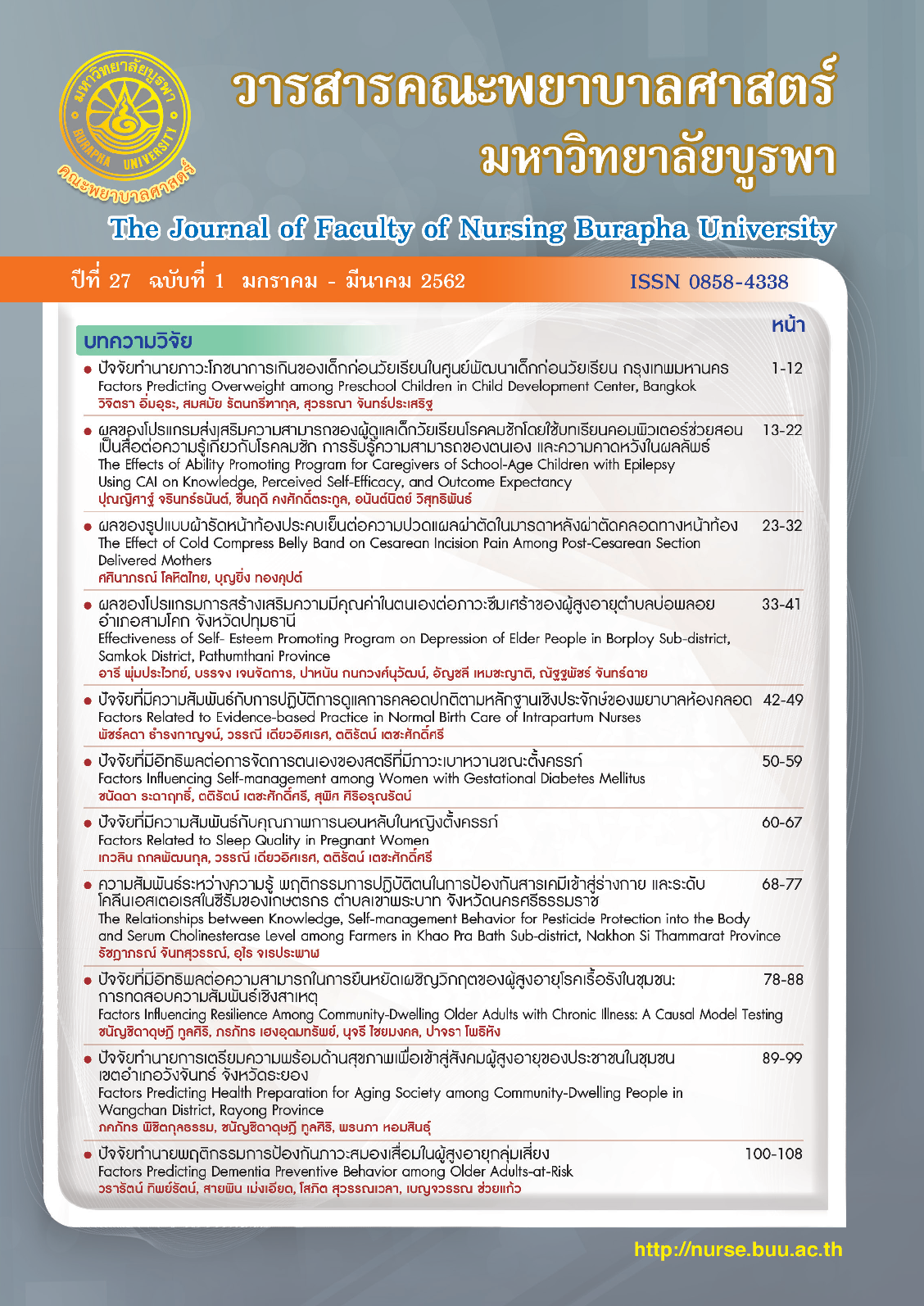
Factors Related to Sleep Quality in Pregnant Women
Keywords:
sleep quality, pregnant women, physical discomfortAbstract
Abstract
The objective of this correlational research was to examine the relationships between maternal age, gestational age, severity of physical discomfort, and the quality of sleep in pregnant women. A simple random sampling was used to recruit a sample of 132 women with normal and in the second and third trimesters of their pregnancy, who received antenatal care at Chaophraya Abhaibhubejhr hospital, Prachinburi province. Data were carried out from February to April 2018. Research instruments included a demographic questionnaire, the severity of physical discomfort during pregnancy questionnaire, and the Pittsburgh Sleep Quality Index (Thai version). Their reliabilities were .85 and .81, respectively. Data were analyzed by using descriptive statistics and Pearson's correlation coefficients.
The results revealed that 94.7% of the total sample had poor sleep quality. Severity of physical discomfort was significantly related to sleep quality (r = .533, p <.01). However, maternal age and gestational age were found no relationship with the sleep quality. These findings suggest that nurses involving in antenatal care should assess and provide a nursing intervention to relief severity of physical discomfort in order to enhance sleep quality in pregnant women especially during their second and third trimesters.
References
Jirapramukpitak, T., & Tanchaiswad, W. (1994). Sleep disturbances among nurses of
Songklanagarind Hospital. Journal of the Psychiatrist Association of Thailand, 42(3), 122-131. [In Thai]
Angelone, A. M., Mattei, A., Sbarbati, M., & Di Orio, F. (2011). Prevalence and correlates for
self-reported sleep problems among nursing students. Journal of Preventive Medicine and Hygiene, 52(4), 201-208.
Buysse, D. J., Reynolds III, C. F., Monk, T. H., Berman, S. R., & Kupfer, D. J. (1989). The Pittsburgh Sleep Quality Index: A new instrument for psychiatric practice and
research. Psychiatry Research, 28(2), 193-213.
Costa, V. M., Viana, M. B., & Aguiar, R. A. (2015). Pregnancy in patients with sickle cell disease: Menteral and perinatal outcomes. The Journal of Maternal-Fetal &
Neonatal Medicine, 28(6), 685-689.
Darvill, R., Skirton, H., & Farrand, P. (2010). Psychological factors that impact on women's experiences of first-time motherhood: A qualitative study of the transition.
Midwifery, 26(3), 357-366.
Gerber, M., Brand, S., Holsboer-Trachsler, E., & Puhse, U. (2009). Fitness and exercise as
correlates of sleep complaints: Is it all in our minds? Official Journal of the American College of Sports Medicine, 42(5), 893-901.
Kamysheva, B. A., Wertheim, E. H., Skouteris, H., Paxton, S. J., & Milgrom, J. (2009). Frequency,
severity, and effect on life of physical symptoms experienced during pregnancy. Journal of Midwifery Women’s Health, 54, 43-49.
Kamysheva, E., Skouteris, H., Eleanor, H. W., Susan J. P., & Jeannette, M. (2010). A prospective
investigation of the relationships among sleep quality, physical symptoms, and depressive symptoms during pregnancy. Journal of Affective Disorders, 123(1-3), 317-320.
Krejcie, R. V., & Morgan, D. W. (1970). Determining sample size for research activities.
Educational and Psychological Measurement, 30(3), 607-610.
Hedman, C. M., Pohjasvaara, T., Tolonen, U., Suhonen-Malm, A. S., & Myllylä, V. V. (2002). Effect of pregnancy on mother’s sleep. Sleep Medicine, 3(1), 37-42.
Ko, S. H., Chang, S. C., & Chen, C. H. (2010). A comparative study of sleep quality between
pregnant and non-pregnant Taiwanese women. Journal of Nursing Scholarship,
42(1), 23-30.
Murray, S. S., McKinney, E. S., & Murray, S. S. (2010). Foundations of maternal-newborn
and women's health nursing. Maryland Heights, MO: Saunders Elsevier.
Okun, M. L., Luther, J. Prather, A. A., Perel, J. M., Wisniewski, S., & Wisner, K. L. (2011). Changes in sleep quality, but not hormones predict time to postpartum depression
Wallace, A. M., Boyer, D. B., Dan, A., & Holm, K. (1986). Aerobic exercise, maternal
self-esteem, and physical discomfort during pregnancy. Journal of Nurse-
Midwifery, 31(6), 255-262.
World Health Organization. (2012). Early marriages, adolescent and young pregnant
2012. Retrieved from http://www.who,int/gb/ebwha/pdf_files/.../A65_13-en.pdf