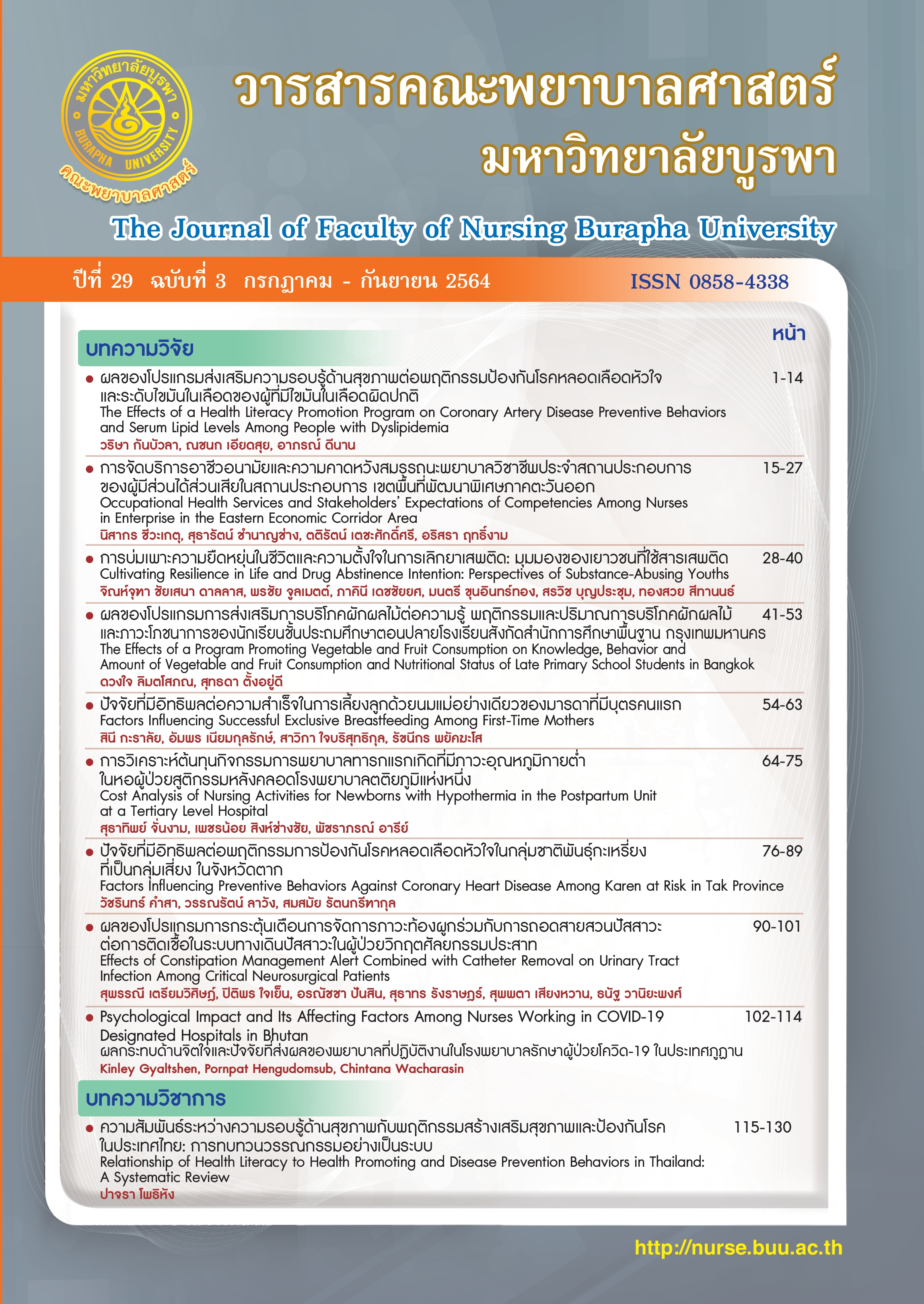
Psychological Impact and Its Affecting Factors Among Nurses Working in COVID-19 Designated Hospitals in Bhutan
Keywords:
Nurses, COVID-19, religiosity, workload perception, psychological impactAbstract
The purpose of this study was to examine psychological impact and its affecting factors among the nurses working at COVID-19 designated hospitals in Bhutan. A predictive correlational design was used. The sample consisted of 133 nurses providing care for patients with COVID-19 in these hospitals using the simple random sampling technique. Self-reported questionnaires were used to collect data regarding nurses’ demographic information, knowledge about Covid-19, fear of Covid-19, religiosity, workload perception, perceived organizational support and psychological impact. Data were analyzed using the descriptive statistics and standard multiple regression.
The results showed that this sample had a mean psychological impact score of 20.49 (SD = 6.07), and classified in a moderate level. Fear of COVID-19, religiosity, workload perception and perceived organizational support accounted for 15.3% of the variance in psychological impact. Only workload perception has significant effect on psychological impact (β = .28, p < .05). The study results will help to generate baseline data on the psychological impact occurred among these nurses. It can also be used to develop interventions to mitigate this psychological impact and support the work of nurses during such pandemics.
References
M. D., & Pakpour, A. H. (2020). The fear of
COVID-19 scale: Development and initial
validation. International Journal of Mental
Health and Addiction, 1-9. doi: 10.1007/
s11469-020-00270-8
Braquehais, M. D., Vargas-Cáceres, S., Gómez-Durán,
E., Nieva, G., Valero, S., Casas, M., & Bruguera,
E. (2020). The impact of the COVID-19
pandemic on the mental health of
healthcare professionals. An International
Journal of medicine, 113(9), 613-617.
Cortés-Álvarez, N. Y., Piñeiro-Lamas, R., &
Vuelvas-Olmos, C. R. (2020). Psychological
effects and associated factors of COVID-19
in a Mexican sample. Disaster Medicine and
Public Health Preparedness, 14(3), 413-424.
Fradelos, E. C., Alikari, V., Vus, V., Papathanasiou,
I. V., Tsaras, K., Tzavella, F., & Lekka, D.
(2020). Assessment of the relation between
religiosity, anxiety, depression and
psychological resilience in nursing staff.
Health Psychology Research, 8(1), 30-34.
Fradelos, E. C., Papathanasiou, I. V., Kourakos, M.,
Zyga, S., Tzavella, F., & Tsaras, K. (2017).
Religiosity in nursing: The translation,
validation and cultural adoption of the
centrality of religiosity scale-10 in Greek
language. Likars’ka sprava, 468(7), 180-187.
Galehdar, N., Kamran, A., Toulabi, T., & Heydari, H.
(2020). Exploring nurses’ experiences of
psychological distress during care of
patients with COVID-19: A qualitative study.
BMC Psychiatry, 20(1), 1-9. doi:10.1186/
s12888-020-02898-1
Greenglass, E. R., Burke, R. J., & Fiksenbaum, L.
(2001). Workload and burnout in nurses.
Journal of Community & Applied Social
Psychology, 11(3), 211-215.
Hong, S., Ai, M., Xu, X., Wang, W., Chen, J., Zhang,
Q., . . . Kuang, L. (2021). Immediate
psychological impact on nurses working
at 42 government-designated hospitals
during COVID-19 outbreak in China: A
cross-sectional study. Nursing Outlook,
69(1), 6-12.
Huber, S., & Huber, O. (2012). The centrality of
religiosity scale (CRS). Religions, 3, 710-724.
Labrague, L. J., & de Los Santos, J. A. A. (2020).
Fear of Covid-19, psychological distress,
work satisfaction and turnover intention
among frontline nurses. Journal of Nursing
Management, 29(3), 395-403.
Labrague, L. J., McEnroe Petitte, D. M., Leocadio,
M. C., Van Bogaert, P., & Tsaras, K. (2018).
Perceptions of organizational support and
its impact on nurses’ job outcomes. In
Nursing Forum, 53(3), 339-347.
Lazarus, R. S., & Flokman, S. (1984). Stress
appraisal, and coping. New York: Springer.
Lee, M. C., Thampi, S., Chan, H. P., Khoo, D., Chin,
B. Z., Foo, D. P., . . . Jacob, R. (2020).
Psychological distress during the COVID-19
pandemic amongst anaesthesiologists
and nurses. British Journal of Anaesthesia,
125(4), e384-e386.
Lucchini, A., Iozzo, P., & Bambi, S. (2020). Nursing
workload in the COVID-19 era. Intensive &
Critical Care Nursing, 61, 102929. doi:
10.1016/j.iccn.2020.102929
Ministry of Health, R. G. O. B. (2021). National
situational update on COVID-19. Retrieved
from http://43.230.208.13/
Miranda, F. B. G., Yamamura, M., Pereira, S. S.,
Pereira, C. D. S., Protti-Zanatta, S. T., Costa,
M. K., & Zerbetto, S. R.(2021). Psychological
distress among nursing professionals during
the COVID-19 pandemic: Scoping review.
Escola Anna Nery, 24(2), 115-122.
Norbu, P. (2010). Nurse staffing workload,
supervisory social support and job
satisfaction of nursing staffs in Bhutan.
Master’s thesis, Nursing, Faculty of Nursing,
Burapha University.
Park, J.S., Lee, E.H., Park, N.R., & Choi, Y. H. (2018).
Mental health of nurses working at a
government-designated hospital during a
MERS-CoV outbreak: A cross-sectional
study. Archives of Psychiatric Nursing, 32(1),
2-6.
Pereira, A., Oliveira, C. A., Bártolo, A., Monteiro, S.,
Vagos, P., & Jardim, J. (2019). Reliability
and factor structure of the 10-item Kessler
psychological distress scale (K10) among
Portuguese adults. Ciencia & Saude
Coletiva, 24(3), 729-736.
Prazeres, F., Passos, L., Simões, J. A., Simões, P.,
Martins, C., & Teixeira, A. (2021). COVID-19-
Related fear and anxiety: Spiritual-religious
coping in healthcare workers in Portugal.
International Journal of Environmental
Research and Public Health, 18(1), 220-231.
Said, R. M., & El-Shafei, D. A. (2021). Occupational
stress, job satisfaction, and intent to leave:
Nurses working on front lines during
COVID-19 pandemic in Zagazig City, Egypt.
Environmental Science and Pollution
Research, 28(7), 8791-8801. doi:10.1007/
s11356-020-11235-8
Shang, Y., Pan, C., Yang, X., Zhong, M., Shang, X.,
Wu, Z., & Zheng, X. (2020). Management of
critically ill patients with COVID-19 in ICU:
Statement from front-line intensive care
experts in Wuhan, China. Annals of
intensive care, 10(1), 1-24.
Shen, X., Zou, X., Zhong, X., Yan, J., & Li, L. (2020).
Psychological stress of ICU nurses in the
time of COVID-19. Critical Care, 24(1), 1-3.
Shi, Y., Wang, J., Yang, Y., Wang, Z., Wang, G.,
Hashimoto, K., & Liu, H. (2020). Knowledge
and attitudes of medical staff in Chinese
psychiatric hospitals regarding COVID-19.
Brain, Behavior, & Immunity-Health, 4,
100064. doi: 10.1016/j.bbih.2020.100064.
Spector, P. E., & Jex, S. M. (1998). Development
of four self-report measures of job stressors
and strain: Interpersonal conflict at work
scale, organizational constraints scale,
quantitative workload inventory, and
physical symptoms inventory. Journal of
Occupational Health Psychology, 3(4),
356-367.
Wu, Y., Wang, J., Liu, J., Zheng, J., Liu, K., Baggs,
J. G., & You, L. (2020). The impact of work
environment on workplace violence,
burnout and work attitudes for hospital
nurses: A structural equation modeling
analysis. Journal of Nursing Management,
28(3), 495-503.
Yildirim, M., & Solmaz, F. (2020). COVID-19 burnout,
COVID-19 stress and resilience: Initial
psychometric properties of COVID-19
burnout scale. Death Studies, 1-9. doi.org
/10.1080/07481187.2020.1818885
Zerbini, G., Ebigbo, A., Reicherts, P., Kunz, M., &
Messman, H. (2020). Psychosocial burden
of healthcare professionals in times of
COVID-19-A survey conducted at the
University Hospital Augsburg. GMS German
Medical Science, 18, 1-9. doi: 10.3205/000281
Zhong, B.L., Luo, W., Li, H.M., Zhang, Q.Q., Liu, X.G.,
Li, W.T., & Li, Y. (2020). Knowledge, attitudes,
and practices towards COVID-19 among
Chinese residents during the rapid rise
period of the COVID-19 outbreak: A quick
online cross-sectional survey. International
journal of biological sciences, 16(10),
1745-1752.