System and Mechanisms for Aging Society at Sub-district Level
Keywords:
Aging society, systems, and mechanisms for an aging society, communityAbstract
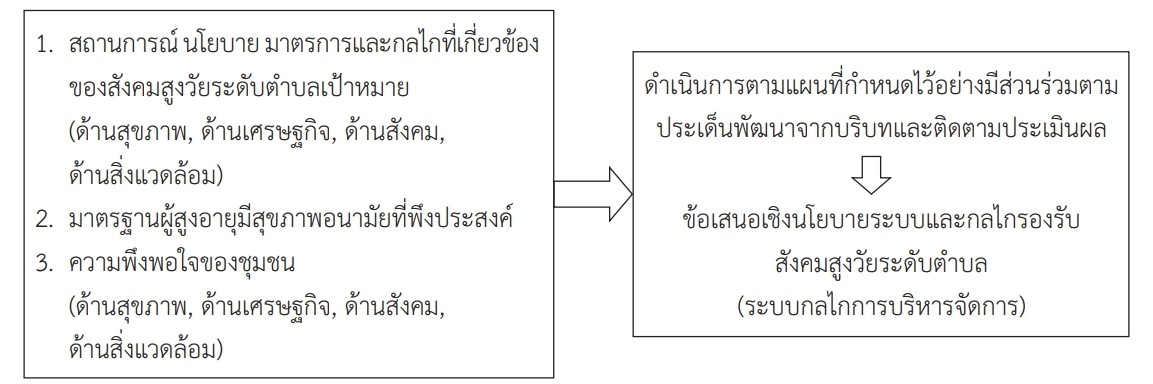
This participatory research aimed to study population needs regarding systems and mechanisms to support an aging society and to formulate a policy proposal to support the aged society at the sub-district level in 5 districts of Nakhon Sawan province. The research process had four steps: 1) Build relationships, survey communities, and select change leaders at the areas’ local and intermediate levels; 2) Study the needs and satisfaction of the elderly and stakeholders at the sub-district level (which included 523 participants); 3) Develop a draft system and mechanism to support an aging society at the sub-district level through a learning exchange platform, and; 4) Drive policies into action with the participation of stakeholders and conduct a follow-up evaluation.
The results showed that the needs of the elderly and the community leaders working with the elderly could be classified along four dimensions: 1) health dimension: health care knowledge and disease prevention, surveying and caring for the elderly in need, a peer-to-peer visitation system, proactive service arrangements, and a long-term care system for patients (especially transportation) to get treatment; 2) economic dimension: organizing a savings system, community welfare and funeral services, creating jobs to increase income and sustain the wisdom of the elderly; 3) social dimension: building strength and warmth within the family, promoting values regarding friendship and continued merit-making, creating a culture of collaboration between the local government and the people's sector, respecting each other, promoting and inheriting wisdom and community security; 4) environmental dimension: home improvements suitable for the elderly, public areas for elderly, and building a green and clean community. Two systems and mechanisms emerged to support an aging society. The first was creating a system and mechanism to support an aging society at the sub-district level and at the provincial level, and to promote the exchange of knowledge between areas. The second was to promote an appropriate work system to support an aging society. This included 23 management systems and processes with six components: 1) restructuring group management; 2) aligning the work system with community context; 3) creating an atmosphere of freedom in communication; 4) developing new knowledge and skills for driving the group; 5) building teamwork at the group level, and; 6) providing incentives for work.
References
Nakhon Sawan Provincial Health Assembly Committee. (2015). Main document/ resolution of public policy development project for participatory health Nakhon Sawan province, Nakhon Sawan: Iprint Shop.
National Board of Elders Ministry of Social Development and Human Security. (2009). National plan for the elderly, vol. 2 (2002 - 2021), Revised edition, No. 1. Bangkok: The Agricultural Cooperative Association of Thailand Printing House. [In Thai]
National Reform Council. (2015). Reform agenda No. 30, system reform to support aging society, page 2. Bangkok: Secretariat of the House of Representatives. [In Thai].
Office of the National Health Commission. (2019). Annual report 2018. Nonthaburi: Office of the National Health Commission.
Puraya, A., Piyakong, D., Wongwiggan, S., & Boonpracom, R. (2021). Exploring the elderly care system: A view from community in Thailand. Jurnal Ners, 16(1), 1-7.
World Health Organization [WHO]. (2002). Active ageing: A policy framework. Geneva: WHO Press.
Downloads
Published
How to Cite
Issue
Section
License

This work is licensed under a Creative Commons Attribution-NonCommercial-NoDerivatives 4.0 International License.