The Effectiveness of Organizing Health Education Activities Based on Self-Efficacy Theory on Electronic Cigarette Smoking Prevention Behaviors of Upper Secondary School Students in Nonthaburi Province
Keywords:
Electronic cigarettes, smoking prevention behaviors, Self-efficacy Development, grade 10 studentsAbstract
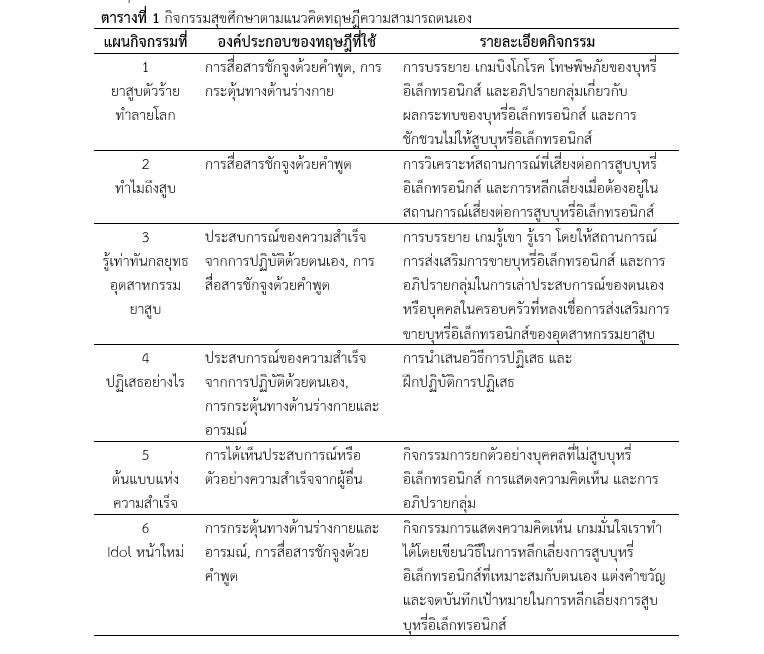
The purpose of this quasi-experimental research was to examine the effectiveness of health education activities based on self-efficacy theory on electronic cigarette smoking prevention behaviors of upper secondary school students in Nonthaburi province. Participants were 62 students in grade 10 in the first semester of academic year 2021. The subjects were equally divided into experimental and comparison groups. The research instruments were: 1) Six health education activity plans regarding electronic cigarette smoking prevention, based on self-efficacy theory, including lecture, recreation games, small-group discussion, practice for politely refusing, making slogans, and 6 weeks of 50-minute journaling weekly, and; 2) Questionnaires including knowledge, attitude, perceived self-efficacy, outcome expectation, and practice for prevention of electronic cigarette smoking. The data were analyzed using frequencies, percentages, means, standard deviations, and t-tests.
The results revealed that after the health education activities, experimental group mean scores in the areas of knowledge, attitude, perceived self-efficacy, outcome expectation and practice for prevention of electronic cigarette smoking were significantly higher than both the pre-experiment scores and the comparison group scores (p < .001). The results could benefit upper secondary school students, as well as educational and healthcare personnel who apply these health education activities for prevention of electronic cigarette smoking.
References
Academic Development Group, Bureau of tobacco Control. (2018). Situation of Tobacco consumption among Thailand students age 15-18 years old, 2018. Nonthaburi: Bureau of Tobacco Control. [in Thai]
Action on Smoking and Health Foundation, Thailand. (2017). Harmfulness of electronic cigarettes to children and Young adults; Questions everyone wants to know (2nd ed.). Bangkok: Action on Smoking and Health Foundation, Thailand. [in Thai]
Badura, A. (1997). Self-efficacy: Toward A unifying throry of behavior change. Poychological Revilns, 84(2), 191-215.
Bureau of Tobacco Control. (2016). Global youth tobacco survey: Thailand, 2015. Bangkok: Zenith Group. [in Thai]
Center for Disease Control and Prevention. (2017). Health effects of cigarette smoking. Retrieved from https://www.cdc.gov/tobacco/data_statistics/fact_sheets/health_ effects/effects_cig_smoking/index.htm
Dhippayom, T., & Nimpitakpong, P. (2014). Electronic cigarettes. Journal of Public Health, 44(3), 313-328. [in Thai]
Khongphat, A., & Tantirattanawong, K. (2015). The Effect of self-efficacy reinforce program for smoking prevention of Junior high school education at Koh sri bo ya education centre, Nua Klong district, Krabi provinc. Community Health Development Quarterly Khon Kaen University, 3(3), 409-426. [in Thai]
khorkull, S. (2021). Effectiveness of adolescent male smoking prevention program in educational institutions. Journal of Pacific Institute of Management Science Humanities and Social Sciences, 7(3), 161-173. [in Thai]
Lapyai, S. (2019). New tobacco products on social media and law enforcement on new tobacco products control. Public Health & Health Laws Journal, 5(1), 13-29. [in Thai]
Mahasuan, S., Homsin, P., & Srisuriyawet, R. (2018). Factors related to smoking initiation among female vocational students in Chachoengsao province. Journal of Public Health Nursing, 32(1), 30-44. [in Thai]
Ministry of Education Thailand. (2008). The basic education core curriculum B.E. 2551. Bangkok: The Printing House of the Agricultural Co-operative Federation of Thailand. [in Thai]
Office of Disease Control 3, Nakhon Sawan Province. (2019). The effectiveness of aself-efficacy promoting program on smoking prevention behavior of secondary school students, Uthai Thani Province. Nakhon Sawan: Company The Best Press and Creation Co., Ltd. [in Thai]
Office of Tobacco Products Control Committee, Department of disease control. (2019) Department of Disease Control warns against using electronic cigarettes, increasing risk of deadly pneumonia. Retrieved from https://ddc.moph.go.th/th/site/newsview/view/9475
Pasiphol, S. (2016). Educational measuring and assessments. Bangkok: Chulalongkorn University. [in Thai]
Patanavanich, R. (2019). Situation report on cigarette usage on provincial scope B.E. 2544- 2560. Bangkok: Mahidol University. [in Thai]
Polit, D. F., & Hunger, B. P. (1995). Nursing research: Principles and methods. Philadelphia: Lippincott.
Suvamat, J., & Thiammok, M. (2018). The review of activities on smoking prenvention for adolescents. Journal of Boromarajonani College of Nursing, Bangkok, 34(1), 141-149 [in Thai]
Tobacco Control Research and Knowledge Management Center, Mahidol University. (2018). Statistic report on tobacco consumption in Thailand B.E. 2561. Bangkok: Jaroendee Mun-kong Karn-pim Printing House. [in Thai]
Usaha, J., Gunvihok, T., Julasereekul, S., & Haruhanpong, V. (2015). Meta synthesis of preventive factors for cigarette smoking among Thai youths, Disease Control Journal, 41(4), 271-284. [in Thai]
Downloads
Published
How to Cite
Issue
Section
License

This work is licensed under a Creative Commons Attribution-NonCommercial-NoDerivatives 4.0 International License.