Effects of the empowerment program with Line application on health behaviors and recurrent preterm labor among women having preterm labor
Keywords:
Recurrent preterm labor, empowerment program, Line applicationAbstract
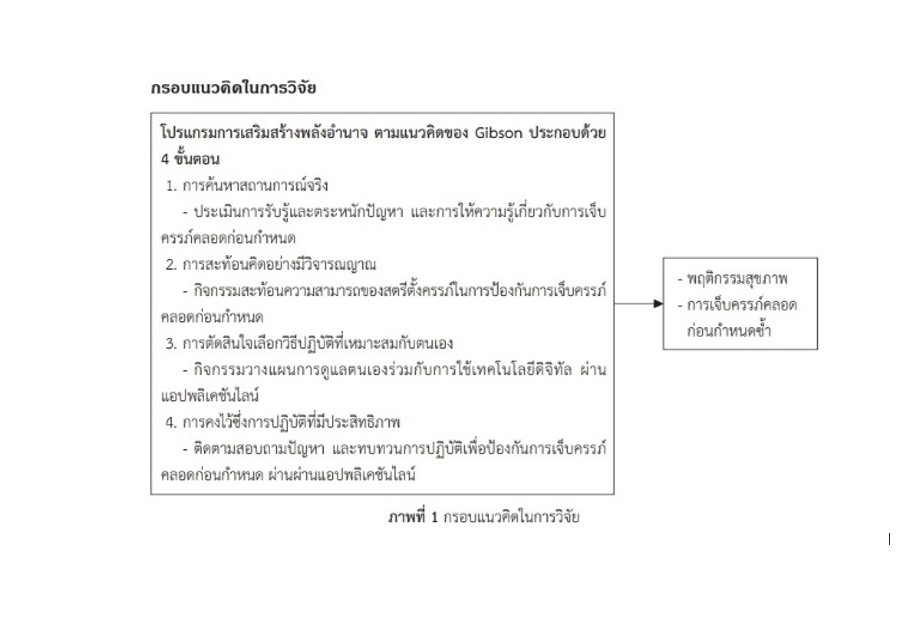
Empowerment helps people gain confidence and make decisions to change their behaviors. This study is quasi-experimental research. The study aimed to determine the effects of the empowerment program with the Line application on health behaviors and recurrent preterm labor among women having preterm labor. The sample was pregnant women with hospital discharge plans after being treated for preventing preterm labor in the hospital for the first time. Fifty samples were recruited by purposive sampling and equally divided into 2 groups; the control group, and the experimental group. Research instrument included a personal information questionnaire, a record of the history of current pregnancy and rate of repeated preterm labor, and the health behaviors assessment. Data were analyzed by using independent t-test and chi-square test
Results revealed that after receiving an empowerment program, the mean score of health behavior of experimental group was statistically significantly higher than that of the control group (t35.92 = 14.40, p < .001) and the rate of repeated preterm labor was lower than the control group, but there was no statistically significant difference (X2 =2.92, p=.09). Recommendations from this study, nurses and midwives should empower women with preterm labor to have health behaviors in preventing recurrence of preterm labor and reducing the rate of preterm labor repeatable.
References
Cunningham, F. G., Leveno, K. J., Bloom, S. L., Dashe, S. J., Hoffman, B. L., Casey, B. M., & Spong, C. Y. (2018). Williams obstetrics (25th ed.). New York: McGraw-Hill Education.
Lilliecreutz, C., Loren, J., Sydsjo, G., & Josefsson, A. (2016). Effect of maternal stress during pregnancy on the risk for preterm birth. BMC Pregnancy and Childbirth, 16(5), 1–8.
Gete, D. G., Waller, M., & Mishra, G. D. (2020). Prepregnancy dietary patterns and risk of preterm birth and low birth weight: findings from the Australian longitudinal study on women’s health. The American Journal of Clinical Nutrition, 111(5), 1048-1058.
Gibson, C. H. (1995). The process of empowerment in mothers of chronically Ill children. Journal of Advanced Nursing, 21, 1201-1210.
Gyetvai, K., Hannah, M., Hodnett, E., & Ohlsson, A. (1999). Tocolytics for preterm labor: A systemic review. Obstetrics & Gynecology, 94, 869-877.
Kelly, K., Marie, S., & John, D. (2013). Environmental contaminant exposures and preterm birth: A comprehensive review. Journal of Toxicology and Environmental Health, 16(2), 69-113.
Kolatat, T. (2016). The effect of prematurity: Thai maternal and child health .http:// www.tmchnetwork.com /node/164. [in Thai]
Konggern, P., Wongasa, W., & Sombatsirinan, K. (2016). The effect of an empowerment program on pregnant women at risk of giving birth. before maturity and husband to health promotion behaviors number of miscarriages and low birth weight infants. Thai Journal of Nursing Council, 31, 67-82. [in Thai]
Koranantakul, A. (2019). Academic article: Predicting preterm birth: Prevent and maintain. The Royal Thai College of Obstetricians and Gynaecologists, 28,8-15. [in Thai]
Maloni, J. A. (2011). Lack of evidence for prescription of antepartum bed rest. Expert Review of Obstetrics & Gynecology, 6(4), 385-393.
Nathalie, G., & Antoine, P. (2011). From powerlessness to empowerment: Mothers expect more than information from the prenatal consultation for preterm labour. Paediatrics & Child Health, 16(10), 638–642
Nuiman, T. (2011). Effect of empowerment program on behaviors for prevention of preterm labour among Muslim teenage pregnant women. Thai Journal of Nursing, 60(2),22-30. [in Thai]
Okun, M. L., Schetter, C. D., & Glynn, L. M. (2011). Poor sleep quality is associated with preterm birth. Sleep ,34(11):1493-1498
Palmer, K. T., Bonzini, M., Harris, E. C., Linaker, C., & Bonde, J. P. (2013). Work activities and risk of prematurity, low birth weight and pre-eclampsia: An updated review with metaanalysis. Occupational Medicine Journal, 70(4), 213-22.
Stylianou-Riga, P., Kouis, P., Kinni, P., Rigas, A., Papadouri, T., Yiallouros, P. K., & Theodorou, M. (2018). Maternal socioeconomic factors and the risk of premature birth and low birth weight in Cyprus: A case-control study. Reproductive Health, 15(1), 157. doi: 10.1186/s12978- 018-0603-7
Thato, R. (2018). Nursing research: Concepts to application (4th ed.). Bangkok: Chulalongkorn University. [in Thai]
World Health Organization [WHO]. (2019). World prematurity day 2012 . http://www.who.int/pmnch/media/news/2012/20121117_world_.html.2019
Downloads
Published
How to Cite
Issue
Section
License

This work is licensed under a Creative Commons Attribution-NonCommercial-NoDerivatives 4.0 International License.