The Model Development of Social Ecology of Health Promotion to Control Overnutrition of Personnel In Regional Health Promotion Center 11 Nakhon Si Thammarat
Keywords:
Model development, Health Promotion, Social Ecology, OvernutritionAbstract
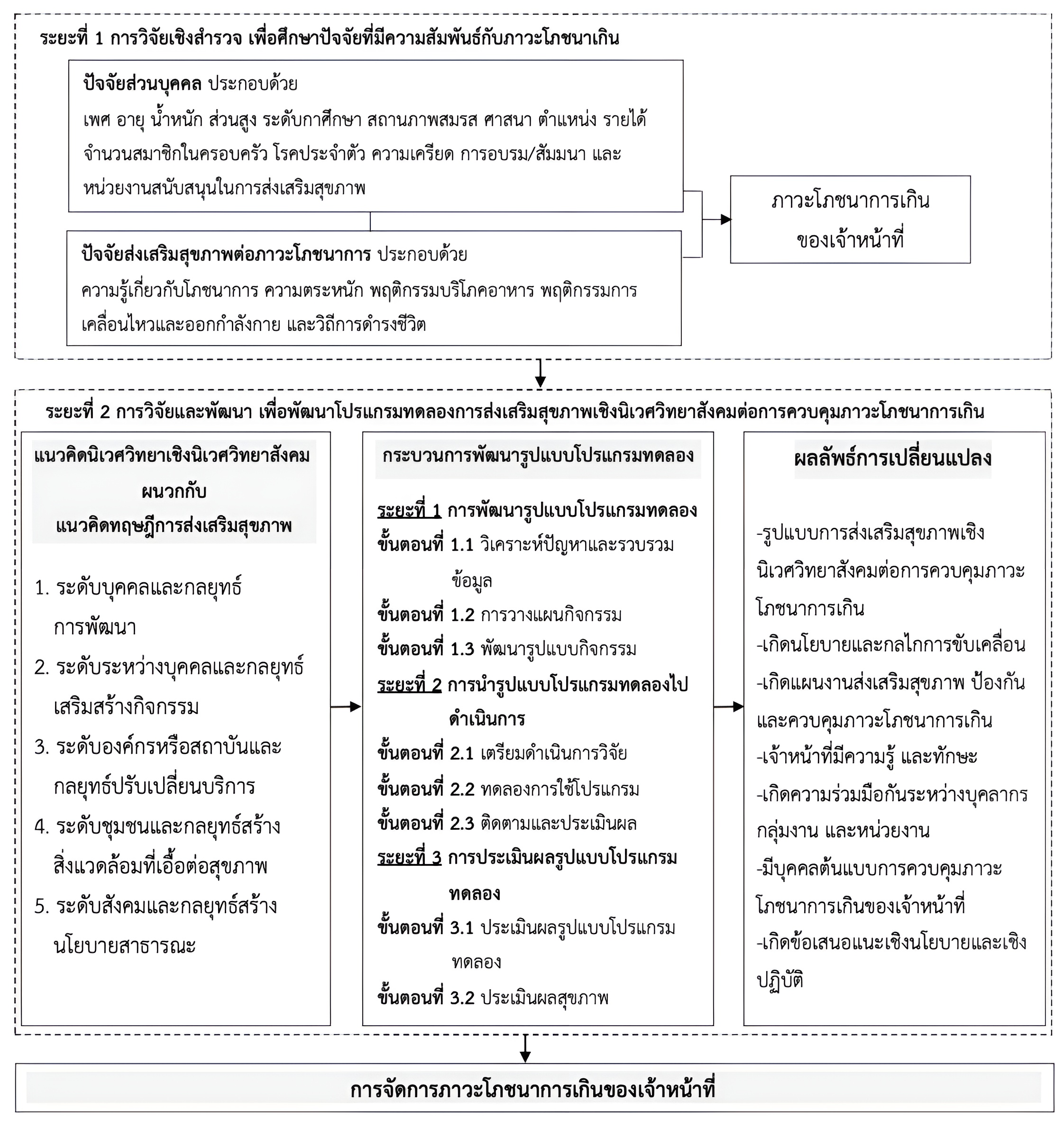
This research aimed to investigate factors associated with overnutrition, formulate a social ecology health promotion model for overnutrition control, and assess the model’s effectiveness among personnel at Regional Health Promotion Center 11, Nakhon Si Thammarat. This mixed-method study comprised a survey involving 61 participants with overnutrition, and a research and development phase that included a program with 20 participants. The analysis encompassed descriptive statistics, paired sample t-tests, and Spearman’s correlation coefficient.
The findings indicated that gender, religion, awareness levels, and lifestyle behaviors were significantly correlated with overnutrition (p<0.05). The development of the experimental program unfolded in three phases: Phase 1 involved model development, data collection, analysis, activity planning, and the creation of health materials and knowledge resources. Phase 2 involved the application of the model within the experimental program, with regular program monitoring. Phase 3 encompassed model evaluation.
Post-program results revealed a mean body mass index improvement (X=25.82, SD =3.59) compared to pre-program values (X=26.32, SD =3.46). Notably, 50.0% of participants showed enhanced nutritional status. The post-test outcomes were significantly better than the pre-test results (p<0.05), with model effectiveness evaluation scoring at a high level (X=4.36, SD = 0.14).
Recommendations emerging from this research advocate for policy formulation, goal-setting, planning, monitoring, and evaluation of health promotion initiatives. Additionally, there is a need for supporting suitable activities, empowering individuals, fostering motivation for health behavior change, utilizing communication and technology, and implementing the program in organizations, communities, or non-communicable disease (NCD) clinics.
References
Blanched, C. M. (2005). Social ecological correlates of physical activity in normal weigh overweight and obese individuals. International Journal Obesity, 50(1), 720-726.
Burean of Nutrition. (2021). The situation of nutritional status in the working age group. Nonthaburi: Ministry of Public Health. [In Thai]
Homsuwan, P. (2009). The effect of behavior changes program upon lipid level of patients with diabetics type 2, lower southern region. Master’s Thesis, Nursing Science, Faculty of Nursing, Chulalongkorn University. [In Thai]
Homsuwan, R., & Kanoktate, T. (2018). The ecological model: The control and prevention of hand foot mouth disease in children by multiple factors Influencing. Journal of Nursing and Health Sciences, 12(3), 18-21. [In Thai]
McLeroy, K., Bibcau, D., Steckler, A., & Glanz, K. (1988). An ecological perspective on health promotion programs. Health Education Quarterly, 15(4), 351-77.
Meknuntapaisit, W. (2019). The management for over nutrition of village health volunteer in Pissanulok province. Doctoral Dissertation, Philosophy, Regional Development Strategies, Rajabhat Maha Sarakham University. [In Thai]
Phosuya, K., & Tina, S. (2020). The evaluate effectiveness of nutrition problem solving among students in Ban Chomphu school, Ai Nalai sub district, Wiang Sa District, Nan Province. Nan: Provincial Public Health Office. [In Thai]
Prasitrattasin, S. (2012). Research methodology in social sciences. Bangkok: Chulalongkorn University Press. [In Thai]
Punset, K., Klinthuesin, S., Kingkaew, A., & Wongmaneeroj, W. (2015). Cardiovascular risk among staffs working at the central of ministry of public health using risk assessment of Rama - EGAT heart score. The Ministry of Public Health clinic, Rajavithi hospital, Department of Medical Services, 25(2), 65-71. [In Thai]
Regional Health Promotion Center 11 Nakhon Si Thammarat. (2021). Information and health situation of officer. Nakhon Si Thammarat: Working Age Development Cluster. [In Thai]
Sih, M. (2017). The effect of social ecological model and stage - based work place health promotion program on blood lipid control behaviors and total cholesterol in employees of the electricity generating authority of Thailand. Master’s Thesis,
Nursing Science, Community Nurse Practitioner, Prince of Songkla University. [In Thai]
Steward, H. J. (1972). Theory of culture change: The methodology of multilinear evolution. Urbana and Chicago: University of Illinois Press, 63(1), 117-119.
Yaemlamai, N., & Hongwiset, S. (2018). Evaluation of a health promotion program for the elderly, Takhiantia sub-district municipality, Bang-lamung district, Chonburi province. Nakhon Phanom University Journal, 8(3), 17-25. [In Thai]
Downloads
Published
How to Cite
Issue
Section
License

This work is licensed under a Creative Commons Attribution-NonCommercial-NoDerivatives 4.0 International License.