Effects of Simulation Based-Learning on Nursing Students’ Clinical judgement
Keywords:
Simulation Based-Learning, Clinical judgement, Nursing studentAbstract
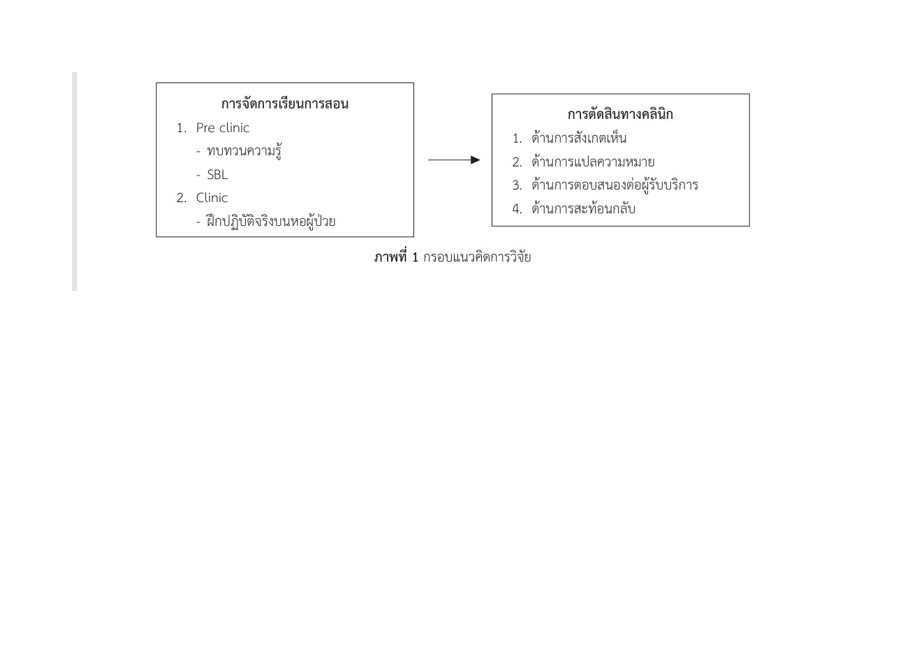
This study is quasi-experimental research with a one-group pre-posttest design. The objective was to examine the effect of simulation based-learning on nursing students’ clinical judgement. The sample consisted of 146 third-year Bachelor of Science in nursing students from Boromarajonani College of Nursing Sawanpracharak Nakhonsawan, academic year 2023, who were enrolled in the adult nursing practicum II. Data were collected from October 2023 to May 2024 using the Thai version of a Lasater Clinical Judgment rubric assessment tool, with a Cronbach's alpha coefficient of 0.78. Students completed the evaluation themselves before starting the first simulation scenario and at the end of the last scenario. Data were analyzed using paired t-test statistics through computer software. The result illustrated that the sample group had significantly higher clinical judgment skills scores after the trial compared to before the trial, with a statistical significance at the .01 level (p < .001).
These findings suggest that learning through simulation based-learning is beneficial for students' learning and can enhance the clinical judgment skills of nursing students. Therefore, simulation based-learning should be incorporated into all nursing courses to continuously develop the clinical decision-making skills of nursing students.
References
Ayed, A., & Khalaf, I. (2018). The outcomes of integrating high fidelity simulation in nursing education: An integrative review. Open Journal of Nursing, 8(5), 292-302. https://doi.org/10.4236/ojn.2018.85025
Ayed, A., Khalaf, I. A., Fashafsheh, I., Saleh, A., Bawadi, H., Abuidhail, J., & Joudallah, H. (2022). Effect of high-fidelity simulation on clinical judgment among nursing students. INQUIRY: The Journal of Health Care Organization, Provision, and Financing, 59, 1-6. https://doi.org/10.1177/00469580221081997
Connor, J., Flenady, T., Massey, D., & Dwyer, T. (2023). Clinical judgement in nursing-An evolutionary concept analysis. Journal of Clinical Nursing, 32(13-14), 3328-3340. https://doi.org/10.1111/jocn.16469
Dickison, P., Haerling, K. A., & Lasater, K. (2019). Integrating the National Council of State Boards of Nursing clinical judgment model into nursing educational frameworks. Journal of Nursing Education, 58(2), 72-78. https://doi.org/10.3928/01484834-20190122-03
Fawaz, M. A., & Hamdan-Mansour, A. M. (2016). Impact of high-fidelity simulation on the development of clinical judgment and motivation among Lebanese nursing students. Nurse education today, 46, 36-42. https://doi.org/10.1016/j.nedt.2016.08.026
Fogg, N., Kubin, L., Wilson, C. E., & Trinka, M. (2020). Using virtual simulation to develop clinical judgment in undergraduate nursing students. Clinical Simulation in Nursing, 48, 55-58. https://doi.org/10.1016/j.ecns.2020.08.010
Kavanagh, J. M., & Szweda, C. (2017). A crisis in competency: The strategic and ethical imperative to assessing new graduate nurses’ clinical reasoning. Nursing Education Perspectives, 38(2), 57-62. https://doi.org/10.1097/01.NEP.0000000000000112
Klenke-Borgmann, L., Cantrell, M. A., & Mariani, B. (2021). Clinical judgment in nursing students after observation of in-class simulations. Clinical Simulation in Nursing, 51, 19-27. https://doi.org/10.1016/j.ecns.2020.11.006
Kolb, D. A. (1984). Experiential Learning: Experience as the Source of Learning and Development.
Englewood Cliffs, NJ: Prentice Hall.
Lasater, K. (2007). Clinical judgment development: using simulation to create an assessment rubric. Journal of nursing education, 46(11). https://doi.org/10.3928/01484834-20071101-04
Lasater, K. (2011). Clinical judgment: The last frontier for evaluation. Nurse Education in Practice, 11(2), 86-92. https://doi.org/10.1016/j.nepr.2010.11.013
Lindsey, P. L., & Jenkins, S. (2013). Nursing students’ clinical judgment regarding rapid response: the influence of a clinical simulation education intervention. Nursing forum, 48(1), 61-70. https://doi.org/10.1111/nuf.12002
Manetti, W. (2018). Evaluating the clinical judgment of prelicensure nursing students in the clinical setting. Nurse Educator, 43(5), 272-276. https://doi.org/10.1097/NNE.0000000000000489
Miraglia, R., & Asselin, M. E. (2015). The Lasater Clinical Judgment Rubric as a framework to enhance clinical judgment in novice and experienced nurses. Journal for Nurses in Professional Development, 31(5), 284-291. https://doi.org/10.1097/NND.0000000000000209
Pardue, K. T., Holt, K., Dunbar, D. M., & Baugh, N. (2023). Exploring the development of nursing clinical judgment among students using virtual reality simulation. Nurse Educator, 48(2), 71-75. https://doi.org/10.1097/NNE.0000000000001318
Punsumreung, T., Kanhadilok, S., & Inchaithep, S. (2020). The Thai version of Lasater clinical judgement rubric (T-LCJR): Psychometric properties. Journal of Nursing and Education, 13(1), 15-26.
Rogers, B. A., & Franklin, A. E. (2023). Lasater clinical judgment rubric reliability for scoring clinical judgment after observing asynchronous simulation and feasibility/usability with learners. Nurse Education Today, 125, 105769. https://doi.org/10.1016/j.nedt.2023.105769
Salameh, B., Ayed, A., & Lasater, K. (2021). Effects of a complex case study and high-fidelity simulation on mechanical ventilation on knowledge and clinical judgment of undergraduate nursing students. Nurse Educator, 46(4), 64-69. https://doi.org/10.1097/NNE.0000000000000938
Strickland, H. P., Cheshire, M. H., & March, A. L. (2017). Clinical judgment during simulation: A comparison of student and faculty scores. Nursing Education Perspectives, 38(2), 85-86. https://doi.org/10.1097/01.NEP.0000000000000109
Tanner, C. A. (2006). Thinking like a nurse: a research-based model of clinical judgment in nursing. Journal of nursing education, 45(6). https://doi.org/10.3928/01484834-20060601-04
Tamata, A. T., & Mohammadnezhad, M. (2023). A systematic review study on the factors affecting shortage of nursing workforce in the hospitals. Nursing open, 10(3), 1247-1257. https://doi.org/10.1002/nop2.1434
Thammakijpirote, K., Maneewong, C., & Sanongyard, J. (2023). Teaching and learning using virtual simulation for critical thinking in nursing students: A systematic review. The Journal of Boromarjonani College of Nursing, Suphanburi, 6(1), 5-28.
Van Graan, A. C., Williams, M. J., & Koen, M. P. (2016). Professional nurses’ understanding of clinical judgement: A contextual inquiry. health sa gesondheid, 21, 280-293. https://doi.org/10.1016/j.hsag.2016.04.001
Victor, J., Ruppert, W., & Ballasy, S. (2017). Examining the relationships between clinical judgment, simulation performance, and clinical performance. Nurse Educator, 42(5), 236-239. https://doi.org/10.1097/nne.0000000000000359
Downloads
Published
How to Cite
Issue
Section
License

This work is licensed under a Creative Commons Attribution-NonCommercial-NoDerivatives 4.0 International License.