Factors Predicting Depression Among Nursing Students at a Private University
Keywords:
Depression, parenting stress, Resilience, Nursing studentsAbstract
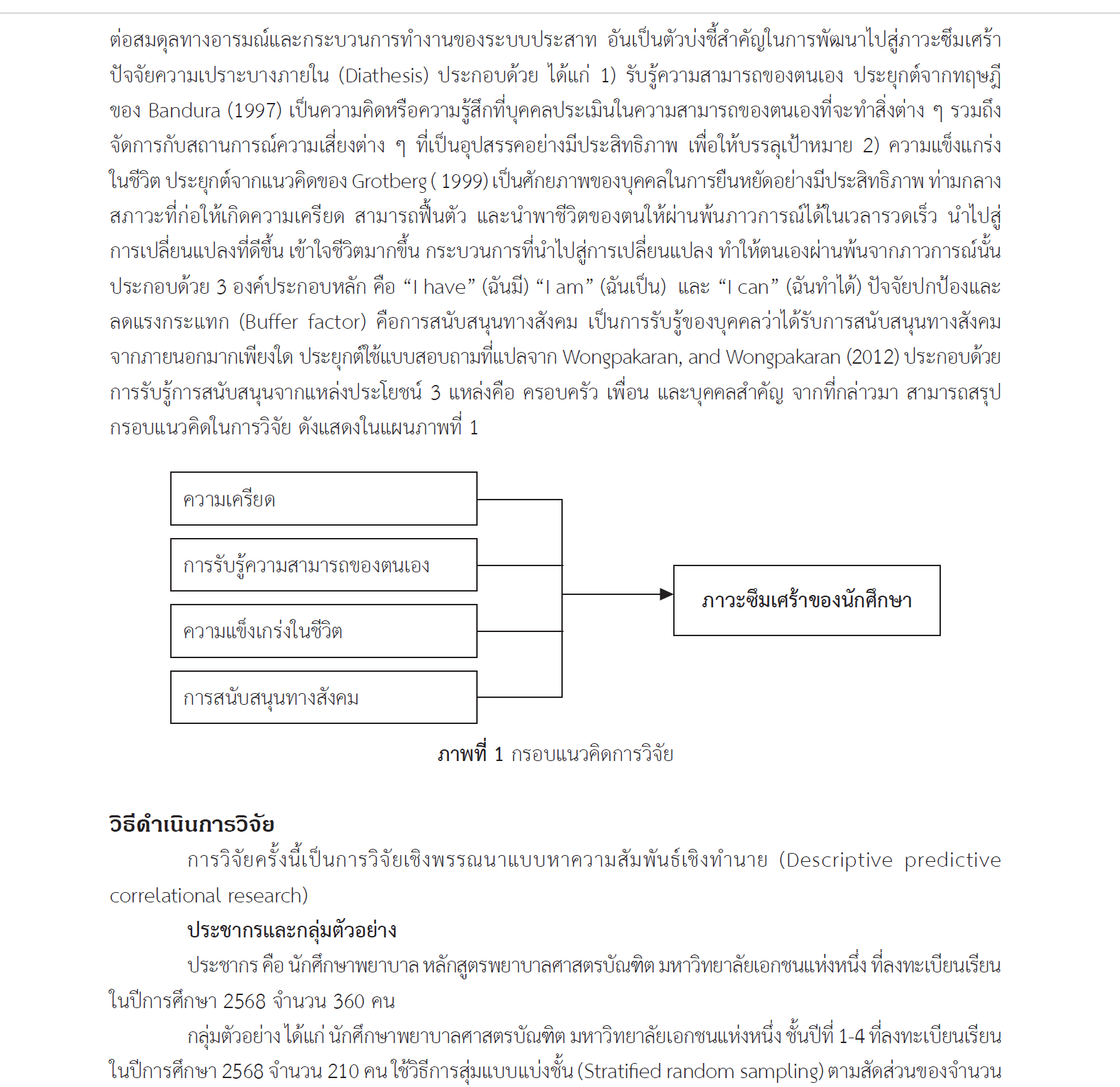
This descriptive correlational–predictive research aimed to examine factors predicting depression among nursing students at a private university. The sample consisted of 210 nursing students during the 2025 academic year, selected through simple random sampling. Research instruments included questionnaires on depression, stress, self-efficacy, resilience, and multidimensional perceived social support. The reliability of these instruments, assessed using Cronbach’s alpha coefficients, was 0.93, 0.90, 0.87, 0.95, and 0.93, respectively. Data were analyzed using descriptive statistics and stepwise multiple regression analysis.
The findings revealed that stress and resilience were significant predictors of depression, jointly explaining 65.8% of the variance (R² = 0.658, p < .001). Specifically, stress showed a positive association with depression (β = .721, p < .001). Whereas resilience demonstrated a negative association (β = -.244, p < .001). Therefore, nursing instructors and relevant stakeholders should develop interventions focusing on stress reduction combined with resilience enhancement to effectively mitigate depression in this student population.
References
Aziz, S. Q. A., Taha, N. M., Sandramogan, Y., Kasim, N. M., & Harun, S. A. (2025). Financial issues and students’ stress among private university students in Selangor, Malaysia. International Journal of Research and Innovation in Social Science (IJRISS), 9(4), 6982–6990. https://doi.org/10.47772/IJRISS.2025.90400514
Bandura, A. (1997). Self-efficacy: The exercise of control. New York: W. H. Freeman.
Bell, M. L., Kenward, M. G., Fairclough, D. L., & Horton, N. J. (2013). Differential dropout and bias in randomised controlled trials: When it matters and when it may not. BMJ, 346, e8668. doi.org/10.1136/bmj.e8668
Chatrung, C., Mahaprom, T., Kerdmuang, S., & Suwanchareon, S. (2022). Factors associated with depression in nursing students. Journal of Health and Nursing Research (Journal of Boromarajonani College of Nursing, Bangkok), 38(3), 82–90. Retrieved from https://he01.tci-thaijo.org/index.php/bcnbangkok/article/view/255677 [In Thai]
Cohen, J. (1988). Statistical power analysis for the behavioral sciences (2nd ed.). Hillsdale, NJ: Lawrence Erlbaum Associates.
Demi R, S., Ercan, F., & Erdoğan, E. (2022). Depression-related factors in nursing students: A path analysis. Perspectives in Psychiatric Care, 58(4), 2646–2652. doi.org/10.1111/ppc.13105
Department of Mental Health. (2024). Report on the mental health situation of Thai people 2024. Nonthaburi: Ministry of Public Health. [In Thai]
Grotberg, E. H. (1999). Tapping your inner strength: How to find the resilience to deal with anything. Oakland, CA: New Harbinger Publications.
Klongdee, K., & Chaniang, S. (2021). Factors predicting depression in nursing students at Boromarajonani College of Nursing Nakhonphanom, Nakhonphanom University. Journal of the Police Nurses and Health Science, 13(1), 148–157. Retrieved from https://he01.tci-thaijo.org/index.php/policenurse/article/view/247485 [In Thai]
Kuptniratsaikul, V., & Pekuman, P. (1997). The study of the center for epidemiologic studies-Depression (CES-D) in Thai people. Siriraj Hosp Gaz, 49(5), 442-448. [In Thai]
Li, Z., Zhao, J., & Cao, X. (2022). Resilience as a mediator between social support and depression among nursing students: A cross-sectional study. Nurse Education Today, 108, 105190. https://doi.org/10.1016/j.nedt.2021.105190
Mahatnirunkul, S., Poompisanchai, V., & Tapunya, P. (1997). Suanprung stress test-20. Academic Psychiatry and Psychology Journal, 13(3), 1-20. [In Thai]
McDermott, R. C., Cheng, H. L., Wong, J., Booth, N., & Leung, C. (2020). Resilience and depressive symptoms in emerging adulthood: The mediating role of negative cognitive style. Journal of American College Health, 68(2), 123–131. doi.org/10.1080/07448481.2018.1529573
Meuangkhwa, P., Chaniang, S., & Klongdee, K. (2021). Depression among Thai Undergraduate Students: The Critical Role of Higher Educational Institutions. Journal of Nursing, Siam University, 21(41), 104–116. doi.org/10.14456/jnsu.v21i41.244029 [In Thai]
Monroe, S. M., & Simons, A. D. (1991). Diathesis-stress theories in the context of life stress research: Implications for the depressive disorders. Psychological Bulletin, 110(3), 406–425. https://doi.org/10.1037/0033-2909.110.3.406
Morgan, K. I., & Townsend, M. C. (2020). Pocket guide to psychiatric nursing (11th ed.). Philadelphia: F.A. Davis.
Nway, N. C., Phetrasuwan, S., Putdivarnichapong, W., & Vongsirimas, N. (2023). Factors contributing to depressive symptoms among undergraduate nursing students: A cross-sectional study. Nurse Education in Practice, 68, 103587. doi.org/10.1016/j.nepr.2023.103587
Phoosuwan, N., & Lundberg, P. C. (2020). Knowledge, attitude and self-efficacy program intended to improve public health professionals' ability to identify and manage perinatal depressive symptoms: A quasi-experimental study. BMC Public Health, 20(1), 1926. doi.org/10.1186/s12889-020-10086-9. [In Thai]
Pulido-Criollo, F. P., Cueto-Escobedo, J., & Guillén- Ruiz, G. (2018). Stress in nursing university students and mental health. Health and Academic Achievement, Blandina Bernal-Morales, Intech Open. doi.org/10.5772/intechopen.72993
Selye, H. (1946). The General Adaptation Syndrome and the Diseases of Adaptation. The Journal of Clinical Endocrinology, 6, 117-230. doi.org/10.1210/jcem-6-2-117
Wagner, F., Wagner, R. G., Kolanisi, U., Makuapane, L. P., Masango, M., & Gómez-Olivé, F. X. (2022). The relationship between depression symptoms and academic performance among first-year undergraduate students at a South African university: A cross-sectional study. BMC Public Health, 22(1),1–9. doi.org/10.1186/s12889-022-14517-7
Wongpakaran, N., & Wongpakaran, T. (2012). A revised Thai Multi-Dimensional Scale of Perceived Social Support. The Spanish journal of psychology, 15(3), 1503–1509. doi.org/10.5209/rev_sjop.2012.v15.n3.39434 [In Thai]
Zimet, G. D., Dahlem, N. W., Zimet, S. G., & Farley, G. K. (1988). The multidimensional scale perceived social support. Journal of Personality Assessment, 52(1), 30–41
Downloads
Published
How to Cite
Issue
Section
License

This work is licensed under a Creative Commons Attribution-NonCommercial-NoDerivatives 4.0 International License.