Correlation between Quality of Knowledge Management and Knowledge Management Acceptance among Personnel at the Faculty of Nursing
Keywords:
Knowledge management quality, Knowledge management acceptance, Nursing personnelAbstract
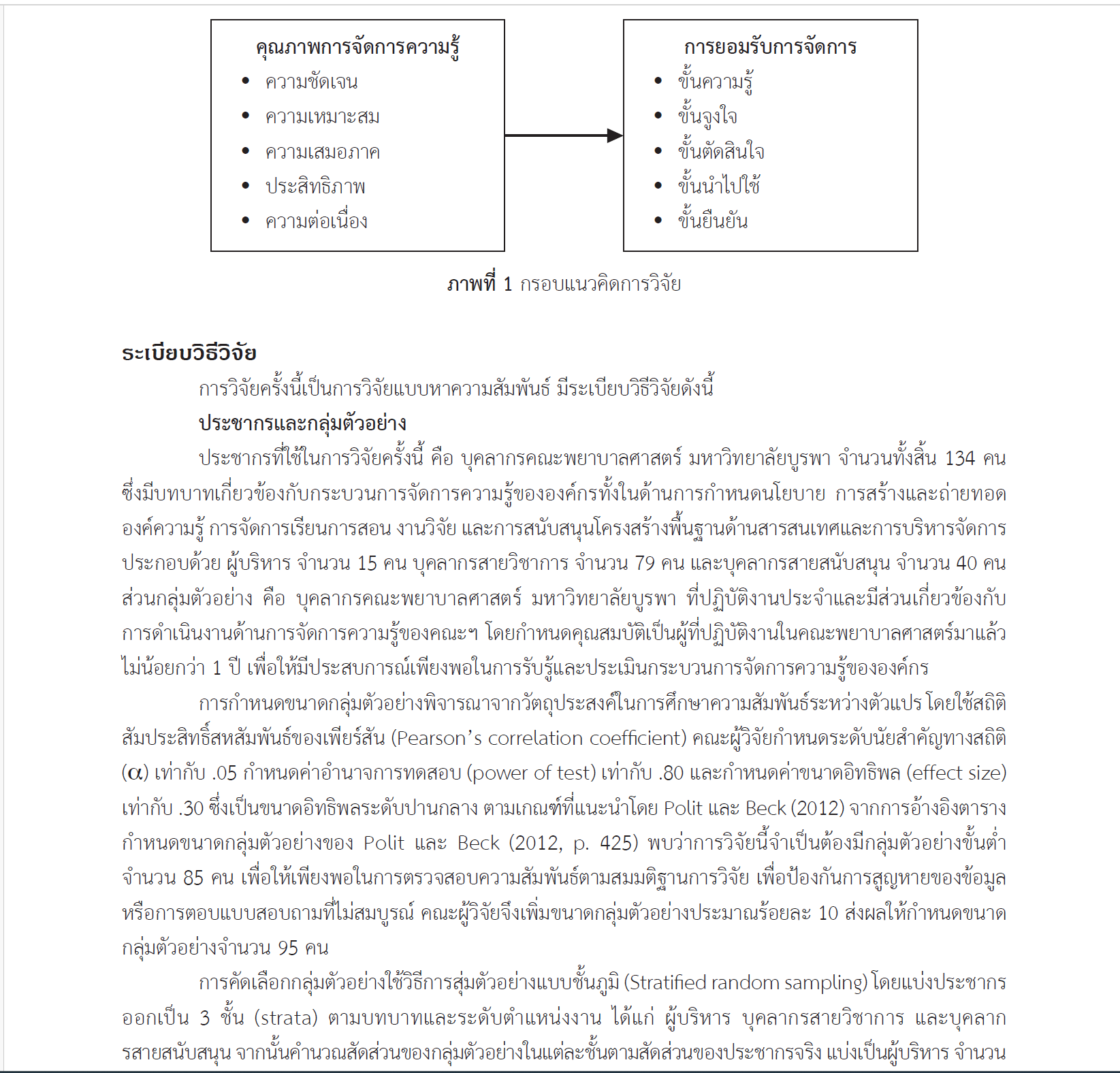
Knowledge management (KM) is a crucial mechanism for enhancing the quality of organizational management, teaching and learning, and human resource development in higher education institutions, particularly in faculties of nursing where continuous knowledge development and innovation are essential. This descriptive correlational research aimed to examine (1) the level of knowledge management quality, (2) the level of staff acceptance of knowledge management, and (3) the relationship between KM quality and staff acceptance. Data were collected throughout the 2024 academic year using a five-point Likert-scale questionnaire. The sample consisted of 88 staff members of the Faculty of Nursing, Burapha University, selected through stratified random sampling. Data were collected online via Google Forms, with an average completion time of 15–20 minutes per questionnaire. Participant confidentiality was ensured through data coding. Data were analyzed using descriptive statistics and Pearson’s correlation coefficient (r).
The results indicated that the overall quality of knowledge management was at a very high level (M = 4.23, SD = 0.71) across all dimensions, while overall acceptance of knowledge management was at a high level (M = 4.11, SD = 0.71), with the motivation dimension demonstrating the highest mean score. Furthermore, all dimensions of KM quality were positively and significantly correlated with KM acceptance (p < .001; r = .42–.69). These findings suggest that high-quality knowledge management practices have a significant influence on staff acceptance, with correlation levels ranging from moderate to high. In conclusion, clear, appropriate, and continuously implemented KM processes are key factors promoting staff acceptance and effective utilization of KM systems. Managerial implications emphasize the development of responsive e-learning or e-KM systems and the regular establishment of Communities of Practice to facilitate knowledge sharing and foster a sustainable learning organization culture.
References
Alharbi, G. L. (2024). The effects of knowledge management processes on organizational performance. Humanities and Social Sciences Communications, 11, 286.
Aujirapongpan, S., & Jutidharabongse, J. (2017). The role of knowledge management in developing strategic intuition. Suratthani Rajabhat Journal, 4(2), 21–44.
Azeroual, O., Schöpfel, J., & Saake, G. (2021). Implementation and user acceptance of research information systems (RIS). arXiv preprint arXiv:2111.08309.
Davis, F. D. (1989). Perceived usefulness, perceived ease of use, and user acceptance of information technology. MIS Quarterly, 13(3), 319–340.
Durst, S., & Zieba, M. (2022). Knowledge risks in the 21st century: Management challenges and trends. Journal of Knowledge Management, 26(1), 43–61.
Fadel, K. J., & Durcikova, A. (2014). If it’s fair, I’ll share: The effect of perceived knowledge validation fairness on contribution. Information & Management, 51(6), 873–883.
Intra, C. (2020). Factors influencing government knowledge management in the Office of the Permanent Secretary for Defense. The Journal of Development Administration Research, 10(1), 75–85.
Jarupruttipong, C. (2023). Factors affecting adoption of knowledge-based system for emergency medicine. Journal of Emergency Medical Services of Thailand, 3(1), 79–93.
Jennex, M. E., & Olfman, L. (2006). A model of knowledge management success. International Journal of Knowledge Management, 2(3), 51–68.
Kingwan, D., Lapnarongchai, N., & Kumsuk, K. (2024). A study of knowledge, attitude, and practice of knowledge management (KM) among personnel in the Faculty of Nursing, Mahidol University. Mahidol R2R e-Journal, 11(2), 87–99.
Lee, H., & Choi, B. (2003). Knowledge management enablers, processes, and organizational performance. Journal of Management Information Systems, 20(1), 179–228.
Navachewinmai, N., & Maneerat, C. (2019). The knowledge management toward teaching in the School of Nakhon Pathom Rajabhat University students of graduate diploma
program in teaching profession. Journal of Management Science, Nakhon Pathom Rajabhat University, 5(2), 256–270.
Nyame, G., Qin, Z., & Ampomah, P. (2021). Evaluation of knowledge management system using technology acceptance model. International Journal of Knowledge Management Studies, 12(2), 175–190.
Sarnthima, T., & Lomain, U. (2023). Guidelines for improving knowledge management of personnel who are procurement officers, Khon Kaen University. KKU Research Journal of Humanities and Social Sciences (Graduate Studies), 11(1), 34–52.
Sroykratoke, S., & Charoensuk, S. (2024). Organizational factors related to knowledge management of employees at Nakhon Ratchasima College. Journal of Administration and Social Science Review, 7(2), 283–294.
Supa, P., Kiatwatcharachai, K., & Boonyarataphan, T. (2024). Factors affecting the success of personnel knowledge management in the Mae Hong Son Provincial Cultural Office. CRRU Law, Political Science and Social Science Journal, 8(2), 206–227.
Urbancová, H., & Venclová, K. (2013). Importance of knowledge continuity in business continuity management. Acta Universitatis Bohemiae Meridionalis, 16(1), 3–13.
Venkatesh, V., Morris, M. G., Davis, G. B., & Davis, F. D. (2003). User acceptance of information technology: Toward a unified view. MIS Quarterly, 27(3), 425–478.
Zhou, M., & Shi, Y. (2020). How fairness perceptions affect knowledge sharing and green innovation. Journal of Cleaner Production, 259, 120974.
Downloads
Published
How to Cite
Issue
Section
License

This work is licensed under a Creative Commons Attribution-NonCommercial-NoDerivatives 4.0 International License.