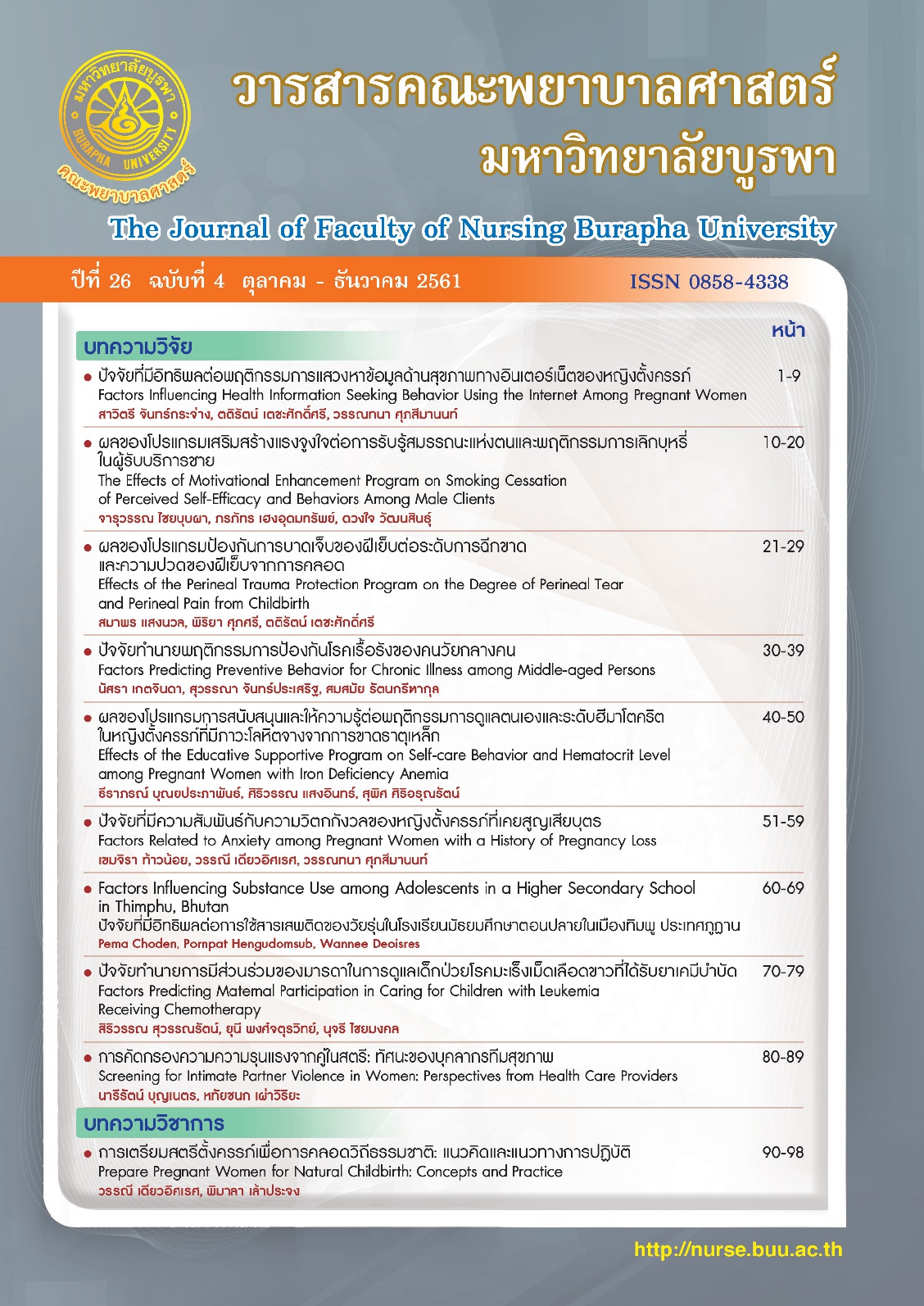
การเตรียมสตรีตั้งครรภ์เพื่อการคลอดวิถีธรรมชาติ: แนวคิดและแนวทาง การปฏิบัติ
คำสำคัญ:
สตรีตั้งครรภ์, การเตรียมตัวคลอด, การคลอดวิถีธรรมชาติบทคัดย่อ
บทคัดย่อ
การตั้งครรภ์และการคลอดเป็นกระบวนการเปลี่ยนแปลงทางสรีระวิทยาปกติ และกลไกธรรมชาติออกแบบการคลอดลูกมาอย่างสอดคล้องและเหมาะสมกับสรีระของผู้หญิง แต่ปัจจุบันอัตราการผ่าท้องคลอดได้เพิ่มสูงขึ้นอย่างรวดเร็วทั่วโลกรวมทั้งประเทศไทย การผ่าท้องคลอดที่ไม่จำเป็นมีโอกาสเกิดภาวะแทรกซ้อนมากกว่าการคลอดปกติ และยังมีผลกระทบด้านสุขภาพตามมาทั้งในระยะสั้นและระยะยาวทั้งกับมารดาและทารก และการตั้งครรภ์ครั้งต่อไป สาเหตุสำคัญที่การผ่าท้องคลอดที่ไม่จำเป็นเพิ่มขึ้นคือ มารดามีความกลัวการคลอด ดังนั้นการเตรียมสตรีตั้งครรภ์ให้มีความพร้อม มีความมั่นในการคลอดตามกระบวนการธรรมชาติ จึงเป็นสิ่งจำเป็น ซึ่งพยาบาลและผดุงครรภ์เป็นผู้ที่มีบทบาทที่สำคัญในการดูแลสุขภาพสตรีตั้งครรภ์และส่งเสริม ปกป้อง สนับสนุนการคลอดธรรมชาติ จึงควรมีความรู้และความสามารถในการจัดบริการการเตรียมตัวสตรีตั้งครรภ์เพื่อการคลอดวิถีธรรมชาติ บทความนี้มีวัตถุประสงค์เพื่อทบทวนแนวคิดเกี่ยวกับการคลอดวิถีธรรมชาติ แนวคิดการเตรียมตัวคลอดวิถีธรรมชาติ และนำเสนอแนวทางการจัดสอนการเตรียมตัวคลอดวิถีธรรมชาติ
เอกสารอ้างอิง
Balaskas, J. (1992). Active birth: The new approach to giving birth naturally. Harvard
Common.
Dick-Read, G. (2004). Childbirth without Fear: The principles and practice of natural
childbirth. Pinter & Martin.
Duncan, L. G., Cohn, M. L., Chao, M. T., Cook, J. G., Riccobono, J., & Bardacke, N. (2017).
Benefits of preparing for childbirth with mindfulness training: A randomized controlled trial with active comparison. BMC Pregnancy and Childbirth, 17, 140 DOI 10.1186/s12884-017-1319-3.
Haapio, S., Kaunonen, M., Arffman, M., & Astedt-Kurki, P. (2017). Effects of extended
childbirth education by midwives on the childbirth fear of first-time mothers: An RCT. Scandinavian Journal of Caring Sciences, 31, 293–301.
Kistin, N., Benton, D., Rao, S., & Sullivan, M. (1990). Breast-feeding rates among black urban
low-income women: Effect of prenatal education. Pediatrics, 86, 741-746.
Kovavisarach, E. (2016). How to give birth? Bangkok: Tatata Publication. [In Thai]
Kovavisarach, E., Khunpadit, S., Kao-iean, S., Junruchakul, B., Srisantiroj, N., &
Pitukkijronnakorn, S. (2014). Maternal and fetal medicine. In Thailand medical services profile 2011-2014 (pp. 14-1 - 14-33). Nonthaburi: Department of Medical Services, Ministry of Public Health. [In Thai]
Lamaze, F. (1958). Painless childbirth. London: Burke.
Laursen, M., Johansen, C., & Hedegaard, M. (2009). Fear of childbirth and risk for birth
complications in nulliparous women in the Danish national birth cohort. British Journal of Obstetrics and Gynaecology, 116(10), 1350–1355.
Levett, K. M., Smith, C. A., Bensoussan, A., & Dahlen, H. G. (2016). Complementary therapies
for labour and birth study: A randomised controlled trial of antenatal integrative medicine for pain management in labour. BMJ Open, 6:e010691. doi:10.1136/bmjopen-2015-010691
Lothian, J. (1992). How large is too large: optimal childbirth class size. Journal of
Perinatal Education, 1, 3.
Lothian J. (1996). Why become certified? Journal of Perinatal Education, 5(4), 67-70.
Lothian J., & DeVries, C. (2017). Giving birth with confidence: The official Lamaze guide.
Meadowbrook, Minneapolis.
Lothian, J. A. (2018). Preparation for labor and childbirth. Retrieved from
https://www.uptodate.com/contents/preparation-for-labor-and-childbirth/print
Maimburg, R. D., Væth, M., Hvidman, L., & Olse, J. (2010). Randomised trial of structured
antenatal training sessions to improve the birth process. International Journal of Obstetrics and Gynaecology, 117, 921–928.
Permsup, N., Sawatphanit, W. & Deoisres, W. (2017). Effect of childbirth preparation on fear of
childbirth, labor pain coping behaviors, and satisfaction with childbirth experience in primiparous at a hospital under the jurisdiction of Royal Thai Navy. Royal Thai Navy Medical Journal, 44(2), 55-72. [In Thai]
Chomkhuntod, P., Charuwatcharapaniskul, U., & Chareonsanti, J. (2014). Effects of childbirth
preparation on pain level, duration of labor, and perceptions on childbirth experience in adolescent pregnant women. Nursing Journal, 41(1), 13-29. [In Thai]
Serçekuş, P., & Başkale, H. (2016). Effects of antenatal education on fear of childbirth,
maternal self-efficacy and parental attachment. Midwifery, 34, 166-72.
Simpson, K. R., Newman, G., & Chirino, O. R. (2010). Patient education to reduce elective
labour inductions. American Journal of Maternal/Child Nursing, 35, 188-194.
Soriano-Vidal, F. J., Vila-Candel, R., Soriano-Martín, P. J., Tejedor-Tornero, A., & Castro-Sánchez, E. (2018). The effect of prenatal education classes on the birth expectations of Spanish women. Midwifery, 60, 41–47.
World Health Organization. (2015). WHO statement on caesarean section rates. Retrieved
From ttp://www.who.int/reproductivehealth/publications/maternalperinatalhealth/cs-statement/en/