
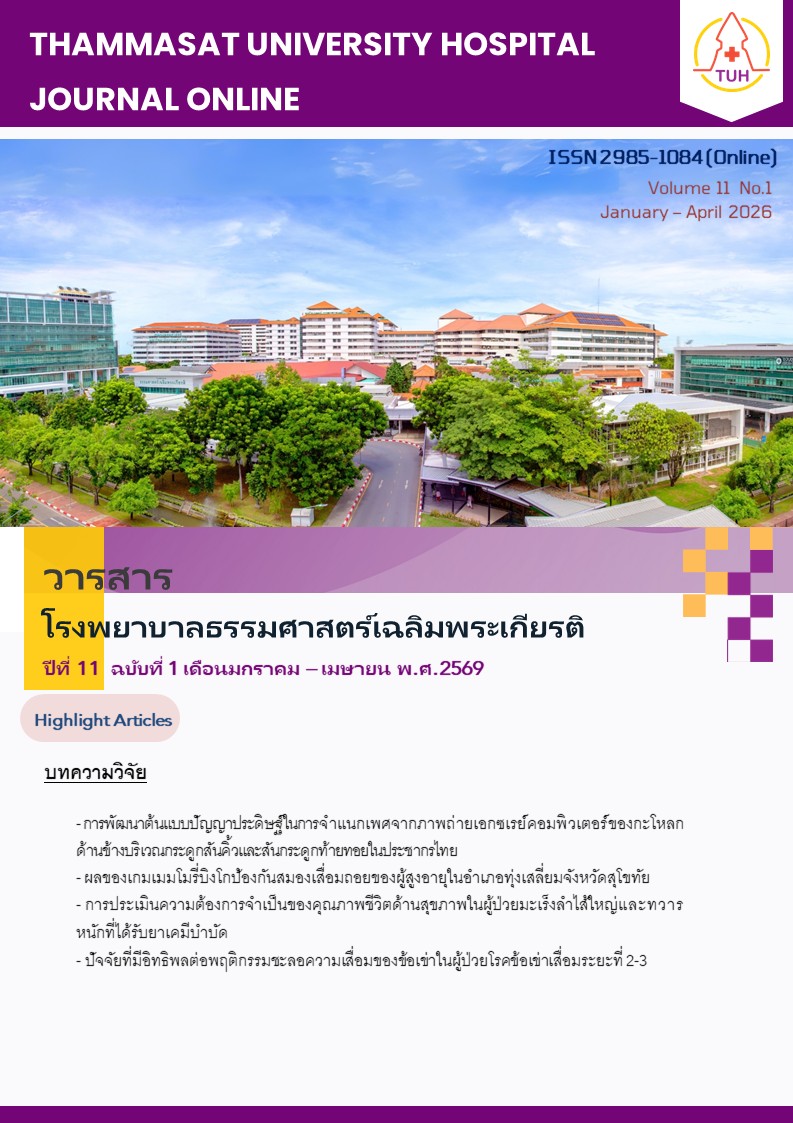
Factors Influencing Behaviors in Delaying Progression of Knee Osteoarthritis among Patients with Stage 2-3 Knee Osteoarthritis
Keywords:
Knee osteoarthritis, Behaviors in delaying progression of knee osteoarthritis, Health believe model, Self-efficacy, Self-careAbstract
Background: Perceived risk of disease, perceived severity of disease, perceived benefits of behavior, and perceived barriers to behavior influence health behavior. Therefore, beliefs or perceptions influence individual behavior and are related to the practice of activities to delay knee osteoarthritis.
Objective: To study the behavior of delaying knee degeneration and the factors affecting the behavior of delaying knee degeneration in patients with osteoarthritis stages 2-3.
Material and method: A cross-sectional analytical study was conducted to study the factors influencing the behavior of delaying knee osteoarthritis in patients with stage 2-3 osteoarthritis. A sample of 160 patients was selected using a simple random sampling method. The research instruments were a personal data record form, a health belief model perception test, a knee osteoarthritis delay behavior questionnaire, and a knee osteoarthritis severity scale with a Cronbach's alpha coefficient greater than 0.80. Data were collected at the outpatient department of orthopedic surgery at the hospital. General data were analyzed using descriptive statistics, and multiple regression statistics were used.
ระยะขอบ 2.54 ซม.
Result: The factors of self-efficacy perception in delaying osteoarthritis, severity of osteoarthritis symptoms, and perceived benefits of delaying osteoarthritis were significantly positively associated with behaviors to delay osteoarthritis (p < .05)
Conclusion: Self-efficacy, symptom severity, and perceived benefits significantly influence behaviors that delay knee osteoarthritis. Strengthening patient confidence and emphasizing preventive benefits can support effective self-care and slow disease progression.
References
GBD 2021 Osteoarthritis Collaborators. Global, regional, and national burden of osteoarthritis, 1990–2020 and projections to 2050: a systematic analysis for the Global Burden of Disease Study 2021. Lancet Rheumatol. 2023;5(9):e508–22. doi:10.1016/S2665-9913(23)00163-7
Di J, Bai J, Zhang J, et al. Regional disparities, age-related changes and sex-related differences in knee osteoarthritis. BMC Musculoskelet Disord. 2024; 25:66. doi:10.1186/s12891-024-07191-w
Wojcieszek A, Kurowska A, Majda A, Liszka H, Gadek A. The impact of chronic pain, stiffness and difficulties in performing daily activities on the quality of life of older patients with knee osteoarthritis. Int J Environ Res Public Health. 2022;19(24):6815. doi:10.3390/
ijerph192416815
Park D, Park YM, Ko SH, Choi YH, Min DU, Ahn JH, Kim B, Koh HS, Han K. Association between knee osteoarthritis and the risk of cardiovascular disease and the synergistic adverse effects of lack of exercise. Sci Rep. 2023;13(1):2777. doi:10.1038/s41598-023-29581-1
Zhang Y, et al. The prevalence of depression and anxiety in patients with knee osteoarthritis: a systematic review and meta-analysis. Osteoarthritis Cartilage. 2020;28(1):1-10.
Castro-Dominguez F, Tibesku C, McAlindon T, Okoroafor U, Thakkar V, Dakin H, et al. Literature review to understand the burden and current non-surgical management of moderate-severe pain associated with knee osteoarthritis. Rheumatol Ther. 2024;
(6):1457–1499. doi:10.1007/s40744-024-00720-y
Langworthy M, Dasa V, Spitzer AI. Knee osteoarthritis: disease burden, available treatments, and emerging options. Ther Adv Musculoskelet Dis. 2024; 16:1759720X241273009. doi:10.1177/1759720X241273009
Mutambudzi M, Henkens K. Chronic health conditions and work-related stress in older adults participating in the Dutch workforce. Eur J Ageing. 2020;17(4):499–508. doi:10.1007/s10433-020-00554-x
Collins JE, Neogi T, Losina E. Trajectories of structural disease progression in knee osteoarthritis. Arthritis Care Res (Hoboken). 2021;73(9):1354–1362. doi:10.1002/acr.24340.
Kellgren JH, Lawrence JS. Radiological assessment of osteo-arthrosis. Ann Rheum Dis. 1957;16(4):494-502. doi:10.1136/ard.16.4.494
Nelligan RK, Hinman RS, McManus F, De Silva AP, Gregory M, Bidgood N, Bennell KL. Effects of an eLearning course for patients on osteoarthritis knowledge and pain self-efficacy in people with hip and/or knee osteoarthritis: a randomised controlled trial. Patient Educ Couns. 2025; 137:108792. doi:10.1016/j.pec.2025.108792
Brophy RH, Fillingham YA. AAOS clinical practice guideline summary: management of osteoarthritis of the knee (nonarthroplasty), third edition. J Am Acad Orthop Surg. 2022;30(9): e721-9. doi:10.5435/JAAOS-D-21-01233
ฉัตรสุดา กานกายันต์, อภิรดี เจริญนุกูล, วิทยา วาโย. การชะลอการเกิดข้อเข่าเสื่อมก่อนเข้าสู่วัยสูงอายุ. รามาธิบดีพยาบาลสาร. 2563; 26(1):5-17.
เพียงระวี นิประพันธ์, สุมาลี เลิศมัลลิกาพร, รังสิยา นารินทร์. ปัจจัยที่เกี่ยวข้องกับพฤติกรรมการป้องกันก่อนข้อเข่าเสื่อมของผู้ที่อยู่ในชุมชน. พยาบาลสาร. 2564;48(1):147-58.
Rosenstock IM. The health belief model and preventive health behavior. In: Becker MH, editor. The health belief model and personal behavior. New Jersey: Charles B. Slack; 1974. p. 27-59.
Cohen J. Statistical power analysis for the behavioral sciences. 2nd ed. Hillsdale (NJ): Lawrence Erlbaum Associates; 1988.
ศศิกัญญ์ ผ่องชมพู. ปัจจัยที่มีความสัมพันธ์กับพฤติกรรมการมีส่วนร่วมในการรักษาโรคข้อเข่าเสื่อมตามรูปแบบโอเอนีลำปางในจังหวัดลำปาง [วิทยานิพนธ์]. กรุงเทพมหานคร: มหาวิทยาลัยธรรมศาสตร์; 2562.
Charoencholvanich K, Pongcharoen B. Oxford knee score and SF-36: translation & reliability for use with total knee arthroscopy patients in Thailand. J Med Assoc Thai. 2005;88(9):1194-202.
Izadi M, Tøien T, Øhrn FD, Husby OS, Schnell Husby VK, Winther SB, et al. Muscle strength is a key predictor of physical function in advanced knee osteoarthritis. Musculoskelet Sci Pract. 2025; 78:103339. doi: 10.1016/j.msksp.2025.103339
Norozi E, Nazari F, Moodi M. The effect of educational intervention based on the health belief model on osteoarthritis-preventive behaviors in middle-aged women. J Edu Health Promot. 2020;9:327. doi:10.4103/jehp.jehp_436_20
รุ่งแสง อุชชิน, รัตน์ศิริ ทาโต. ปัจจัยทำนายพฤติกรรมการป้องกันโรคข้อเข่าเสื่อมของพยาบาลวิชาชีพ โรงพยาบาลระดับตติยภูมิ กรุงเทพมหานคร. วารสารพยาบาลศาสตร์ จุฬาลงกรณ์มหาวิทยาลัย. 2560;29(1):11-24.
Takagi S, Omori G, Koga H, Endo K, Koga Y, Nawata A, Endo N. Quadriceps muscle weakness is related to increased risk of radiographic knee OA but not its progression in both women and men: the Matsudai Knee Osteoarthritis Survey. Knee Surg Sports Traumatol Arthrosc. 2018;26(9):2607-14. doi:10.1007/s00167-017-4551-5
สุขวิดา มโนรังสรรค์, ฉัตรพร เรืองทอง, หฤทัย ร่มโพธิ์คาพงษ์, วริศ ญาณมงคลศิลป์. การศึกษาความแข็งแรงกล้ามเนื้อขาด้วยเครื่อง hand-held dynamometer ของผู้สูงอายุไทยในชุมชน. วารสารกายภาพบำบัด. 2558;37(1):1-11.
ดวงกมล สีมันตะ, กู้เกียรติ ทุดปอ, ประเสริฐ ประสมรักษ์. ผลของโปรแกรมการออกกำลังกายด้วยยางยืดร่วมกับการส่งเสริมพฤติกรรมสุขภาพต่อการชะลอโรคข้อเข่าเสื่อมของผู้สูงอายุ ตำบลกุดแห่ อำเภอเลิงนกทา จังหวัดยโสธร. วารสารการพยาบาลและการดูแลสุขภาพ. 2561;36(2):41-8.
Downloads
Published
How to Cite
Issue
Section
License
Copyright (c) 2026 Thammasat University Hospital Journal Online

This work is licensed under a Creative Commons Attribution-NonCommercial-NoDerivatives 4.0 International License.


