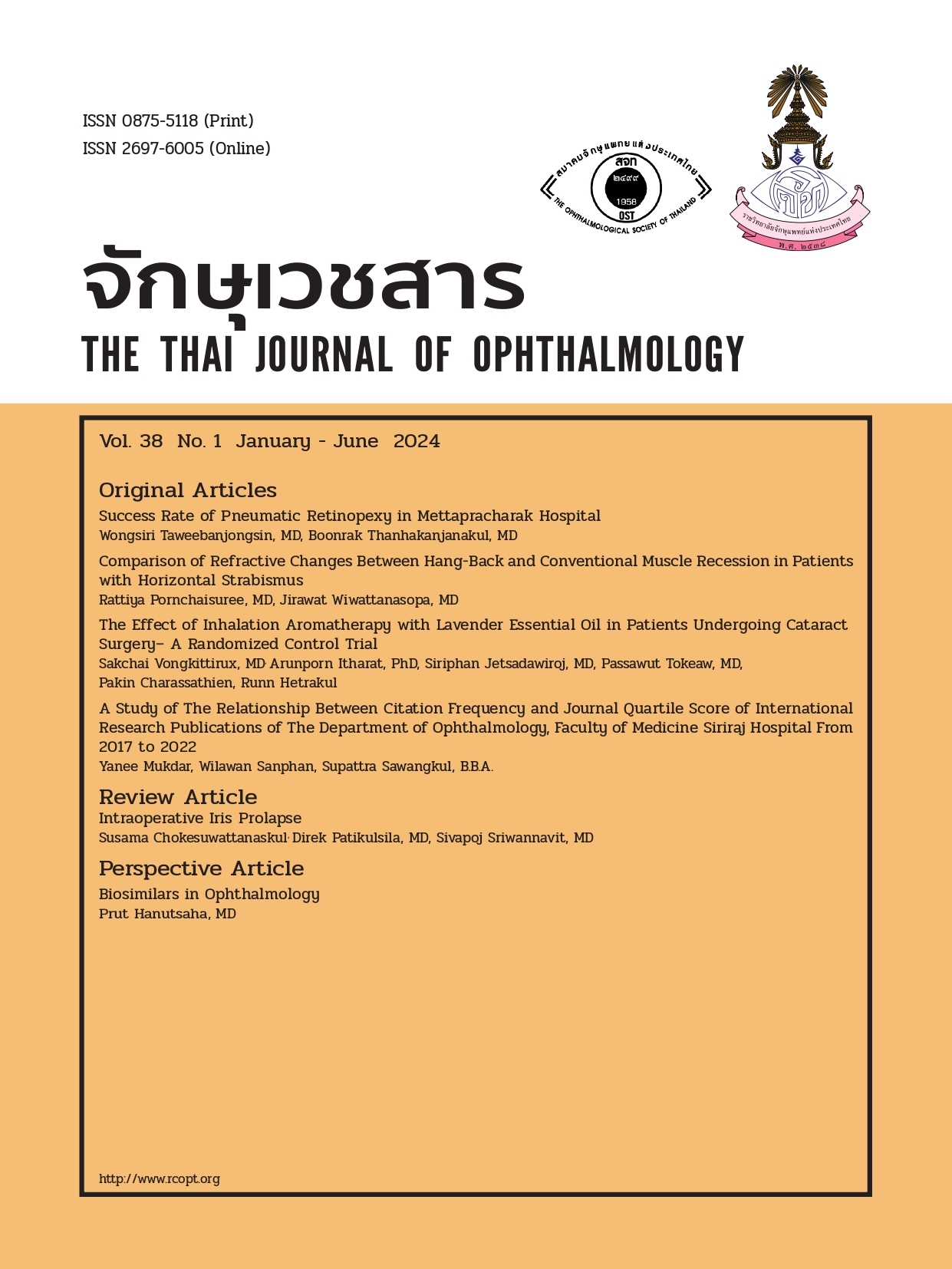
การศึกษาความผิดปกติของค่าสายตาภายหลังการผ่าตัดแก้ไขตาเขใน แนวนอนโดยเปรียบเทียบระหว่างการผ่าตัดด้วยวิธีการดั้งเดิมกับการผ่าตัด ด้วยวิธีแฮงแบ็ค
บทคัดย่อ
วัตถุประสงค์: เพื่อศึกษาเปรียบเทียบความผิดปกติของค่าสายตาภายหลังการผ่าตัดแก้ไขภาวะตาเขในแนวนอน ในกลุ่มผู้ป่วย
ที่ได้รับการผ่าตัดแบบดั้งเดิมกับกลุ่มผู้ป่วยที่ได้รับการผ่าตัดด้วยวิธีแฮงแบ็ค
วิธีการศึกษา: เป็นการศึกษาไปข้างหน้าในผู้ป่วยที่ได้รับการผ่าตัดแก้ไขตาเขในแนวราบในโรงพยาบาลราชวิถี โดยเปรียบเทียบ
กลุ่มที่ได้รับการตัดแบบดั้งเดิมกับกลุ่มแฮงแบ็ค แล้วดูความผิดปกติของค่าสายตาด้วยการวัดค่าสายตา, ค่าสายตาเอียงที่ผิวกระจกตา,
ความยาวของลูกตา หลังจากนั้นจะวัดค่าต่างๆเหล่านี้ ที่ 1 สัปดาห์, 1 เดือน, และ 3 เดือน แล้วนำมาเปรียบเทียบกับก่อนผ่าตัด
ผลการศึกษา: ศึกษาทั้งหมด 32 ตา จากผู้เข้าร่วมการศึกษาทั้งหมด 21 คน ผ่าตัดแบบดั้งเดิม 16 ตา (จาก 11 คน) และผ่าตัด
แบบแฮงแบ็ค 16 ตา (จาก 10 คน) การผ่าตัดทำโดยจักษุแพทย์เด็กและโรคตาเขของโรงพยาบาลราชวิถี 2 ท่าน โดยมีวิธีในการผ่าตัด
ทีเ่ ป็นมาตรฐานเดยี วกัน ทีก่ ่อนการผา่ ตดั กลุม่ ดัง้ เดิมมีคา่ สายอยูท่ ี่ -1.688 ± 1.749 D ในขณะทีก่ ลุม่ แฮงแบค็ มคี ่าสายตาอยูที่ -1.218
± 1.442 D (p-value = 0.162) ค่าสายตาเอียงที่ผิวกระจกตากลุ่มดั้งเดิมมีค่าอยู่ที่ -1.130 ± 0.689 D กลุ่มแฮงแบ็คค่าสายตาอยู่ที่
-1.130 ± 0.628 D (p-value = 0.253) เมื่อติดตามถึง 3 เดือน พบว่ากลุ่มดั้งเดิมมีค่าสายอยู่ที่ -1.922 ± 2.283 D กลุ่มแฮงแบ็คมี
ค่าสายตาอยู่ที่ -1.398 ± 1.667 D (p-value = 0.463) ค่าสายตาเอียงที่ผิวกระจกตากลุ่มดั้งเดิมอยู่ที่ -1.334 ± 0.768 D กลุ่มแฮง
แบ็คค่าสายตาอยู่ที่ -1.284 ± 0.781 D (p-value = 0.856)
สรุป: ความผิดปกติของค่าสายตาภายหลังการผ่าตัดแก้ไขตาเขในแนวนอนในการผ่าตัดแบบดั้งเดิมกับกลุ่มผู้ป่วยที่ได้รับการ
ผ่าตัดแบบแฮงแบ็คไม่ได้มีความแตกต่างกันอย่างมีนัยสำคัญทางสถิติเมื่อติดตามหลังการผ่าตัดเป็นระยะเวลา 3 เดือน
เอกสารอ้างอิง
Mezad-Koursh D, Leshno A, Ziv-Baran T, Stolovitch C. Refractive Changes Induced by Strabismus Corrective Surgery in Adults. J Ophthalmol. 2017;2017:2680204. doi: 10.1155/2017/2680204. Epub 2017 Jan 16. PMID: 28191347; PMCID: PMC5278515.
Noh JH, Park KH, Lee JY, Jung MS, Kim SY. Changes in refractive error and anterior segment parameters after isolated lateral rectus muscle recession. Journal of American Association for Pediatric Ophthalmology and Strabismus. 2013;17(3):291–5.
Chun BY, Kim HK, Kwon JY. Comparison of magnitude of astigmatism induced by lateral rectus recession. Optom Vis Sci. 2010 Jan;87(1):61-5. doi: 10.1097/OPX.0b013e3181c1d695. PMID: 19935439.
Karakosta C, Bougioukas KI, Karra M, Kontopanos G, Methenitis G, Liaskou M, Paraskevopoulos K, Kokolaki A. Changes in astigmatism after horizontal muscle recession strabismus surgery: A retrospective cohort study. Indian J Ophthalmol. 2021 Jul;69(7):1888-1893. doi: 10.4103/ijo.IJO_3228_20. PMID: 34146052; PMCID: PMC8374751.
Marshall D. Changes in refraction following operation for strabismus. Arch Ophthalmol. 1936;15(6):1020-1031. doi:10.1001/archopht.1936.00840180064006.
Thompson WE, Reinecke RD. The changes in refractive status following routine strabismus surgery. J Pediatr Ophthalmol Strabismus. 1980 Nov-Dec;17(6):372-4. doi: 10.3928/0191-3913-19801101-05. PMID: 7205517.
Hainsworth DP, Bierly JR, Schmeisser ET, Baker RS. Corneal topographic changes after extraocular muscle surgery. J AAPOS. 1999 Apr;3(2):80-6. doi: 10.1016/ s1091-8531(99)70074-1. PMID: 10221799.
Cruz, Oscar A. et al. Amblyopia Preferred Practice Pattern. Ophthalmology, Volume 130, Issue 3, P136 -P178.
Bernard R. Fundamentals of biostatistics. 5thed: Duxbury Press; 2000.
Kwitko S, Sawusch MR, McDonnell PJ, Gritz DC, Moreira H, Evensen D. Effect of Extraocular Muscle Surgery on Corneal Topography. Arch Ophthalmol. 1991;109(6):873–878. doi:10.1001/archopht. 1991.01080060137042.
Cakmak H, Kocatürk T, Dündar SO. Comparison of surgically induced astigmatism in patients with horizontal rectus muscle recession. Int J Ophthalmol. 2014;7(4):709-713. Published 2014 Aug 18. doi:10.3980/j.issn.2222-3959.2014.04.23.
Hong SW, Kang NY. Astigmatic changes after horizontal rectus muscle surgery in intermittent exotropia. Korean J Ophthalmol. 2012;26(6):438-445. doi:10.3341/kjo.2012.26.6.438.
เผยแพร่แล้ว
ฉบับ
ประเภทบทความ
สัญญาอนุญาต

อนุญาตภายใต้เงื่อนไข Creative Commons Attribution-NonCommercial-NoDerivatives 4.0 International License.
วารสารจักษุวิทยาไทย (TJO) เป็นวารสารทางวิทยาศาสตร์ที่ผ่านการตรวจสอบโดยผู้ทรงคุณวุฒิ ตีพิมพ์ปีละสองครั้งสำหรับราชวิทยาลัยจักษุแพทย์แห่งประเทศไทย วัตถุประสงค์ของวารสารคือเพื่อให้ความรู้ทางวิทยาศาสตร์ที่ทันสมัยในสาขาจักษุวิทยา ให้การศึกษาต่อเนื่องแก่จักษุแพทย์ ส่งเสริมความร่วมมือและการแลกเปลี่ยนความคิดเห็นระหว่างผู้อ่าน
ลิขสิทธิ์ของบทความที่ตีพิมพ์เป็นของวารสารจักษุวิทยาไทย อย่างไรก็ตาม เนื้อหา ความคิด และความคิดเห็นในบทความนั้นมาจากผู้เขียน คณะบรรณาธิการไม่จำเป็นต้องเห็นด้วยกับความคิดและความคิดเห็นของผู้เขียน
ผู้เขียนหรือผู้อ่านสามารถติดต่อคณะบรรณาธิการได้ทางอีเมลที่ admin@rcopt.org

