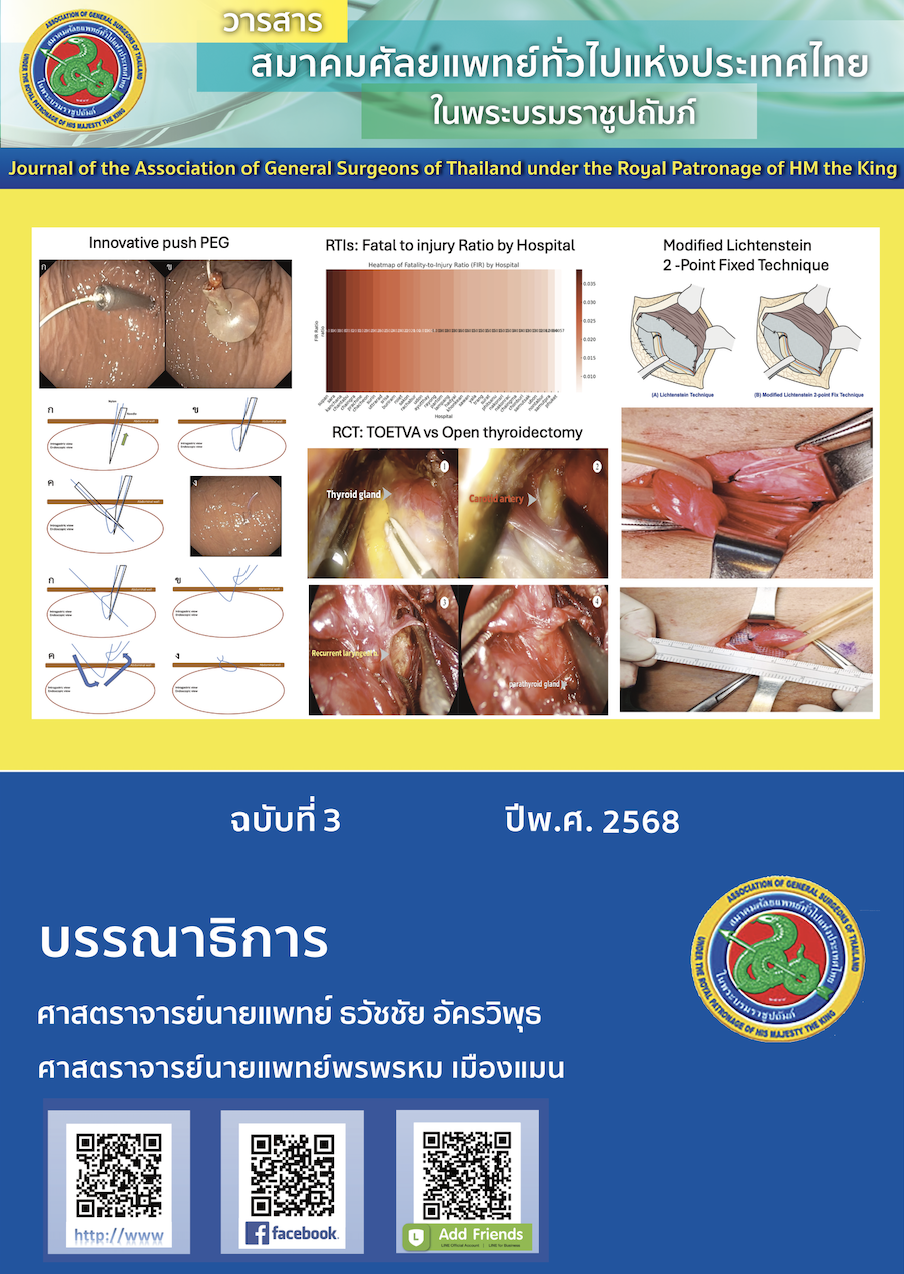
ความสัมพันธ์ระหว่างระยะทางจากทางหลวงสายหลักถึงโรงพยาบาลกับการเสียชีวิตจากบาดเจ็บทางถนนในประเทศไทย
คำสำคัญ:
การบาดเจ็บทางถนน, อัตราส่วนการตายต่อการบาดเจ็บ, อัตราการเสียชีวิต, ทางหลวงสายหลัก, RTIs, FIRบทคัดย่อ
ภูมิหลัง: การบาดเจ็บทางถนน (RTIs) ยังคงเป็นสาเหตุหลักของการเจ็บป่วยและการเสียชีวิตทั่วโลก โดยเฉพาะในประเทศรายได้ปานกลางถึงต่ำเช่นประเทศไทย การเข้าถึงการรักษาภาวะบาดเจ็บฉุกเฉินอย่างทันท่วงทีมีความสำคัญต่อการรอดชีวิต แต่ปัจจัยด้านระยะทางจากโรงพยาบาลถึงถนนสายหลักที่ส่งผลต่อผลลัพธ์การบาดเจ็บทางถนนในประเทศไทยยังไม่เป็นที่เข้าใจชัดเจน
วิธีการศึกษา: การศึกษาย้อนหลังแบบสังเกตการณ์ โดยวิเคราะห์ข้อมูลจากโรงพยาบาล 35 แห่งทั่วประเทศไทยในปี 2567 คำนวณระยะทางจากโรงพยาบาลถึงทางหลวงสายหลักด้วยระบบสารสนเทศภูมิศาสตร์ ตัวชี้วัดผลลัพธ์รวมจำนวนผู้บาดเจ็บจาก RTI จำนวนผู้เสียชีวิต และอัตราส่วนการตายต่อการบาดเจ็บ (Fatality injury ratio, FIR) ใช้การวิเคราะห์ทางสถิติ ได้แก่ สหสัมพันธ์แบบเพียร์สัน การถดถอยเชิงเส้นพหุคูณ และการถดถอยโลจิสติกเพื่อตรวจสอบความสัมพันธ์ระหว่างระยะทาง ภาระการบาดเจ็บ และอัตราการเสียชีวิต โดยใช้แผนที่แสดงการกระจายเชิงพื้นที่ด้วยความร้อน (spatial heatmaps) ระบุกลุ่มพื้นที่ที่มีอัตราการเสียชีวิตสูง
ผลการศึกษา: ระยะทางเฉลี่ยจากโรงพยาบาลถึงถนนสายหลักใกล้ที่สุดอยู่ที่ 14.7 กม. (SD 8.3) พบผู้บาดเจ็บจาก RTI ทั้งสิ้น 12,450 ราย เสียชีวิต 312 ราย อัตราการเสียชีวิต 2.5% ระยะทางจากถนนสายหลักไม่แสดงสหสัมพันธ์ที่สำคัญกับจำนวนผู้บาดเจ็บ (r=0.09, p=0.711) แต่มีความสัมพันธ์ทางบวกปานกลางกับจำนวนผู้เสียชีวิต (r=0.38, p=0.193) การถดถอยพหุคูณชี้ว่าจำนวนผู้บาดเจ็บและผู้พิการเป็นตัวทำนายการเสียชีวิตได้อย่างมีนัยสำคัญ (p<0.001) ในขณะที่ระยะทางแสดงความสัมพันธ์ทางลบในระดับเกณฑ์ตัดสิน (borderline) กับการเสียชีวิต การถดถอยโลจิสติกจำแนกโรงพยาบาลตามระดับ FIR ด้วยความแม่นยำ 85.7% โดยภาระผู้พิการเป็นตัวทำนาย FIR สูงได้อย่างชัดเจน แผนที่ความร้อนแสดงกลุ่มพื้นที่ที่มี FIR สูงในจังหวัดห่างไกล
สรุป: ระยะทางใกล้ถนนสายหลักไม่สามารถทำนายอุบัติการณ์หรืออัตราการเสียชีวิตจาก RTI ได้โดยตรง แต่ความรุนแรงของการบาดเจ็บและภาระผู้พิการเป็นปัจจัยหลักที่ส่งผลต่อผลลัพธ์การเสียชีวิต ความห่างไกลทางภูมิศาสตร์อาจทำให้การเข้าถึงการรักษาล่าช้าและส่งผลต่อการรอดชีวิต ผลการศึกษานี้เน้นย้ำความจำเป็นในการพัฒนากลยุทธ์การดูแลผู้บาดเจ็บแบบบูรณาการที่แก้ไขปัญหาการเข้าถึงบริการทันเวลาและการฟื้นฟูสมรรถภาพ รวมถึงการจัดสรรทรัพยากรระบบการแพทย์ฉุกเฉิน (EMS) อย่างตรงเป้าไปยังพื้นที่เสี่ยงสูงในประเทศไทย
เอกสารอ้างอิง
Harmsen AMK, Giannakopoulos GF, Moerbeek PR, et al. The influence of prehospital time on trauma patients outcome: a systematic review. Eur J Trauma Emerg Surg. 2015 Dec;41(6):533-9.
Shanthakumar D, Payne A, Leitch T, et al. Trauma Care in Low- and Middle-Income Countries. Surg J (N Y). 2021 Oct 22;7(4):e281-e285.
Colnaric JM, El Sibai RH, Bachir RH, et al. Injury severity score as a predictor of mortality in adult trauma patients by injury mechanism types in the United States: A retrospective observational study. Medicine (Baltimore). 2022 Jul 15;101(28):e29614..
Balikuddembe JK, Ardalan A, Stephen KM, et al. Risk factors associated with road traffic injuries at the prone-areas in Kampala city: a retrospective cross-sectional study. J Inj Violence Res. 2021 Jan;13(1):13-22.
Newgard CD, Schmicker RH, Hedges JR, et al. Resuscitation Outcomes Consortium Investigators. Emergency medical services intervals and survival in trauma: assessment of the "golden hour" in a North American prospective cohort. Ann Emerg Med. 2010 Mar;55(3):235-246.e4.
Peden M, Scurfield R, Sleet D, et al. World report on road traffic injury prevention. Geneva: World Health Organization; 2004.
World Health Organization. Global status report on road safety 2018. Geneva: WHO; 2018.
Nantulya VM, Reich MR. The neglected epidemic: road traffic injuries in developing countries. BMJ. 2002 May 11;324(7346):1139-41.
Whitaker J, O'Donohoe N, Denning M, et al. Assessing trauma care systems in low-income and middle-income countries: a systematic review and evidence synthesis mapping the Three Delays framework to injury health system assessments. BMJ Glob Health. 2021 May;6(5):e004324.
Abegaz T, Berhane Y, Worku A, et al. Effectiveness of an improved road safety policy in Ethiopia: an interrupted time series study. BMC Public Health. 2014 Oct 20;14:539.
El Tayeb S, Abdalla S, Mørkve O, et al. Injuries in Khartoum state, the Sudan: a household survey of incidence and risk factors. Int J Inj Contr Saf Promot. 2014;21(2):144-53.
Mock C, Arreola-Risa C, Quansah R. Strengthening care for injured persons in less developed countries: a case study of Ghana and Mexico. Inj Control Saf Promot. 2003 Mar-Jun;10(1-2):45-51.
Tang N, Stein J, Hsia RY, et al. Trends and characteristics of US emergency department visits, 1997-2007. JAMA. 2010 Apr 7;304(6):664-70. doi:10.1001/jama.2010.1112.
Redelmeier DA, Tibshirani RJ, Evans L. Traffic-law enforcement and risk of death from motor-vehicle crashes: case-crossover study. Lancet. 2003 Jul 5;362(9376):717-20. doi:10.1016/S0140-6736(03)14105-9.
Gosselin RA, Spiegel DA, Coughlin R, et al. Injuries: the neglected burden in developing countries. Bull World Health Organ. 2009 Apr;87(4):246. doi:10.2471/BLT.08.054842.