
Dextrose Prolotherapy Treatment in De Quervain Tenosynovitis: Case Reports
Keywords:
De Quervain disease, tenosynovitis, prolotherapy, dextrose, case reportsAbstract
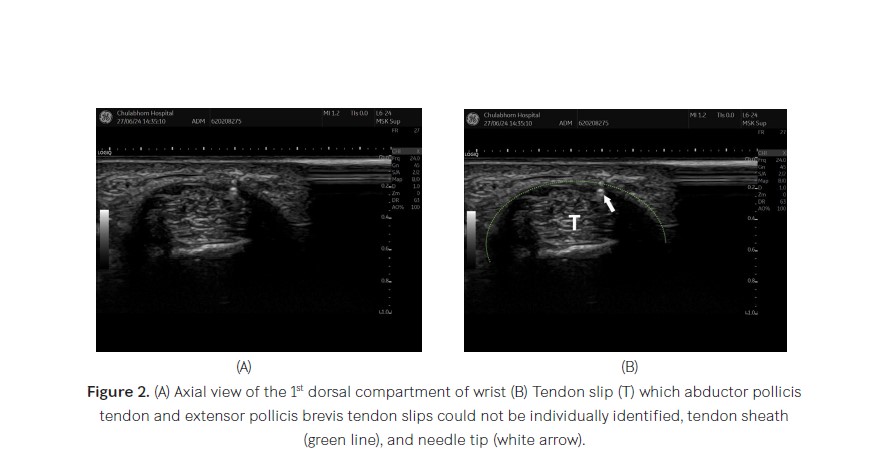
De Quervain tenosynovitis is a condition commonly found in patients presenting with wrist pain. The initial treatment typically involves rest, splinting, medication, and physical modalities. However, some patients do not show a favorable response to these treatments. In this report, we present two patients with chronic tenosynovitis of the first dorsal compartment whose condition did not improve with initial treatment. Both patients received ultrasound-guided injection with 1.5-2 ml 25% dextrose therapy (50% dextrose 0.75-1 ml + 1% lidocaine 0.75-1 ml) as their treatment. Their condition significantly improved, eliminating their symptoms to the point of almost complete resolution, allowing them to be able to return to their daily activities. Therefore, dextrose prolotherapy could be considered as a treatment option for de Quervain tenosynovitis.
Downloads
References
Ilyas AM, Ast M, Schaffer AA, Thoder J. De quervain tenosynovitis of the wrist. J Am Acad Orthop Surg. 2007;15(12):757-764. doi:10.5435/00124635-200712000-00009
Stahl S, Vida D, Meisner C, et al. Systematic review and meta-analysis on the work-related cause of de Quervain tenosynovitis: a critical appraisal of its recognition as an occupational disease: A critical appraisal of its recognition as an occupational disease. Plast Reconstr Surg. 2013;132(6):1479-1491. doi:10.1097/01.prs.0000434409.32594.1b
Adachi S, Yamamoto A, Kobayashi T, et al. Prevalence of de quervain’s disease in the general population and risk factors. Kitakanto Med J. 2011;61(4):479-482. doi:10.2974/kmj.61.479
Shen PC, Chang PC, Jou IM, Chen CH, Lee FH, Hsieh JL. Hand tendinopathy risk factors in Taiwan: A population-based cohort study. Medicine (Baltimore). 2019;98(1):e13795. doi:10.1097/MD.0000000000013795
Sharma R, Aggarwal AN, Bhatt S, Kumar S, Bhargava SK. Outcome of low level lasers versus ultrasonic therapy in de Quervain’s tenosynovitis. Indian J Orthop. 2015;49(5):542-548. doi:10.4103/0019-5413.164050
Haghighat S, Vahdatpour B, Ataei E. The effect of extracorporeal shockwave therapy on de Quervain tenosynovitis; A clinical trial. Shiraz E Med J. 2021;22(8). doi:10.5812/semj.106559
Ashraf MO, Devadoss VG. Systematic review and meta-analysis on steroid injection therapy for de Quervain’s tenosynovitis in adults. Eur J Orthop Surg Traumatol. 2014;24(2):149-157. doi:10.1007/s00590-012-1164-z
Hauser RA, Lackner JB, Steilen-Matias D, Harris DK. A systematic review of dextrose prolotherapy for chronic musculoskeletal pain. Clin Med Insights Arthritis Musculoskelet Disord. 2016;9:139-159. doi:10.4137/CMAMD.S39160
Riley DS, Barber MS, Kienle GS, et al. CARE guidelines for case reports: explanation and elaboration document. J Clin Epidemiol. 2017;89:218-235. doi:10.1016/j.jclinepi.2017.04.026
Brinks A, Koes BW, Volkers ACW, Verhaar JAN, Bierma-Zeinstra SMA. Adverse effects of extra-articular corticosteroid injections: a systematic review. BMC Musculoskelet Disord. 2010;11(1):206. doi:10.1186/1471-2474-11-206
Chen H, Yuan A. (548) Prolotherapy treatment for Dequervain’s Tenosynovitis and Intersection Syndrome. J Pain. 2015;16(4):S113. doi:10.1016/j.jpain.2015.01.469
Siampa VS, Tan CW. Treatment of de Quervain’s tenosynovitis with prolotherapy: A case report. Journal of Anesthesiology and Clinical Research. 2022;4(1):349-354. doi:10.37275/jacr.v4i1.257
Zora H, Bayrak G. The impact of prolotherapy and steroid injection on DE Quervain’s tenosynovitis: A retrospective outcome study. Acta Medica Alanya. 2024;8(1):68-76. doi:10.30565/medalanya.1456072
Goswami A. Prolotherapy. J Pain Palliat Care Pharmacother. 2012;26(4):376-378. doi:10.3109/15360288.2012.734900
Downloads
Published
How to Cite
Issue
Section
License
Copyright (c) 2025 Chulabhorn Royal Academy

This work is licensed under a Creative Commons Attribution-NonCommercial-NoDerivatives 4.0 International License.
Copyright and Disclaimer
Articles published in this journal are the copyright of Chulabhorn Royal Academy.
The opinions expressed in each article are those of the individual authors and do not necessarily reflect the views of Chulabhorn Royal Academy or any other faculty members of the Academy. The authors are fully responsible for all content in their respective articles. In the event of any errors or inaccuracies, the responsibility lies solely with the individual authors.


