
Mapping Inferior Epigastric Artery Relative to Abdominal Landmarks: Defining Surgical Safe Zones and Risks
Keywords:
Inferior epigastric artery, Laparoscopic surgery, Trocar placement, CadaverAbstract
Abstact
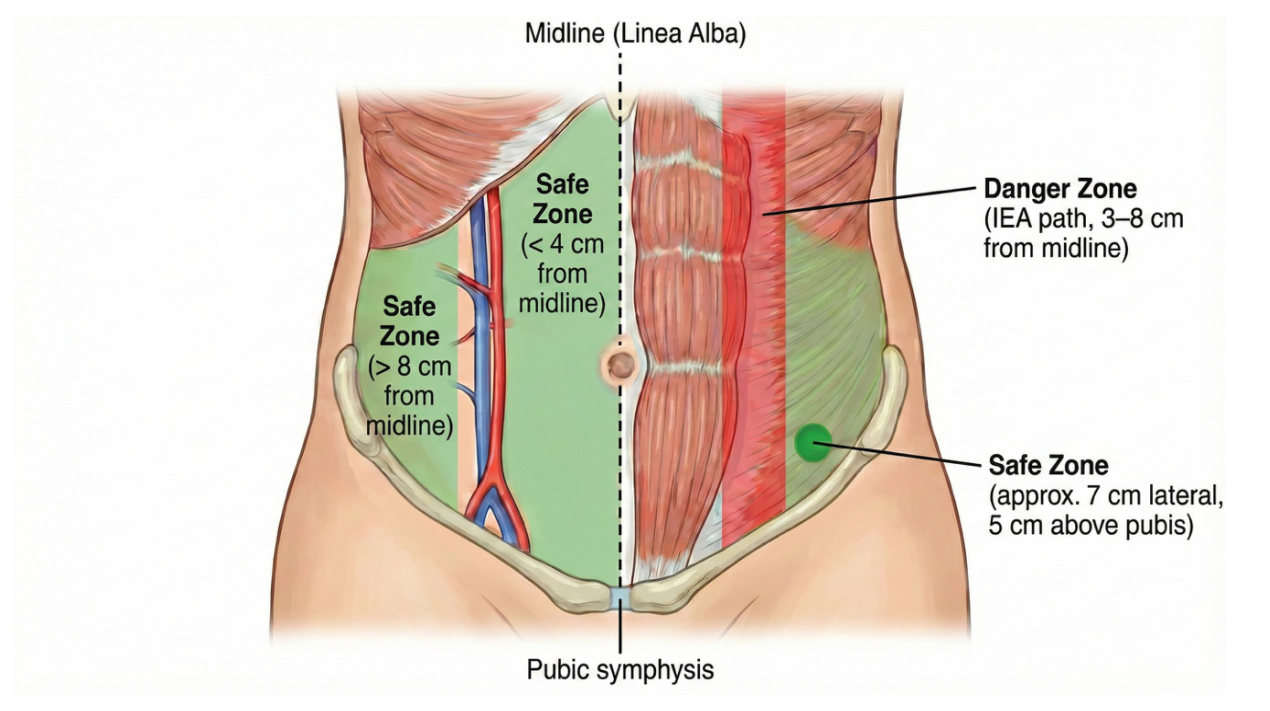
The inferior epigastric artery (IEA) is a critical landmark during laparoscopic surgery. While IEA injuries occur in only up to 2% of procedures, they can lead to serious complications such as port-site hematomas or life-threatening hemorrhage. This systematic review aims to clarify the IEA’s anatomical course relative to key abdominal landmarks to define surgical safe zones. We synthesized data from cadaveric dissections, radiologic imaging (CT and ultrasound), and surgical anatomy reviews. The IEA consistently courses within a paramedian "danger zone," typically located 4-8 cm lateral to the midline. Variations exist based on population and side; for instance, some studies show the vessel as close as 2 cm or as far as 10 cm from the midline. Higher BMI also tends to push the IEA slightly more lateral. To minimize injury risk, trocars should be placed in identified "safe zones": the avascular midline (linea alba) or areas >8 cm lateral to the midline. Given the current lack of Thai-specific anatomical data, local cadaveric studies are essential to refine these safety guidelines for regional populations.
Downloads
References
Mustafa, A.Y.A.A., et al., Anatomical Study and Clinical Importance of the Inferior Epigastric Artery. Int. J. Morphol, 2021. 39(3): p. 688-691.
Kandinata N, Van Fossen K. Anatomy, abdomen and pelvis: Epigastric artery. In: StatPearls. StatPearls Publishing; 2025.
de Rosnay P, Chandiramani M, Usman S, Owen E. Injury of epigastric vessels at laparoscopy: diagnosis and management. Gynecol Surg. 2011;8(3):353-356. doi:10.1007/s10397-010-0653-5
Prevezanos D, Chaikalis L, Vlachos D, et al. Utilization of the inferior epigastric artery in renal transplantation for patients with severe vascular atherosclerosis: A strategy to optimize graft availability. Cureus. 2025;17(1):e77852. doi:10.7759/cureus.77852
Epstein J, Arora A, Ellis H. Surface anatomy of the inferior epigastric artery in relation to laparoscopic injury. Clin Anat. 2004;17(5):400-408. doi:10.1002/ca.10192
Kostov S, Dineva S, Kornovski Y, Slavchev S, Ivanova Y, Yordanov A. Vascular Anatomy and Variations of the Anterior Abdominal Wall - Significance in Abdominal Surgery. Prague Med Rep. 2023;124(2):108-142. doi:10.14712/23362936.2023.9
Joy P, Prithishkumar IJ, Isaac B. Clinical anatomy of the inferior epigastric artery with special relevance to invasive procedures of the anterior abdominal wall. J Minim Access Surg. 2017;13(1):18-21. doi:10.4103/0972-9941.181331
Pun TC, Chau MT, Lam C, Tang G, Leong L. Sonographic localization of abdominal vessels in Chinese women: its role in laparoscopic surgery. Ultrasound Obstet Gynecol. 1998;11(1):59-61. doi:10.1046/j.1469-0705.1998.11010059.x
Gan Y, Xian Z, Liang M, et al. Anatomical characteristics of the inferior epigastric artery in Uygur and it’s implication in the management of bleeding. Asian J Surg. 2023;46(10):4352-4356. doi:10.1016/j.asjsur.2022.11.094
Saber AA, Meslemani AM, Davis R, Pimentel R. Safety zones for anterior abdominal wall entry during laparoscopy: a CT scan mapping of epigastric vessels: A CT scan mapping of epigastric vessels. Ann Surg. 2004;239(2):182-185. doi:10.1097/01.sla.0000109151.53296.07
Soren JK, Gond MS, Sharma D, Srivastav V. Variations in course of inferior epigastric artery- importance in laproscopic surgery. J Med Dent Sci Res. 2016;3(9):47-52.
Rao MP, Swamy V, Arole V, Mishra P. Study of the course of inferior epigastric artery with reference to laparoscopic portal. J Minim Access Surg. 2013;9(4):154-158. doi:10.4103/0972-9941.118826
Ramana B, Arora E, Belyansky I. Signs and landmarks in eTEP Rives-Stoppa repair of ventral hernias. Hernia. 2021;25(2):545-550. doi:10.1007/s10029-020-02216-4
Rao MP, Swamy V, Arole V, Mishra P. Study of the course of inferior epigastric artery with reference to laparoscopic portal. J Minim Access Surg. 2013;9(4):154-158. doi:10.4103/0972-9941.118826
Drakonaki EE, Adriaensen MEAPM, Al-Bulushi HIJ, Koliarakis I, Tsiaoussis J, Vanderdood K. Sonoanatomy of the ilioinguinal, iliohypogastric, genitofemoral, obturator, and pudendal nerves: a practical guide for US-guided injections. J Ultrason. 2022;22(88):e44-e50. doi:10.15557/JoU.2022.0008
Basic principles and anatomy for the laparoscopic surgeon. Abdominal Key.https://abdominalkey.com/basic-principles-and-anatomy-for-the-laparoscopic-surgeon/. Accessed March 15, 2025.
Andrade DR, Abranches D, Souza N, et al. An analysis of the anatomical trajectory of the inferior epigastric arteries in the era of videolaparoscopic surgery: is there in fact a “safety zone” for the prevention of iatrogenic lesions? Eur J Anat. 2012;16(1):43-48.
Joy P, Simon B, Prithishkumar IJ, Isaac B. Topography of inferior epigastric artery relevant to laparoscopy: a CT angiographic study. Surg Radiol Anat. 2016;38(3):279-283. doi:10.1007/s00276-015-1513-9
Burnett TL, Garza-Cavazos A, Groesch K, Robbs R, Diaz-Sylvester P, Siddique SA. Location of the deep epigastric vessels in the resting and insufflated abdomen. J Minim Invasive Gynecol. 2016;23(5):798-803. doi:10.1016/j.jmig.2016.04.002
Wong C, Merkur H. Inferior epigastric artery: Surface anatomy, prevention and management of injury. Aust N Z J Obstet Gynaecol. 2016;56(2):137-141. doi:10.1111/ajo.12426
Vilos GA, Ternamian A, Laberge PY, et al. Guideline no. 412: Laparoscopic entry for gynaecological surgery. J Obstet Gynaecol Can. 2021;43(3):376-389.e1. doi:10.1016/j.jogc.2020.12.012
GUARÍN-SASTRE, D.E. and A.F. YEPES, Surface Abdominal Anatomy, Aesthetics, and Proportionality, in TULUA Abdominoplasty. 2025, Elsevier. p. 13-22.
Egea AM. Surgical anatomy of the anterolateral wall of the abdomen and classification of the diastasis recti. In: New Concepts in Diastasi Recti Surgery. Springer Nature Switzerland; 2024:13-30.
Güven E, Dura MC, Aktürk H, Güraslan H. Safety of laparoscopic entry points in patients with a history of abdominal surgery: A research article. Cureus. 2023;15(10):e47244. doi:10.7759/cureus.47244
Barrie J. Principles of laparoscopic surgery. In: Dennison AR, Maddern GJ, Fan J, eds. Bailey & Love's Essential Operations in Hepatobiliary and Pancreatic Surgery. CRC Press; 2024:52-60.
Abdul-Ameer HH, Jaffar AA, Hassan HA. Surgical anatomy of the superior epigastric artery. Iraqi J Med Sci. 2006;5(1):3-7.
Madhok B, Nanayakkara K, Mahawar K. Safety considerations in laparoscopic surgery: A narrative review. World J Gastrointest Endosc. 2022;14(1):1-16. doi:10.4253/wjge.v14.i1.1
Cardoso GI, Chinelatto LA, Hojaij F, Akamatsu FE, Jacomo AL. Corona Mortis: A systematic review of literature. Clinics (Sao Paulo). 2021;76(e2182):e2182. doi:10.6061/clinics/2021/e2182
Tazi ST. Comparison of breast sensibility following breast reconstruction with two different techniques: deep inferior epigastric perforator flap and implant. EMJ Oncol. 2024;12(1):86-93.
Munarriz R, Thirumavalavan N, Gross MS. Is there a role for vascular surgery in the contemporary management of erectile dysfunction? Urol Clin North Am. 2021;48(4):543-555. doi:10.1016/j.ucl.2021.07.002
Downloads
Published
How to Cite
Issue
Section
License
Copyright (c) 2026 Chulabhorn Royal Academy

This work is licensed under a Creative Commons Attribution-NonCommercial-NoDerivatives 4.0 International License.
Copyright and Disclaimer
Articles published in this journal are the copyright of Chulabhorn Royal Academy.
The opinions expressed in each article are those of the individual authors and do not necessarily reflect the views of Chulabhorn Royal Academy or any other faculty members of the Academy. The authors are fully responsible for all content in their respective articles. In the event of any errors or inaccuracies, the responsibility lies solely with the individual authors.


