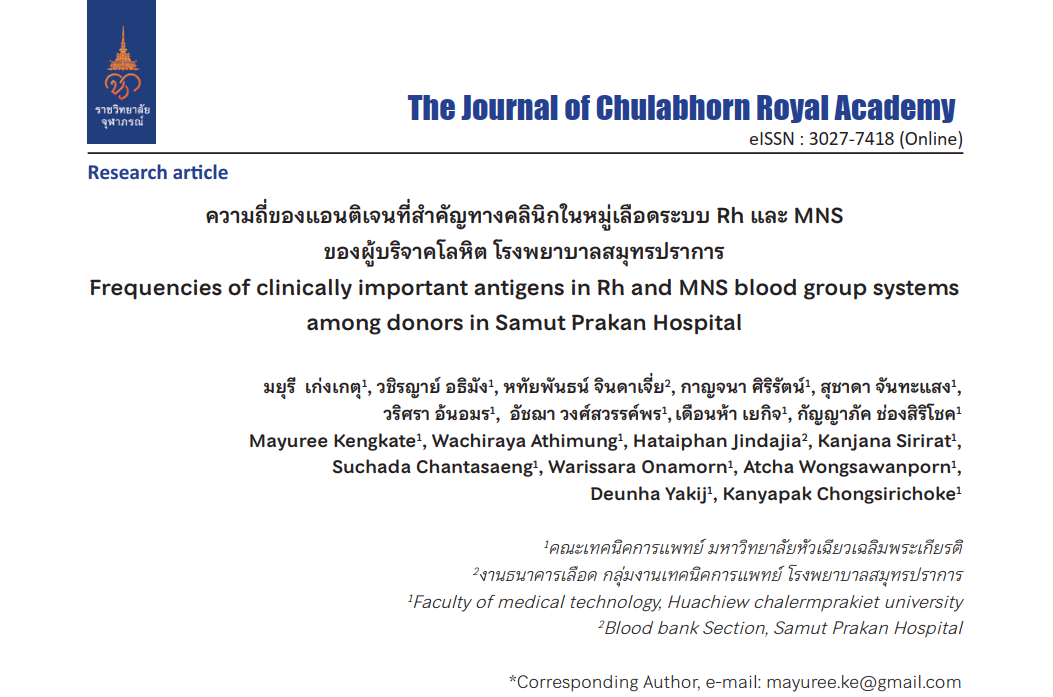
Frequencies of clinically important antigens in Rh and MNS blood group systems among donors in Samut Prakan Hospital
Keywords:
Red blood cell antigens, Rh blood group system, MNS blood group systemAbstract
Currently, hospitals in Thailand have shown increasing interest in detecting clinically significant red blood cell antigens in donor blood samples, specifically within the Rh and MNS systems. As patients frequently develop alloantibodies against these blood group systems, ensuring transfusion safety requires the selection of antigen-negative blood units that correspond to the patient’s antibodies. Consequently, pre-transfusion phenotyping of donor blood is highly beneficial for facilitating safe and rapid blood procurement.
This research investigated the frequency of Rh and MNS blood group antigens among 315 blood donors at Samut Prakan Hospital utilizing the standard tube technique. The results revealed the following Rh antigen frequencies: D (99.68%), C (95.56%), c (36.83%), E (28.57%), and e (98.73%). Regarding the MNS system, the antigen frequencies were: M (93.65%), N (48.57%), and Mia (12.7%). The most prevalent Rh phenotype was DCCee (60.95%), followed by DCcEe (22.54%). For the MNS system, the most common phenotype was M+N- (51.43%).
In conclusion, this study found that D, e, and C were the most common Rh antigens, while M was the most predominant MNS antigen in donor blood samples at Samut Prakan Hospital. These findings are consistent with other studies conducted in Thailand. The obtained data serves as a guideline for establishing a blood donor antigen database at Samut Prakan Hospital.
Downloads
References
Po-ngernnak P, Sasjeenpong S, Chuesakul K, Pangwangthong K. The Prevalence of Red Blood Cell Alloantibodies in Lower Northern Thailand.J Med Assoc Thai. 2016;99(12):1337-1343.https://pubmed.ncbi.nlm.nih.gov/29952524/
Chidtrakoon S, Jeumjanya N, Sasikarn W, Intharanut K and Nathalang O. Prevalence and Specificity of Red Cell Alloantibodies in Repeated Antibody Screening among Thai Blood Donors. J Med Tech Assoc Thailand. 2018;46: 6341-52. https://he01.tci-thaijo.org/ index.php/jmt-amtt/article/view/200805
Srijinda S, Bosuwan S, Nuanin C, Suwanasophon C. Anti-Mi and Anti-E: The Most Common Clinically Significant Red Cell Alloantibodies in Patients at Phramongkutklao Hospital. RTA Med. J. 2560;70: 65-71. https://he02.tci-thaijo.org/index.php/rtamedj/article/view/91113
จริยา สายพิณ. รายงานผู้ป่วย Identification of Multiple Antibodies in a Thai Patient. วารสารโลหิตวิทยาและเวชศาสตร์บริการโลหิต. 2559;26(4):131-6. https://he01.tci-thaijo.org/index.php/JHematolTransfusMed/article/view/69261
Lao-on U. and Lao-on K. A review on the prevalence of unexpected alloantibodies in Thai patients across Thailand. Journal of Associated Medical Sciences. 2025;59(1),129–136. doi:10.12982/jams.2026.016
International Society of Blood Transfusion. Blood group database. https://blooddatabase.isbtweb.org/database. Accessed February 11, 2026.
กัมพล อินทรนุช, วัลลภา ใช้บางยาง, พิชชาภัทร์ นิ่มนุช และ อ้อยทิพย์ ณ ถลาง. ความแตกต่างทางพันธุกรรมของหมู่เลือดในกลุ่มผู้บริจาคโลหิตคนไทย.วารสารโลหิตวิทยาและเวชศาสตร์บริการโลหิต. 2566;33(1):74-7.https://he01.tci-thaijo.org/index.php/JHematolTransfusMed/article/view/262367
ฌลณต เกษตร, ศิริพร ณ ถลาง, นิภาพรรณ ลี้ตระกูล และ อ้อยทิพย์ ณ ถลาง. การตรวจโมเลกุลของ MNS Hybrids (GP.Hut, GP.Mur, GP.Hop, GP.Bun และGP.HF) ในผู้บริจาคโลหิตคนไทยภาคกลางและภาคเหนือ. วารสารโลหิตวิทยาและเวชศาสตร์บริการโลหิต.2558;2: 101-6. https://he01.tci-thaijo.org/index.php/JHematolTransfusMed/article/view/36736
พลอยมณี สุวรรณวุฒิชัย. MNS blood group inThai population: significant or not. วารสารโลหิตวิทยาและเวชศาสตร์บริการโลหิต. 2565;32(2):165-7. https://he01.tci-thaijo.org/index.php/JHematolTransfusMed/article/view/257190
ศศิธร หัสวาที.การตรวจแอนติเจนของเม็ดเลือดแดงในโลหิตบริจาคเพื่อเตรียมโลหิตให้กับผู้ป่วยที่ตรวจพบแอนติบอดีต่อหมู่โลหิต ระบบอื่น ๆ ที่ไม่ใช่ระบบเอบีโอของโรงพยาบาลมหาราชนครราชสีมา.https://www.mnrh.go.th/pdf_file_academic/academic_25650425.pdf. Accessed September 18, 2025.
ศรัญญา ทุมโพธิ์กลาง, ณัฐชนิดา เพียงชัยภูมิ และพลอยมณี สุวรรณวุฒิชัย. การทดสอบแอนติเจน C,E, c, e และ Mia บนเม็ดเลือดแดง โดยใช้เครื่องตรวจวิเคราะห์อัตโนมัติ Ortho Vision Max ในผู้บริจาคโลหิตของภาคบริการโลหิตแห่งชาติที่ 3 จังหวัดชลบุรี.วารสารโลหิตวิทยาและเวชศาสตร์บริการโลหิต.2566;33(2): 21-7. https://he01.tci-thaijo.org/index.php/JHematolTransfusMed/article/view/261111
ทองใบ รุ่งเรือง, ศศิจิต เวชแพศย์, ภิญญดา โรจน์พวง,วราภรณ์ พิมสามสี และ วิโรจน์ จงกลวัฒนา. การตรวจแอนติเจนของเม็ดเลือดแดงในโลหิตบริจาค เพื่อเตรียมเลือดที่ปลอดภัยให้ผู้ป่วยที่ขอใช้เลือดที่โรงพยาบาลศิริราช. วารสารโลหิตวิทยาและเวชศาสตร์บริการโลหิต. 2561;28(4): 423-30. https://he01.tci-thaijo.org/index.php/JHematolTransfusMed/article/view/149261
Duangchan T, Suklim N, Pornpisanvijit V, et al. Distribution of ABO, Rh and MNS blood group from students in Walailak University, Thailand: A descriptive cross-sectional study. Clin Epidemiol Glob Health. 2024;28: 1-5. doi.org/10.1016/j.cegh.2024.101625
Romphruk AV, Butryojantho C, Jirasakonpat B, et al. Phenotype frequencies of Rh (C, c, E,e), M, Mia and Kidd blood group systems among ethnic Thai blood donors from the north-east of Thailand. Int J Immunogenet. 2019;46(3):160-165. doi:10.1111/iji.12420
Tung Quang Nguyen, Tuyen Thi Do, Nga Thanh Thi Hoang, et al. Frequencies of different blood group antigens and phenotypes in Northern Vietnamese donors. Transfus Med. 2025 Aug;35(4): 346-351. doi: 10.1111/tme.13136.
Manoj A Kahar and Rajnikant D Patel. Phenotype frequencies of blood group systems (Rh, Kell, Kidd, Duffy, MNS, P, Lewis, and Lutheran) in blood donors of south Gujarat, India. Asian J Transfus Sci. 2014 Jan-Jun;8(1): 51–55. doi:10.4103/0973-6247.126693.
Al-Riyami AZ, Al-Marhoobi A, Al-Hosni S, Al-Harthi S, Al-Kindy S, Al-Hashami S. Prevalence of red blood cell major blood group antigens and phenotypes among Omani blood donors. Oman Med J. 2019;34(6): 496-503. doi:10.5001/omj.2019.92
Amr J Halawani, Mahmoud M Habibullah, Gasim Dobie, et al. Frequencies of MNS Blood Group Antigens and Phenotypes in Southwestern Saudi Arabia. Int J Gen Med. 2021; 14: 9315–9. doi: 10.2147/IJGM.S344826.
Alalshaikh M, Almalki Y, Hasanato R, et al. Frequency of Rh and K antigens in blood donors in Riyadh. Hematol Transfus Cell Ther. 2022;44(4):555-559. doi:10.1016/j.htct.2021.03.003
Downloads
Published
How to Cite
Issue
Section
License
Copyright (c) 2026 Chulabhorn Royal Academy

This work is licensed under a Creative Commons Attribution-NonCommercial-NoDerivatives 4.0 International License.
Copyright and Disclaimer
Articles published in this journal are the copyright of Chulabhorn Royal Academy.
The opinions expressed in each article are those of the individual authors and do not necessarily reflect the views of Chulabhorn Royal Academy or any other faculty members of the Academy. The authors are fully responsible for all content in their respective articles. In the event of any errors or inaccuracies, the responsibility lies solely with the individual authors.


