
Comparison of Blood Coagulation Tests in Fresh Frozen Plasma Thawed at 37 and 45 Degrees Celsius
Keywords:
Coagulation parameters, Fresh frozen plasma, Plasma thawingAbstract
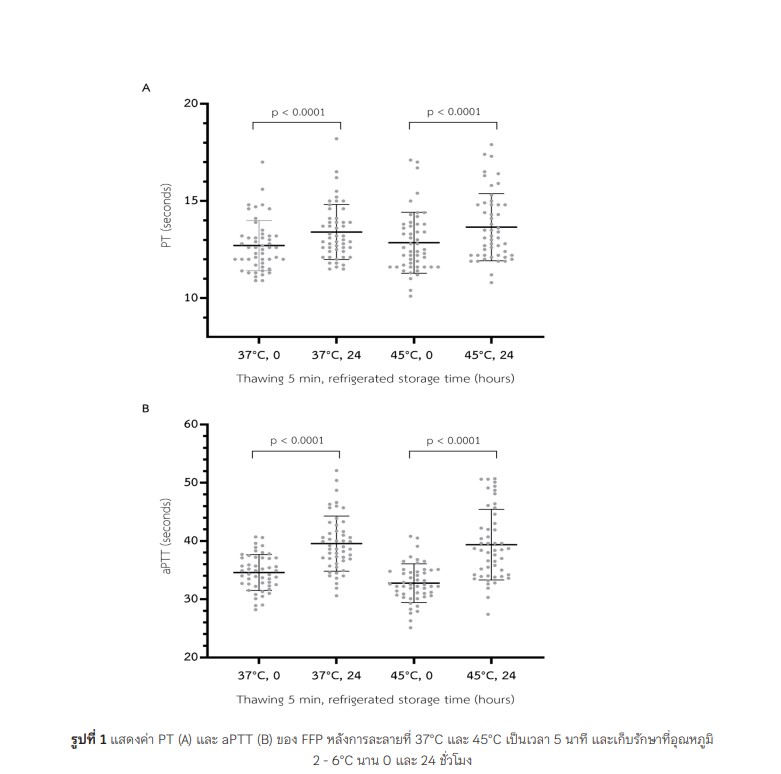
Fresh frozen plasma (FFP) is an important blood component used in the treatment of bleeding, particularly in emergency situations where rapid administration is required. The thawing temperature and the post-thaw storage duration affect the quality of coagulation factors. This study aimed to compare prothrombin time (PT) and activated partial thromboplastin time (aPTT) in FFP thawed at 37°C and 45°C. A total of 150 plasma segments from 100 FFP units were divided into two experimental sets. The first set, PT and aPTT were measured immediately after thawing at 37°C and 45°C for 5 minutes and after 24 hours of storage. The second set, FFP was thawed at 45°C for 20 minutes, with PT measured immediately and after 24 hours of storage, and aPTT measured immediately and after 6, 12, and 24 hours of storage. The results showed that the temperature and duration of thawing did not significantly affect PT and aPTT when compared at the same time points. However, storage after thawing for 24 hours resulted in a significant increase in both PT and aPTT (p < 0.0001). PT increased by 5.5–6.2%, and aPTT increased by 14.2–21.7%, depending on the thawing temperature and duration of thawing. These findings indicate that post-thaw storage impacts plasma quality, particularly aPTT, which is highly sensitive to storage duration. Therefore, FFP should be used immediately after thawing. Further studies are recommended to evaluate the stability of specific coagulation factors before applying the thawing method at 45°C in clinical practice.
Downloads
References
Horstman EE, Tormey CA. Plasma products for transfusion: an overview. Ann Blood. 2022;7:4-4. doi:10.21037/aob-22-7
Bélisle S, Hardy JF. Fresh frozen plasma: Clinical guidelines and use. Transfus Altern Transfus Med. 2003;5(3):363-367. doi:10.1111/j.1778-428x.2003.tb00176.x
Khawar H, Patel P, Stevens JB, Guzman N. Fresh frozen plasma (FFP). In: StatPearls. StatPearls Publishing; 2025. https://www.ncbi.nlm.nih.gov/books/NBK513347/. Accessed September 5, 2025
Australian and New Zealand Society of Blood Transfusion (ANZSBT). Extended Life Plasma: A Framework for Preparation, Storage and Use. 2nd ed. Australian and New Zealand Society of Blood Transfusion Ltd; 2013.
Cardigan R, Green L. Thawed and liquid plasma--what do we know? Vox Sang. 2015;109(1):1-10. doi:10.1111/vox.12251s
Green L, Cardigan R. Review of the shelf life of fresh frozen plasma components following thawing. https://www.transfusionguidelines.org/document-library/documents/position-statement-review-of-the-shelf-life-of-fresh-frozen-plasma-components-following-thawing. Accessed September 6, 2025.
Tholpady A, Monson J, Radovancevic R, Klein K, Bracey A. Analysis of prolonged storage on coagulation Factor (F)V, FVII, and FVIII in thawed plasma: is it time to extend the expiration date beyond 5 days?: ANALYSIS OF STORAGE ON COAGULATION FACTORS. Transfusion. 2013;53(3):645-650. doi:10.1111/j.1537-2995.2012.03786.x
Shamsudin S, Yousuf R, Tang YL, Ding CH, Leong CF. Evaluation of coagulation factor activity and sterility of thawed fresh frozen plasma during storage up to 5 days at 4°C. Malaysian Journal of Pathology. 2020;42(1): 59-64. https://pubmed.ncbi.nlm.nih.gov/32342931/
Noordin SS, Karim FA, Mohammad WMZBW, Hussein AR. Coagulation factor activities changes over 5 days in thawed fresh frozen plasma stored at different initial storage temperatures. Indian J Hematol Blood Transfus. 2018;34(3):510-516. doi:10.1007/s12288-017-0879-8
พิมล เชี่ยวศิลป์, ศศิธร เพชรจันทร, อภิสิทธิ์ ทองไทยสิน, บรรณาธิการ. มาตรฐานธนาคารเลือดและงานบริการโลหิต. พิมพ์ครั้งที่ 5. ศูนย์บริการโลหิตแห่งชาติ สภากาชาดไทย; 2567
European Directorate for the Quality of Medicines & HealthCare (EDQM). Guide to the preparation, use and quality assurance of blood components. 22nd ed. Strasbourg, France: Council of Europe; 2025.
McCullagh J, Booth C, Lancut J, Platton S, Richards P, Green L. Every minute counts: A comparison of thawing times and haemostatic quality of plasma thawed at 37°C and 45°C using four different methods. Transfus Med. 2024;34(4):304-310. doi:10.1111/tme.13061
Monson J, Bracey A, Radovancevic R, Wong C. Effects of thawing FFP at 37 degrees C and 45 degrees C and prolonged storage on the coagulation factors V, VII, and VIII. Transfusion (Paris). 2004;44:64A.
Plotz RD, Ciotola RT. Thawing of fresh-frozen plasma at 45 degrees C versus 37 degrees C. Comparison using satellite packs of the same donor units. Am J Clin Pathol. 1988;89(3): 381-384. doi:10.1093/ajcp/89.3.381
Platton S, Elegbe O, Bower L, et al. Thawing times and hemostatic assessment of fresh frozen plasma thawed at 37°C and 45°C using water-bath methods. Transfusion. 2019;59(11):3478-3484. doi:10.1111/trf.15553
Holcomb JB, Tilley BC, Baraniuk S, et al. Transfusion of plasma, platelets, and red blood cells in a 1:1:1 vs a 1:1:2 ratio and mortality in patients with severe trauma: the PROPPR randomized clinical trial: The PROPPR randomized clinical trial. JAMA. 2015;313(5):471-482. doi:10.1001/jama.2015.12
Lammers D, Richman J, Holcomb JB, Jansen JO. Use of Bayesian statistics to reanalyze data from the Pragmatic Randomized Optimal Platelet and Plasma Ratios trial. JAMA Netw Open. 2023;6(2):e230421. doi:10.1001/jamanetworkopen.2023.0421
Castellone DD. Establishing reference intervals in the coagulation laboratory. Int J Lab Hematol. 2017;39 Suppl 1:121-127. doi:10.1111/ijlh.12661
Ahmed R, Ganguli P, Singh N, et al. Establishing reference ranges and normal values for coagulation screening in healthy Indian male volunteers enrolled for a longitudinal study. Biomedical and Biotechnology Research Journal (BBRJ). 2019;3(1):22. doi:10.4103/BBRJ.BBRJ_140_18
Isaacs MS, Scheuermaier KD, Levy BL, Scott LE, Penny CB, Jacobson BF. In vitro effects of thawing fresh-frozen plasma at various temperatures. Clin Appl Thromb Hemost. 2004; 10(2):143-148. doi:10.1177/107602960401000204
Dhantole L, Dubey A, Sonker A. A study on factors influencing the hemostatic potential of fresh frozen plasma. Asian J Transfus Sci. 2019;13(1):23-29. doi:10.4103/ajts.AJTS_139_17
Rikimaru S, Mimura K, Takano N, et al. Rapid thawing of fresh frozen plasma with a 45°C dry tempering system maintains critical coagulation activities. Transfusion. 2025;65(11):2024-2033. doi:10.1111/trf.18426
Kitchen S, Olson JD, Preston FE. Quality in laboratory hemostasis and thrombosis. Wiley-Blackwell; 2013.
Hoffman R, Benz EJ Jr, Silberstein LE, et al. Hematology: basic principles and practice. 7th ed. Elsevier; 2018.
Winter WE, Flax SD, Harris NS. Coagulation testing in the core laboratory. Lab Med. 2017;48(4):295-313. doi:10.1093/labmed/lmx050
AABB. Standards for blood banks and transfusion services. 32nd ed. AABB; 2020.
Sheffield WP, Bhakta V, Yi QL, Jenkins C. Stability of Thawed Apheresis Fresh-Frozen Plasma Stored for up to 120 Hours at 1°C to 6°C. J Blood Transfus. 2016;2016:6260792. doi:10.1155/2016/6260792
Downloads
Published
How to Cite
Issue
Section
License
Copyright (c) 2026 Chulabhorn Royal Academy

This work is licensed under a Creative Commons Attribution-NonCommercial-NoDerivatives 4.0 International License.
Copyright and Disclaimer
Articles published in this journal are the copyright of Chulabhorn Royal Academy.
The opinions expressed in each article are those of the individual authors and do not necessarily reflect the views of Chulabhorn Royal Academy or any other faculty members of the Academy. The authors are fully responsible for all content in their respective articles. In the event of any errors or inaccuracies, the responsibility lies solely with the individual authors.


