Effects of a Program Based on the COM-B Model and the Behaviour Change Wheel on Food Sanitation Knowledge, Practices, and Motivation Among Food Handlers, and on the Physical and Biological Standards of Street Food Stalls in Phuket Municipality
Keywords:
Food Sanitation Knowledge, Food Sanitation Behavior, Food Sanitation Motivation, COM-B Model, Street Food VendorsAbstract
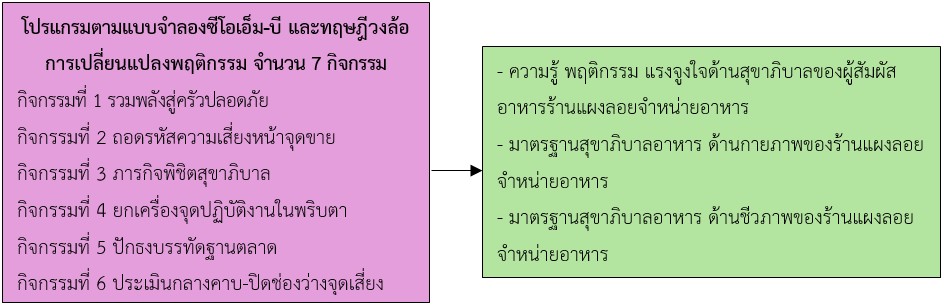
This quasi-experimental study aimed to examine the effects of a program based on the COM-B model and the Behaviour Change Wheel (BCW) theory on food sanitation knowledge, behaviors, and motivation among food handlers, as well as the physical and biological food sanitation standards of street food vendors in Phuket City Municipality. Sixty participants were recruited and equally assigned to an experimental group (n=30) and a control group (n=30). The research instruments included a COM-B and Behaviour Change Wheel-based intervention program, a demographic questionnaire, a food sanitation knowledge test, questionnaires assessing food sanitation practices and motivation, and a food sanitation standards inspection checklist. Data were analyzed using descriptive statistics, paired t-test, independent t-test, analysis of covariance (ANCOVA), one-way repeated measures ANOVA, and two-way repeated measures ANOVA.
The results showed that, after the intervention, the experimental group demonstrated significantly higher food sanitation knowledge, practices, and motivation than before the intervention (p-value < 0.001) and significantly higher scores than the control group (p-value < 0.001). The physical food sanitation standards of street food stalls in the experimental group improved significantly at Weeks 8, 12, and 16 (p-value < 0.001) and were significantly higher than those of the control group. Although the biological food sanitation standards improved in both groups compared with baseline, no significant difference was found between the groups (p-value = 0.08). The findings suggest that the COM-B model and Behaviour Change Wheel-based program is effective in improving food sanitation knowledge, practices, motivation, and physical sanitation standards among food handlers. The program may serve as a practical guideline for public health agencies, local administrative organizations, and street food vendors to enhance food sanitation practices and strengthen food safety.
References
กรมควบคุมโรค. (2566). สรุปรายงานการเฝ้าระวังโรค ประจำปี 2566. นนทบุรี: กองระบาดวิทยา กรมควบคุมโรค กระทรวงสาธารณสุข.
กรมอนามัย. (2566). ผลการวิเคราะห์สถานการณ์การดำเนินงานสุขาภิบาลอาหาร. สำนักสุขาภิบาลอาหารและน้ำ. สืบค้นเมื่อ 12 พฤศจิกายน 2568 จาก https://foodsan.anamai.moph.go.th/th/guarantee-doc-66/download?id=99337&mid=37636&mkey=m_document&lang=th&did=30194.
กองสาธารณสุขและสิ่งแวดล้อม เทศบาลนครภูเก็ต. (2568). สรุปผลการสุ่มตรวจร้านแผงลอยจำหน่ายอาหาร ประจำปี 2567. ภูเก็ต: งานสุขาภิบาลและสิ่งแวดล้อม.
กรรณิการ์ ลดาสุวรรณ, สุมัทนา กลางคาร และกษมา วงษ์ประชุม. (2568). ผลของโปรแกรมการพัฒนาความรอบรู้ด้านสุขาภิบาลอาหารต่อพฤติกรรมของผู้สัมผัสอาหารในร้านอาหาร อำเภอสามโคก จังหวัดปทุมธานี. วารสารสาธารณสุขและวิทยาศาสตร์สุขภาพ, 8(1), 1-21.
ณฐมน สืบซุย. (2567). ผลของโปรแกรมปรับเปลี่ยนพฤติกรรมสุขาภิบาลอาหารของผู้ประกอบการขายอาหาร แผงลอยในเขตธนบุรี กรุงเทพมหานคร. วารสารอนามัยสิ่งแวดล้อมและสุขภาพชุมชน, 9(5), 783-791.
ธนชีพ พีรธรนิศร์, ดุสิต สุจิรารัตน์ และศิราณี ศรีใส. (2558). การวิเคราะห์ปัจจัยที่มีความสัมพันธ์ต่อสภาวการณ์สุขาภิบาลอาหารในเขตเทศบาลนครพิษณุโลก จังหวัดพิษณุโลก. วารสารสาธารณสุขศาสตร์, 45(3), 230-243.
พุทธจักร ช่วยราย. (2558). ผลของโปรแกรมพัฒนาความรู้และพฤติกรรมด้านสุขาภิบาลอาหารในร้านแผงลอยจำหน่ายอาหาร เขตอำเภอเขาชะเมา จังหวัดระยอง. วารสารเครือข่ายวิทยาลัยพยาบาลและการสาธารณสุขภาคใต้, 2(3), 41-57.
ภีมภูริ ปัทมธรรมกุล. (2564). การประยุกต์ใช้สื่ออบรมสุขาภิบาลอาหารแบบออนไลน์ร่วมกับแรงสนับสนุนทางสังคมต่อคุณภาพร้านจำหน่ายอาหารในเขตเทศบาลนครอุดรธานี. วิทยานิพนธ์ปริญญามหาบัณฑิต มหาวิทยาลัยมหาสารคาม.
โรงพยาบาลวชิระภูเก็ต. (2568). สถานการณ์โรคติดต่อที่ต้องเฝ้าระวัง โรงพยาบาลวชิระภูเก็ต. ภูเก็ต: กลุ่มงานเวชกรรมสังคม.
สำนักส่งเสริมและสนับสนุนอาหารปลอดภัย สำนักงานปลัดกระทรวงสาธารณสุข. (2568). รายงานสถานการณ์ความปลอดภัยของอาหาร ประจำปีงบประมาณ พ.ศ. 2567. นนทบุรี: สำนักงานปลัดกระทรวงสาธารณสุข.
อนุสรณ์ สุกสีเหลือง. (2568). ผลของโปรแกรมส่งเสริมความรอบรู้ด้านสุขาภิบาลอาหารต่อพฤติกรรมสุขาภิบาลอาหารของผู้สัมผัสอาหารในร้านอาหาร จังหวัดอ่างทอง. วารสารอนามัยสิ่งแวดล้อมและสุขภาพชุมชน, 10(4), 197-205.
Arendt, S. W., Ellis, J. D., Strohbehn, C., & Paez, P. (2011). Development and use of an instrument to measure retail foodservice employees’ motivation for following food safety practices. Journal of Foodservice Business Research, 14(1), 68-85. https://doi.org/10.1080/15378020.2011.548227
Bloom, B. S., Hastings, J. T., & Madaus, G. F. (1971). Handbook on formative and summative evaluation of student learning. New York: McGraw-Hill.
Cohen, J. (1988). Statistical power analysis for the behavioral sciences (2nd ed.). New Jersey: Lawrence Erlbaum Associates.
Dhudum, B. & Bhosale, Y. (2025). Street food handlers’ knowledge and hygiene practices: A descriptive study. Cureus, 17(1), e77894. https://doi.org/10.7759/cureus.77894
Faul, F., Erdfelder, E., Lang, A. G., & Buchner, A. (2007). G*Power 3: A flexible statistical power analysis program for the social, behavioral, and biomedical sciences. Behavior Research Methods, 39(2), 175-191. https://doi.org/10.3758/bf03193146
Ipsos MORI. (2017). Food handlers and norovirus transmission (FS101143): Social science insights for behaviour change. London: Food Standards Agency.
Madjdian, D. S., et al. (2024). Training and tool supply to enhance food safety behaviors among ready-to-eat chicken vendors in informal markets in Ouagadougou, Burkina Faso: A randomized-controlled trial. Food Control, 163, 110510.
Michie, S., Atkins, L., & West, R. (2014). The behaviour change wheel: A guide to designing interventions (1st ed.). Great Britain: Silverback Publishing.
Ncube, F., Kanda, A., Chijokwe, M., Mabaya, G., & Nyamugure, T. (2020). Food safety knowledge, attitudes and practices of restaurant food handlers in a lower-middle-income country. Food Science & Nutrition, 8(3), 1677-1687. https://doi.org/10.1002/fsn3.1454
Polit, D. F. & Beck, C. T. (2004). Nursing research: Principles and methods (7th ed.). Lippincott Williams & Wilkins.
Sobhan, S., et al. (2024). Effect of a behaviour change intervention on household food hygiene practices in rural Bangladesh: A cluster-randomised controlled trial. International Journal of Hygiene and Environmental Health, 255, 114291.
Sousa, S., et al. (2022). Patterns of street food purchase in cities from Central Asia. Frontiers in Nutrition, 9, 1-12. https://doi.org/10.3389/fnut.2022.925771
World Health Organization. (2015). WHO estimates of the global burden of foodborne diseases: Foodborne diseases burden epidemiology reference group 2007-2015. Geneva: World Health Organization.
Wong, S. Y. W., Mahyudin, N. A., Ho, J. A., & Ungku Zainal Abidin, U. F. (2022). Evaluation of self-efficacy-based intervention: Improving school food handlers’ selected food safety behavior. Food Protection Trends, 42(1), 8-21.
Downloads
Published
How to Cite
Issue
Section
License
Copyright (c) 2026 Journal of Nursing and Public Health Research

This work is licensed under a Creative Commons Attribution-NonCommercial-NoDerivatives 4.0 International License.
1. บทความหรือข้อคิดเห็นใด ๆ ที่ปรากฏในวารสารวิจัยการพยาบาลและการสาธารณสุข ที่เป็นวรรณกรรมของผู้เขียน บรรณาธิการไม่จำเป็นต้องเห็นด้วย
2. บทความที่ได้รับการตีพิมพ์ถือเป็นลิขสิทธิ์ของ วารสารวิจัยการพยาบาลและการสาธารณสุข