
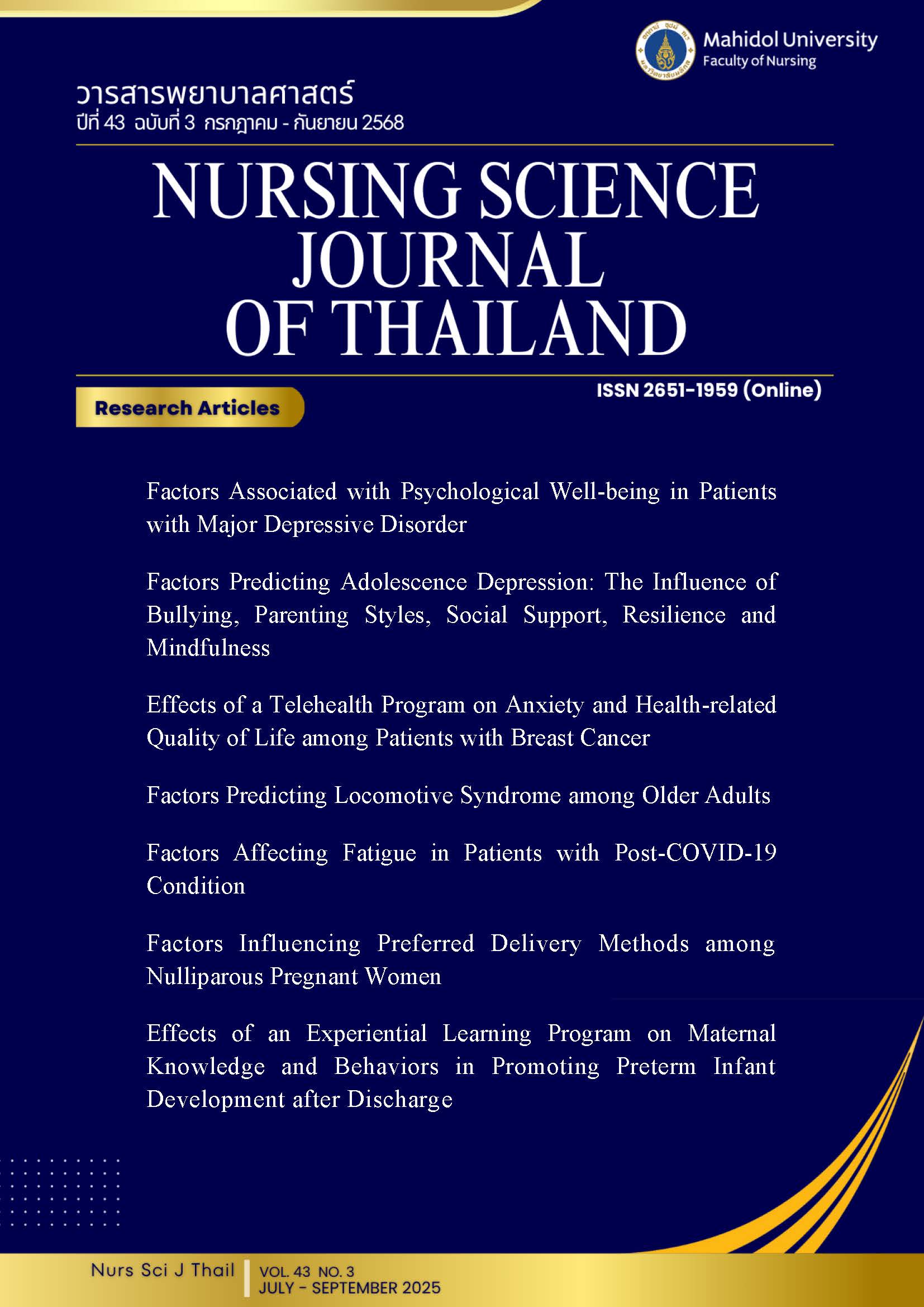
Factors Predicting Adolescent Depression The influence of Bullying, Parenting Styles, Social Support, Resilience and Mindfulness
Article Sidebar
Main Article Content
Abstract
Purpose: To study the predictors of depressive symptoms in early adolescence.
Design: Predictive correlational research.
Methods: Through convenience sampling, 200 junior high school students were selected from government schools in Nakhon Phanom Province. The research instruments included demographic data questionnaires; the Revised Olweus Bully/Victim Questionnaire; Parental Bonding Instrument; Multidimensional Scale of Perceived Social Support; Connor-Davidson Resilience Scale; and Mindfulness Attention Awareness Scale. Descriptive statistics and multiple linear regression were employed to analyze the data.
Main findings: The findings revealed that 28 percent of the sample had depressive symptoms. Multiple linear regression analysis demonstrated that bullying (victim only: = .19, p < .001; bully-victim:
= .13, p < .05), caring parenting style (
= - .23, p < .001), resilience (
= - .18, p < .001), and, mindfulness (
= - .31, p < .001) were statistically significant predictors of depression in early adolescents. All study variables could together account for 56% of the variance explained in the depressive symptoms in adolescent (R2 = .56).
Conclusion and recommendations: The findings of this study highlight the significance of protective factors, including resilience and mindfulness, which play a crucial role in reducing the risk of depressive symptoms. The knowledge derived from this research can be applied to develop effective strategies for mental health prevention and promotion, especially in practical dimension. These strategies should focus on enhancing life skills, mindfulness training, bullying prevention in schools, and promoting positive parenting skills. These approaches serve as mechanism to mitigate and prevent depressive symptoms while promoting stable and sustainable mental well-being among adolescents in the long term.
Article Details

This work is licensed under a Creative Commons Attribution-NonCommercial-NoDerivatives 4.0 International License.
Copyright Notice: Nursing Science Journal of Thailand has exclusive rights to publish and distribute the manuscript and all contents therein. Without the journal’s permission, the dissemination of the manuscript in another journal or online, and the reproduction of the manuscript for non-educational purpose are prohibited.
Disclaimer: The opinion expressed and figures provided in this journal, NSJT, are the sole responsibility of the authors. The editorial board bears no responsibility in this regard.
References
Choi Y, Kang S-K. A study on the key operational policies of the 2019-2023 Substance Abuse and Mental Health Service Administration (SAMHSA). J Humanit Soc Sci. 2020;11(2):2103-14. doi: 10.3390/ijerph17020438.
Chi X, Huang L, Wang J, Zhang P. The prevalence and socio-demographic correlates of depressive symptoms in early adolescents in China: differences in only child and non-only child groups. Int J Environ Res Public Health. 2020;17(2):438. doi: 10.3390/ijerph17020438.
Panyawong W, Santitadakul R, Pavasuthipaisit C. Prevalence of depression and suicidal risks in Thai adolescents: a survey in schools from 13 public health region. Journal of Mental Health Thailand. 2020;28(2):136-49. (in Thai).
Department of Mental Health, Ministry of Public Health. Annual report 2019: 1 Oct 2018-30 Sep 2019. Nonthaburi: Department of Mental Health; 2019. 255 p. (in Thai).
Noypayak P, Piyasil W, Ningsanon W, Ungthavorn P. Guideline in child health supervision. In: Chapter 4, guidelines for promoting growth and development. Bangkok: Sapphasarn; 2014. p.46-54. (in Thai).
Duan S, Duan Z, Li R, Wilson A, Wang Y, Jia Q, et al. Bullying victimization, bullying witnessing, bullying perpetration and suicide risk among adolescents: a serial mediation analysis. J Affect Disord. 2020;273:274-9. doi: 10.1016/j.jad.2020.03.143.
Guo J, Li M, Wang X, Ma S, Ma J. Being bullied and depressive symptoms in Chinese high school students: the role of social support. Psychiatry Res. 2020;284:112676. doi: 10.1016/j.psychres.2019.112676.
Jannah K, Hastuti D, Riany Y. Parenting style and depression among students: the mediating role of self-esteem. Psikohumaniora. 2022;7(1):39-50. doi: 10.21580/pjpp.v7i1.9885.
Zhao J, Wang Y. Harsh parenting and suicide ideation among Chinese adolescents: the roles of self-esteem and school social support. BMC Psychiatry. 2023;23(1):609-17. doi: 10.1186/s12888-023-05108-w.
Rakhshani T, Hamid S, Kamyab A, Kashfi SM, Khani J. The effect of parenting style on anxiety and depression in adolescent girls aged 12–16 years. Heliyon. 2022;8(11):e11478. doi: 10.1016/j.heliyon.2022.e11478.
Ringdal R, Espnes GA, Eilertsen ME, BjØrnsen HN, Moksnes UK. Social support, bullying, school-related stress and mental health in adolescence. Nord Psychol. 2020;72(4):313-30. doi: 10.1080/19012276.2019.1710240.
Liu Q, Jiang M, Li S, Yang Y. Social support, resilience, and self-esteem protect against common mental health problems in early adolescence: a nonrecursive analysis from a two-year longitudinal study. Medicine (Baltimore). 2021;100(4):e24343. doi: 10.1097/MD.0000000000024334.
Zhou ZK, Liu QQ, Niu GF, Sun XJ, Fan CY. Bullying victimization and depression in Chinese children: a moderated mediation model of resilience and mindfulness. Pers Individ Dif. 2017;104:137-42. doi: 10.1016/j.paid.2016.07.040.
Clear SJ, Zimmer-Gembeck MJ, Duffy AL, Barber BL. Internalizing symptoms and loneliness: direct effects of mindfulness and protection against the negative effects of peer victimization and exclusion. Int J Behav Dev. 2020;44(1):51-61. doi: 10.1177/0165025419876358.
Monroe SM, Simons AD. Diathesis-stress theories in the context of life stress research: implications for the depressive disorders. Psychol Bull. 1991;110(3):406-25. doi: 10.1037/0033-2909.110.3.406.
Suntornvijitr S, Hengudomsub P, Vatanasin D, Dethchaiyot P. Predicting factors of depression among secondary school students in extended educational opportunity schools. Nursing Journal of the Ministry of Public. 2018;28(2):53-66. (in Thai).
Radloff LS. The CES-D scale: a self-report depression scale for research in the general population. Appl Psychol Meas. 1977;1(3):385-401. doi: 10.1177/014662167700100306.
Trangkasombat U, Larpboonsarp V, Havanond P. CES-D as a screen for depression in adolescents. Journal of the Psychiatrist Association of Thailand. 1997;42(1):2-13. (in Thai).
Olweus D. Bully/victim problems in school. Prospects. 1996;26(2):331-59. doi: 10.1007/BF03172807.
Tapanya S. A survey of bullying among students. Chiang Mai: Department of Psychiatry, Faculty of Medicine, Chiang Mai University; 2006. 36 p. (in Thai).
Parker G, Tupling H, Brown LB. A parental bonding instrument. Br J Med Psychol. 1979;52(1):1-10. doi: 10.1111/j.2044-8341.1979.tb02487.x.
Charoensuk S. Factors influencing depression in Thai adolescents [Dissertation]. Lexington, KY: University of Kentucky; 2005. 134 p.
Zimet GD, Dahlem NW, Zimet SG, Farley GK. The multidimensional scale of perceived social support. J Pers Assess. 1988;52(1):30-41. doi: 10.1207/s15327752jpa5201_2.
Boonyamalik, P. Epidemiology of adolescent suicidal ideation: roles of perceived life, stress, depressive symptoms, and substance use [Dissertation]. Baltimore, MD: Johns Hopkins University; 2005. 422 p.
Connor KM, Davidson JR. Development of a new resilience scale: The Connor-Davidson resilience scale (CD-RISC). Depression Anxiety. 2003;18(2):76-82. doi: 10.1002/da.10113.
Vongsirimas N, Thanoi W, Klainin-Yobas P. Evaluating psychometric properties of the Connor-Davidson resilience scale (10-item CD-RISC) among university students in Thailand. Nursing Science Journal of Thailand. 2017;35(3):25-35. (in Thai).
Brown KW, Ryan RM. The benefits of being present: mindfulness and its role in psychological well-being. J Pers Soc Psychol. 2003;84(4):822-48. doi: 10.1037/0022-3514.84.4.822.
Santiwong R. Cognitive therapy based on mindfulness in caring for individuals with depression [master’s thesis]. Chonburi: Graduate School, Burapha University; 2007. (in Thai).
Chicoine J, Marcotte D, Poirier M. Bullying perpetration and victimization among adolescents: a diathesis-stress model of depressive symptoms. J Appl Dev Psychol. 2021;77:101350. doi: 10.1016/j.appdev.2021.101350.
Chen S, Li Y, Wang Y, Zhang X, Li H, Liu J. School bullying victimization and depressive symptoms among Chinese adolescents: the mediating role of sleep quality and the moderating role of physical activity. J Pediatr Nurs. 2024;76:1-8. doi: 10.1016/j.pedn.2024.07.028.
