
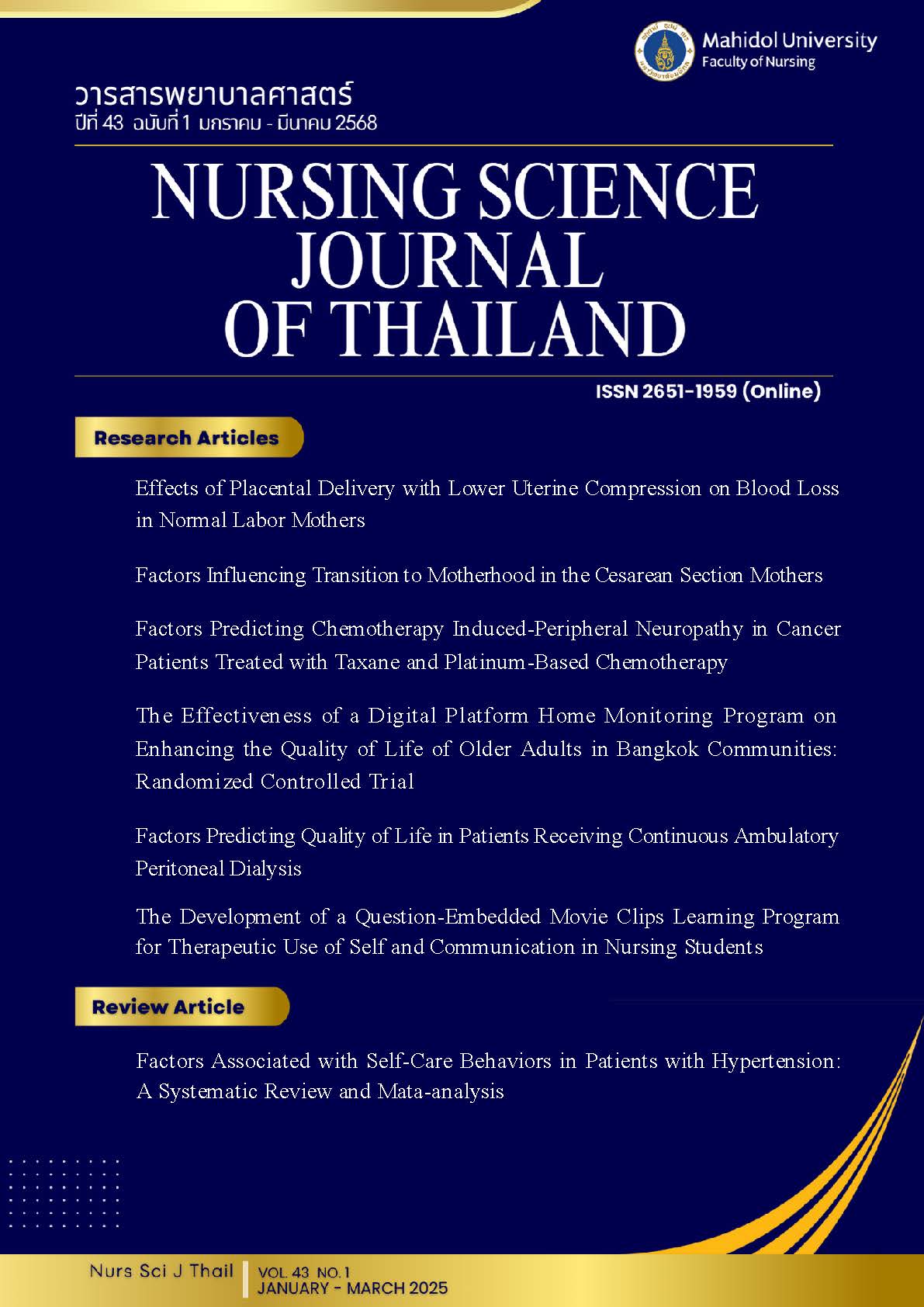
Factors Predicting Quality of Life in Patients Receiving Continuous Ambulatory Peritoneal Dialysis A Secondary Data Analysis
Article Sidebar
Main Article Content
Abstract
Purpose: To examine the predictive power of sex, diabetes comorbidity, hematocrit level, adherence to treatment, and satisfaction with healthcare services on quality of life in patients receiving continuous ambulatory peritoneal dialysis.
Design: Secondary data analysis.
Methods: Data for this study were obtained from 169 patients undergoing continuous ambulatory peritoneal dialysis who were enrolled in the control group of a primary research about telehealth service using randomized controlled trial. Baseline information on sample characteristics, treatment adherence, satisfaction with healthcare services, and quality of life scores was extracted from the trial. Data were analyzed using descriptive statistics and multiple linear regression analysis.
Main findings: The participants reported their total quality of life with a mean score of 62.12 (SD = 17.03). Results from the multiple regression analysis revealed that all independent variables could together explain 24% (R2 = .24) of the variance in the quality of life of patients receiving continuous ambulatory peritoneal dialysis. Patients with good adherence to treatment (β = - .45, p < .001) and without comorbid diabetes mellitus (β = - .17, p = .027) demonstrated better quality of life.
Conclusion and recommendations: Patients undergoing continuous ambulatory peritoneal dialysis should be encouraged to adhere to treatment regimens. Additionally, patients with comorbid diabetes mellitus should be assessed for quality of life on a regular basis and given support to improve the quality of life.
Article Details

This work is licensed under a Creative Commons Attribution-NonCommercial-NoDerivatives 4.0 International License.
Copyright Notice: Nursing Science Journal of Thailand has exclusive rights to publish and distribute the manuscript and all contents therein. Without the journal’s permission, the dissemination of the manuscript in another journal or online, and the reproduction of the manuscript for non-educational purpose are prohibited.

Disclaimer: The opinion expressed and figures provided in this journal, NSJT, are the sole responsibility of the authors. The editorial board bears no responsibility in this regard.
References
The Nephrology Society of Thailand. Thailand renal replacement therapy year 2021-2022 [Internet]. Bangkok: The Nephrology Society of Thailand; 2022 [cited 2025 Feb 07]. Available from: https://www.nephrothai.org/wp-content/uploads/2024/10/New-Annual-report-2021-2022.pdf. (in Thai).
Kidney Disease: Improving Global Outcomes (KDIGO) CKD Work Group. KDIGO 2024 clinical practice guideline for the evaluation and management of chronic kidney disease. Kidney Int. 2024;105(4s):s117-s314. doi: 10.1016/j.kint.2023.10.018.
Warrens H, Banerjee D, Herzog CA. Cardiovascular complications of chronic kidney disease: an introduction. Eur Cardiol. 2022;17:e13. doi: 10.15420/ecr.2021.54.
Perl J, Fuller DS, Bieber BA, Boudville N, Kanjanabuch T, Ito Y, et al. Peritoneal dialysis–related infection rates and outcomes: results from the Peritoneal Dialysis Outcomes and Practice Patterns Study (PDOPPS). Am J Kidney Dis. 2020;76(1):42-53. doi: 10.1053/j.ajkd. 2019.09.016.
Sakulkoo S, Wisitchainont W, Kankran W. Factors influencing quality of life in end-stage renal disease patients receiving continuous ambulatory peritoneal dialysis. Journal of Nursing and Health Care. 2020;38(1):117-26. (in Thai).
Marki E, Moisoglou I, Aggelidou S, Malliarou M, Tsaras K, Papathanasiou IV. Body image, emotional intelligence and quality of life in peritoneal dialysis patients. AIMS Public Health. 2023;10(3):698-709. doi: 10.3934/publichealth.2023048.
Mbeje PN. Factors affecting the quality of life for patients with end-stage renal disease on dialysis in KwaZulu-Natal province, South Africa: a descriptive survey. Health SA. 2022;27:1932. doi: 10.4102/hsag.v27i0.1932.
Kankom W, Thanyapansin P, Srijanpal W. Factors related to the quality of life in older Thai patients with end stage kidney disease (ESKD) undergoing continuous ambulatory peritoneal dialysis (CAPD). Journal of Nursing and Health Research. 2023;24(2):20-36. (in Thai).
Sriyuktasuth A, Vongsirimas N, Praha N, Prapaiwong P. Quality of life and related factors in women receiving hemodialysis and continuous ambulatory peritoneal dialysis: a comparative study. Nurs Sci J Thail. 2017;35(1):72-84. (in Thai).
Zhan L. Quality of life: conceptual and measurement issues. J Adv Nurs. 1992;17(7):795-800. doi: 10.1111/j.1365-2648.1992.tb02000.x.
Nili N, Seirafian S, Hosseini SM, Atapour A, Naeini MK, Mortazavi M. Quality of life of patients on peritoneal dialysis and contributing factors: a cross-sectional study. Journal of Renal and Hepatic Disorders. 2023;7(1):11-21. doi: 10.15586/jrenhep.v7i1.151.
Brown EA, Zhao J, McCullough K, Fuller DS, Figueiredo AE, Bieber B, et al. Burden of kidney disease, health-related quality of life, and employment among patients receiving peritoneal dialysis and in-center hemodialysis: findings from the DOPPS program. Am J Kidney Dis. 2021;78(4):489-500.e1. doi: 10.1053/j.ajkd.2021.02.327.
Bustamante-Rojas L, D'Peña-Ardaillon F, Durán-Agüero S, Tiscornia-González C, Aicardi-Spalloni V. Health-related quality of life of patients on peritoneal dialysis. Rev Med Chil. 2021;149(12):1744-50. doi: 10.4067/s0034-98872021001201744.
Paneerselvam GS, Goh KW, Kassab YW, Farrukh MJ, Goh BH, Lua PL, et al. Health-related quality of life of dialysis patients during early COVID-19 lockdowns: a snapshot from a public hospital in Malaysia. Front Med (Lausanne). 2023;10:992870. doi: 10.3389/fmed. 2023.992870.
Chinnoros S, Depanya C. Quality of life and effecting factors in patients undergoing dialysis: a comparative study. Journal of Health and Health Manage. 2020;6(2):40-54. (in Thai).
Palaka E, Grandy S, van Haalen H, McEwan P, Darlington O. The impact of CKD anaemia on patients: incidence, risk factors, and clinical outcomes-a systematic literature review. Int J Nephrol. 2020;2020:7692376. doi: 10.1155/2020/7692376.
Khamkhom U, Watthayu N, Rattanathanya D. Factors predicting quality of life among chronic kidney disease patients receiving continuous ambulatory peritoneal dialysis. Journal of Nursing Science Chulalongkorn University. 2015;27(2):60-71. (in Thai).
Gao Y, Shan Y, Jiang T, Cai L, Zhang F, Jiang X, Li X, Wang H. Dietary adherence, self-regulatory fatigue and trait self-control among Chinese patients with peritoneal dialysis: a cross-sectional study. Patient Prefer Adherence. 2021;15:443-51. doi: 10.2147/ppa.s298231.
Sharif-Nia H, Marôco J, Froelicher ES, Barzegari S, Sadeghi N, Fatehi R. The relationship between fatigue, pruritus, and thirst distress with quality of life among patients receiving hemodialysis: a mediator model to test concept of treatment adherence. Sci Rep. 2024;14(1):9981. doi: 10.1038/s41598-024-60679-2.
García-Llana H, Remor E, Selgas R. Adherence to treatment, emotional state and quality of life in patients with end-stage renal disease undergoing dialysis. Psicothema. 2013;25(1):79-86. doi: 10.7334/psicothema2012.96.
Bayin Donar G, Top M. A conceptual framework of quality of life in chronic kidney disease in Turkey: a patient-focused approach. Int J Health Plann Manage. 2020;35(6):1335-50.
doi: 10.1002/hpm.3038.
Bu Z, Li C. Enhancing the quality of life for peritoneal dialysis patients: a study of influencing factors. Altern Ther Health Med. 2024;30(1):73-7.
Lam LW, Twinn SF, Chan SW. Self-reported adherence to a therapeutic regimen among patients undergoing continuous ambulatory peritoneal dialysis. J Adv Nurs. 2010;66(4):763-73. doi: 10.1111/j.1365-2648.2009.05235.x.
Sriyuktasuth A, Kusakunniran W, Chuengsaman P, Rattana-umpa N. PD Telehealth: system development and effectiveness evaluation for the improvement of health outcomes in patients with continuous ambulatory peritoneal dialysis (phase 2) [research paper]. Bangkok: Faculty of Nursing, Mahidol University; 2022. 122 p. (in Thai).
Attkisson CC, Zwick R. The client satisfaction questionnaire. Psychometric properties and correlations with service utilization and psychotherapy outcome. Eval Program Plann. 1982;5(3):233-7. doi: 10.1016/0149-7189(82)90074-x.
Thaweethamcharoen T, Srimongkol W, Noparatayaporn P, Jariyayothin P, Sukthinthai N, Aiyasanon N, et al. Validity and reliability of KDQOL-36 in Thai kidney disease patient. Value Health Reg Issues. 2013;2(1):98-102. doi: 10.1016/j.vhri.2013.02.011.
Bonenkamp AA, van Eck van der Sluijs A, Hoekstra T, Verhaar MC, van Ittersum FJ, Abrahams AC, et al. Health-related quality of life in home dialysis patients compared to in-center hemodialysis patients: a systematic review and meta-analysis. Kidney Med. 2020;2(2):139-54. doi: 10.1016/j.xkme.2019.11.005.
Aguiar R, Pei M, Qureshi AR, Lindholm B. Health-related quality of life in peritoneal dialysis patients: a narrative review. Semin Dial. 2019;32(5):452-62. doi: 10.1111/sdi.12770.
Li J, Zou D, Cao P, Yi C, Lin J, Cheng S, et al. Type D personality, medication adherence and peritonitis in continuous ambulatory peritoneal dialysis patients. Psychol Health Med. 2020;25(5):541-49. doi: 10.1080/13548506.2019.1653478.
Meng L-F, Yang L-M, Zhu X-Y, Zhang X-X, Li X-Y, Zhao J, et al. Comparison of clinical features and outcomes in peritoneal dialysis-associated peritonitis patients with and without diabetes: a multicenter retrospective cohort study. World J Diabetes. 2020;11(10):435-46. doi: 10.4239/wjd.v11.i10.435.
Li PKT, Choy ASM, Bavanandan S, Chen W, Foo M, Kanjanabuch T, et al. Anemia management in peritoneal dialysis: perspectives from the Asia Pacific region. Kidney Medicine. 2021;3(3):405-11. doi: 10.1016/j.xkme.2021.01.011.
