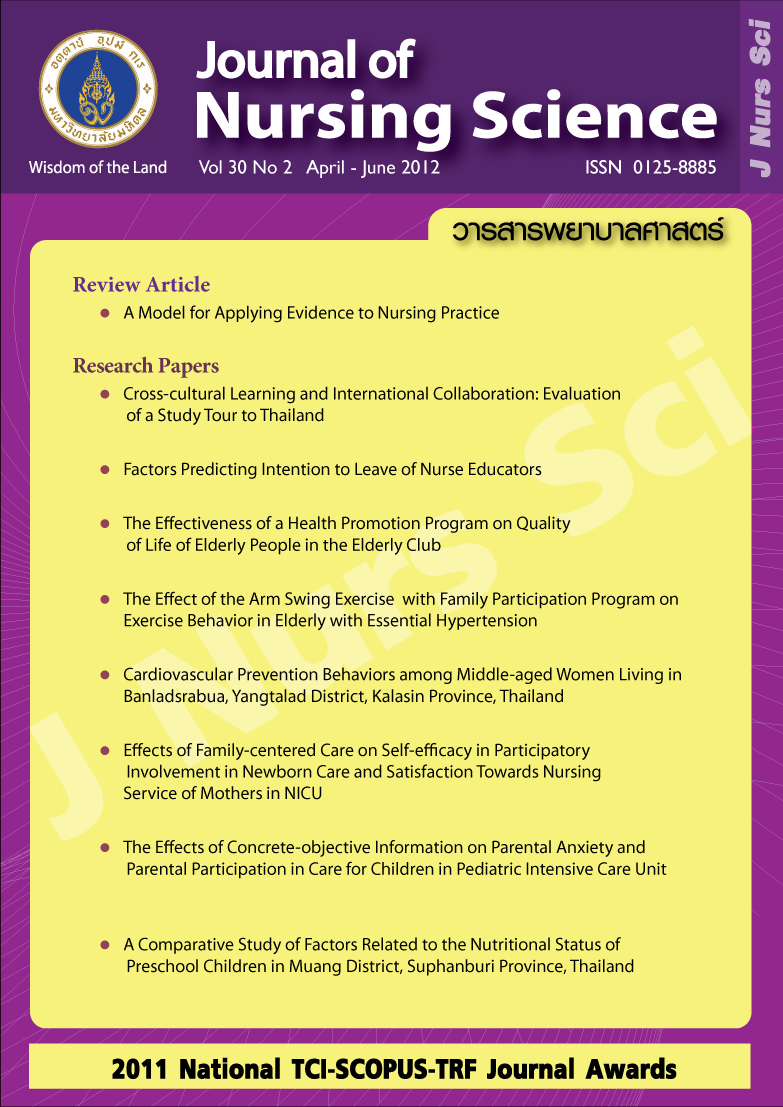
The Effect of the Arm Swing Exercise with Family Participation Program on Exercise Behavior in Elderly with Essential Hypertension
Article Sidebar
Main Article Content
บทคัดย่อ
Purpose: To examine the effect of family support on developing exercise behavior among elderly with essential hypertension using the arm swing exercise program.
Design: Quasi-experimental research design.
Methods: From 8 villages, sixty-two essential hypertension patients at a medical clinic of one
hospital were randomly selected into the experimental and control groups with 31 each. The experimental group received the arm swing exercise program with family members supporting during the program, while those in the control group did the exercise without family participation. Data were collected through the exercise behavior questionnaire before and after the program, and were tested by paired t-test and independent t-test.
Main findings: After receiving the program, the exercise behaviors of the experimental group were significantly better than that of the control group in terms of the time used in daily exercise (p < .001), frequency of exercise during a week (p < .05), and number of arm swing (p < .001).
Conclusion and recommendations: The study findings suggest that exercise promoting program should involve family members to help encouraging and supporting the elderly to exercise consistently.
Article Details
ลิขสิทธิ์: วารสารพยาบาลศาสตร์เป็นเจ้าของลิขสิทธิ์ในการเผยแพร่ผลงานที่ตีพิมพ์ ห้ามผู้ใดนำบทความที่ได้รับการตีพิมพ์ในวารสารพยาบาลศาสตร์ไปเผยแพร่ในลักษณะต่างๆ ดังต่อไปนี้ การส่งบทความไปตีพิมพ์เผยแพร่ที่อื่น การนำบทความเผยแพร่ออนไลน์ การถ่ายเอกสารบทความเพื่อกิจกรรมที่ไม่ใช่การเรียนการสอน ยกเว้นเสียแต่ได้รับอนุญาตจากวารสารพยาบาลศาสตร์
Disclaimer: เนื้อหาบทความหรือข้อคิดเห็นใดๆ ในวารสารพยาบาลศาสตร์ ถือเป็นความรับผิดชอบของผู้เขียน กองบรรณาธิการไม่จำเป็นต้องเห็นด้วยและไม่มีส่วนรับผิดชอบแต่อย่างใด
