
ปัจจัยทำนายการเกิดทารกแรกเกิดน้ำหนักน้อยในสตรีตั้งครรภ์ที่ฝากครรภ์ในคลินิกตั้งครรภ์วัยรุ่น
Article Sidebar
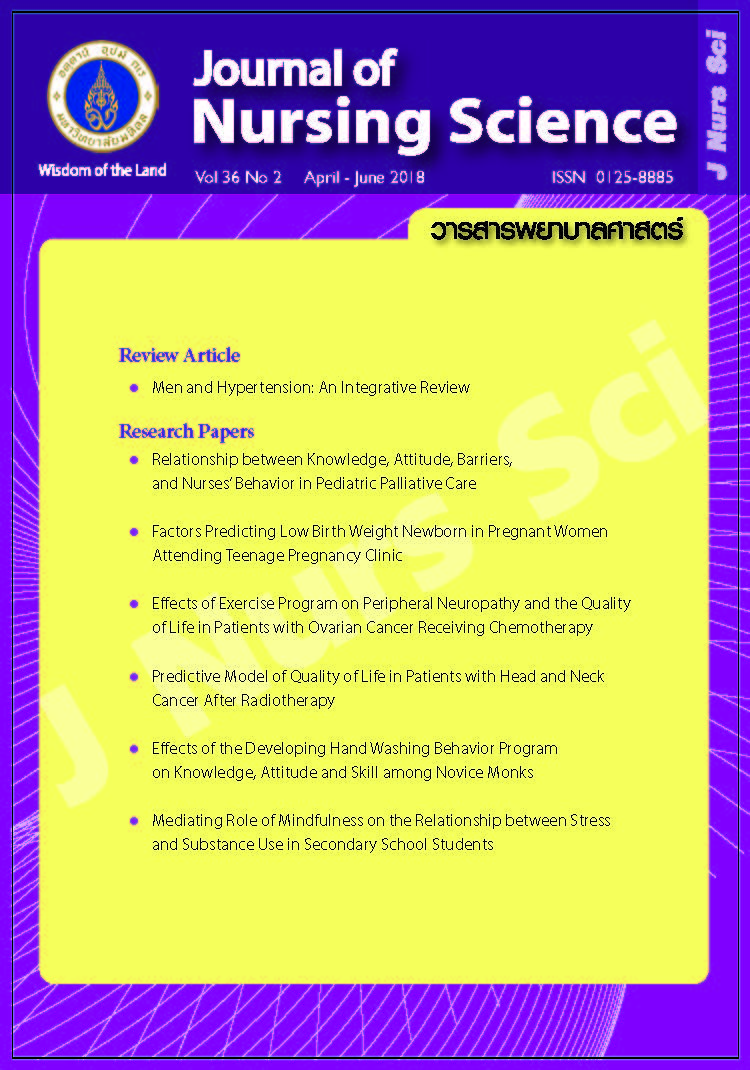
Main Article Content
บทคัดย่อ
วัตถุประสงค์: เพื่อศึกษาอำนาจทำนายของดัชนีมวลกายก่อนการตั้งครรภ์น้ำหนักที่เพิ่มขึ้นระหว่างการตั้งครรภ์ อายุครรภ์ที่มาฝากครรภ์ครั้งแรก ภาวะซีด การสูบบุหรี่มือสอง และการดูแลต่อเนื่อง ต่อการเกิดทารกแรกเกิดน้ำหนักน้อย
รูปแบบการวิจัย: ความสัมพันธ์เชิงทำนายโดยศึกษาย้อนหลังจากแฟ้มข้อมูล
วิธีดำเนินการวิจัย: สตรีตั้งครรภ์วัยรุ่นที่มารับบริการในคลินิกตั้งครรภ์วัยรุ่น หน่วยฝากครรภ์ และคลอดที่โรงพยาบาลศิริราช ในช่วงระยะเวลาตั้งแต่เดือนพฤษภาคม 2555 ถึงเดือนมิถุนายน 2559 จำนวน 490 ราย โดยแบ่งเป็นกลุ่มที่คลอดทารกแรกเกิดน้ำหนักน้อยจำนวน 60 ราย และ กลุ่มที่คลอดทารกแรกเกิดน้ำหนักปกติ จำนวน 430 ราย เก็บรวบรวมข้อมูล โดยใช้ 1) แบบบันทึกข้อมูลส่วนบุคคล 2) แบบบันทึกข้อมูลทางสูติกรรม และ 3) แบบประเมินความต่อเนื่องของการดูแล วิเคราะห์ข้อมูลโดยใช้สถิติไคสแคว์ และสถิติถดถอยโลจิสติกเชิงพหุ
ผลการวิจัย: สตรีตั้งครรภ์วัยรุ่นที่มีน้ำหนักเพิ่มขึ้นน้อยกว่าเกณฑ์ (OR 7.82, 95%CI [4.03 - 15.16]) และมาฝากครรภ์ครั้งแรกเมื่ออายุครรภ์มากกว่า 12 สัปดาห์ (OR 2.86, 95%CI [1.11 - 7.35]) มีความเสี่ยงต่อการเกิดภาวะทารกแรกเกิดน้ำหนักน้อยมากกว่า 7.82 และ 2.86 เท่าตามลำดับ ในขณะที่สตรีตั้งครรภ์วัยรุ่นที่ได้รับการดูแลต่อเนื่องมีความเสี่ยงต่อการเกิดภาวะทารกแรกเกิดน้ำหนักน้อยน้อยกว่า (OR .32, 95%CI [.17 - .61])
สรุปและข้อเสนอแนะ: ควรนำระบบการดูแลต่อเนื่องโดยพยาบาลผดุงครรภ์เจ้าของไข้มาใช้ในการดูแลสตรีตั้งครรภ์วัยรุ่น โดยพยาบาลผดุงครรภ์ควรติดตามประเมินการเพิ่มของน้ำหนักตัวตลอดการตั้งครรภ์ให้เหมาะสม และเฝ้าระวังความเสี่ยงในกลุ่มสตรีตั้งครรภ์วัยรุ่นที่มาฝากครรภ์ครั้งแรกเมื่ออายุครรภ์มากกว่า 12 สัปดาห์
Article Details
ลิขสิทธิ์: วารสารพยาบาลศาสตร์เป็นเจ้าของลิขสิทธิ์ในการเผยแพร่ผลงานที่ตีพิมพ์ ห้ามผู้ใดนำบทความที่ได้รับการตีพิมพ์ในวารสารพยาบาลศาสตร์ไปเผยแพร่ในลักษณะต่างๆ ดังต่อไปนี้ การส่งบทความไปตีพิมพ์เผยแพร่ที่อื่น การนำบทความเผยแพร่ออนไลน์ การถ่ายเอกสารบทความเพื่อกิจกรรมที่ไม่ใช่การเรียนการสอน ยกเว้นเสียแต่ได้รับอนุญาตจากวารสารพยาบาลศาสตร์

Disclaimer: เนื้อหาบทความหรือข้อคิดเห็นใดๆ ในวารสารพยาบาลศาสตร์ ถือเป็นความรับผิดชอบของผู้เขียน กองบรรณาธิการไม่จำเป็นต้องเห็นด้วยและไม่มีส่วนรับผิดชอบแต่อย่างใด
เอกสารอ้างอิง
2. Bereau of Reproductive Health, Ministry of Health. Situation of the Thai adolescent inreproductive health. Nonthaburi: Department of Health, Ministry of Health; 2016. (in Thai).
3. Medical Statisic Unit, Siriraj Hospital. Prevalence in low birth weight newborn and rate of delivery in 2014. Bangkok: Medical Statisic Unit, Siriraj Hospital; 2015. (in Thai).
4. Medical Statisic Unit, Siriraj Hospital. Prevalence in low birth weight newborn and rate of delivery in 2016. Bangkok: Medical Statisic Unit, Siriraj Hospital; 2017. (in Thai).
5. Ruchob R, Sinsuksai N, Phahuwatanakorn W, Boriboonhirunsarn D. Factors predicting delivery of low birth weight infants. Journal of Nursing Science. 2016;33(3):19-29. (in Thai).
6. Ding XX, Wu YL, Xu SJ, Zhu RP, Jia XM, Zhang SF, et al. Maternal anxiety duringpregnancy and adverse birth outcomes: a systematic review and meta-analysis of prospective cohort studies. J Affect Disord. 2014;159:103-10.
7. Dai LL, Mao YY, Luo XM, Shen YP. Prenatal care in combination with maternal educational level has a synergetic effect on the risk of neonatal low birth weight: new findings in a retrospective cohort study in Kunshan City, China. PLoS One. 2014 Nov 26;9(11):e113377. doi: 10.1371/journal.pone.0113377. PubMed PMID: 25426715; PubMed Central PMCID: PMC4245141.
8. Chen Y, Li G, Ruan Y, Zou L, Wang X, Zhang W. An epidemiological survey onlowbirth weight infants in China and analysis of outcomes of full-term low birth weightinfants. BMC Pregnancy Childbirth. 2013 Dec 26;13:242. doi: 10.1186/1471-2393-13-242. PubMed PMID:24370213; PubMed Central PMCID: PMC3877972.
9. Graignic-Philippe R, Dayan J, Chokron S, Jacquet AY, Tordjman S. Effects of prenatalstress on fetal and child development: a critical literature review. Neurosci Biobehav Rev. 2014 Jun;43:137-62. doi: 10.1016/j.neubiorev.2014.03.022. PubMed PMID: 24747487.
10. Coutinho PR, Cecatti JG, Surita FG, Costa ML, Morais SS. Perinatal outcomesassociated with low birth weight in a historical cohort. Reprod Health. 2011 Jun 2;8:18. doi: 10.1186/1742-4755-8-18. PubMed PMID: 21635757; PubMed Central PMCID: PMC3118322.
11. Longo S, Borghesi A, Tzialla C, Stronati M. IUGR and infections. Early Hum Dev. 2014;90 Suppl 1:S42-4.
12. Veloso HJ, da Silva AA, Bettiol H, Goldani MZ, Filho FL, Simoes VM, et al. Low birthweight in Sao Luis, Northeastern Brazil: trends and associated factors. BMC Pregnancy Childbirth. 2014 May 1;14:155. doi: 10.1186/1471-2393-14-155. PubMed PMID: 24885887; PubMed Central PMCID: PMC4108005.
13. Wado YD, Afework MF, Hindin MJ. Effects of maternal pregnancy intention, depressive symptoms and social support on risk of low birth weight: a prospectistudy from southwestern Ethiopia. PLoS One. 2014 May 21;9(5):e96304.doi: 10.1371/journal.pone.0096304. PubMed PMID: 24848269; PubMed Central PMCID: PMC4029816.
14. Allen J, Gibbons K, Beckmann M, Tracy M, Stapleton H, Kildea S. Does model of maternity care make a difference to birth
outcomes for young women? A retrospective cohort study. Int J Nurs Stud. 2015;52(8):1332-42.
15. Wongvilailuk S. Pre-pregnancy body massindex for predicting pregnancy outcomes. Buddhachinaraj Medical Journal. 2010;27(3):502-11. (in Thai).
16. Rosner B. Fundamentals of biostatistics. 7th ed. Boston, MA: Brooks/Cole, Cengage Learning; 2010.
17. Yang S, Peng A, Wei S, Wu J, Zhao J, Zhan Y, et al. Pre-pregnancy body mass index, gestational weight gain, and birth
weight: acohort study in China. PLoS One. 2015 Jun 26;10(6):e0130101. doi: 10.1371/journal.pone.0130101. PubMed PMID: 26115015; PubMed Central PMCID: PMC4482572.
18. Tracy SK, Hartz DL, Tracy MB, Allen J, Forti A, HallB, et al. Caseload midwifery care versus standard maternity care for
women of any risk: M@NGO, a randomised controlled trial. Lancet. 2013;382(9906):1723-32.
19. McLachlan HL, Forster DA, Davey MA, Farrell T, Gold L, Biro MA, et al. Effects of continuity of care by a primary midwife
(caseload midwifery) on caesarean section rates in women of low obstetric risk: the COSMOS randomised controlled trial.
BJOG. 2012;119(2):1483-92.
20. Dahlberg U, Aune I. The woman’s birth experience---the effect of interpersonal relationships and continuity of care. Midwifery. 2013;29(4):407-15.
