
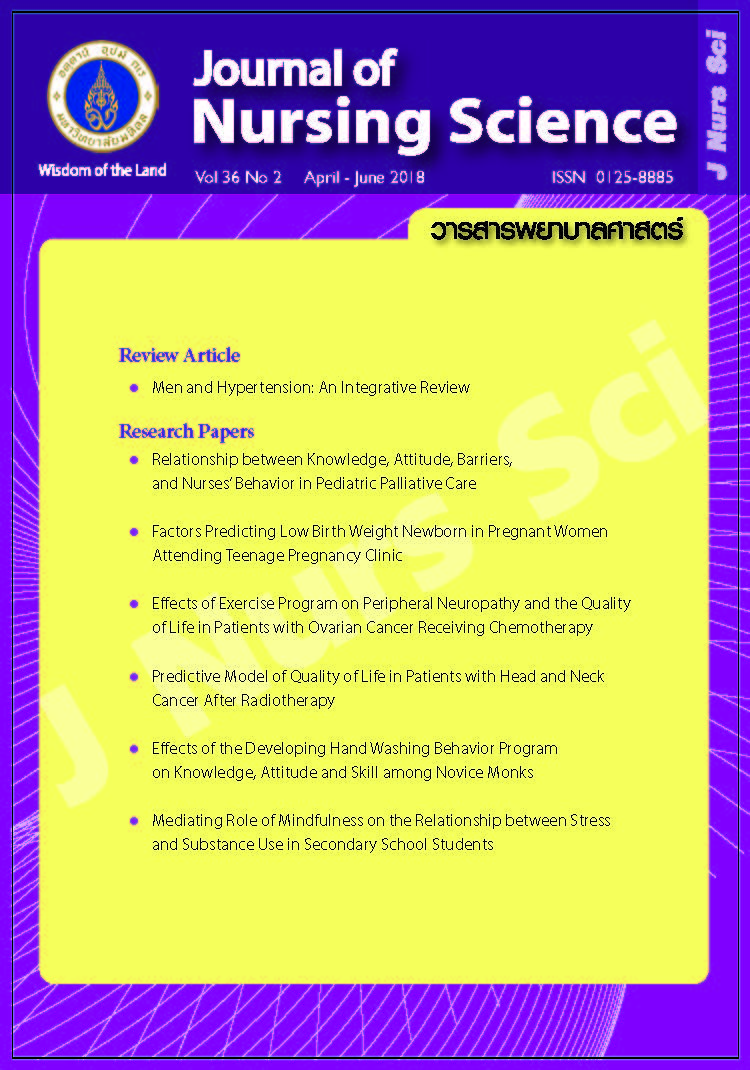
โมเดลการทำนายคุณภาพชีวิตของผู้ป่วยมะเร็งศีรษะและลำคอหลังได้รับรังสีรักษา
Article Sidebar
Main Article Content
บทคัดย่อ
วัตถุประสงค์: เพื่อศึกษาอำนาจในการทำนายคุณภาพชีวิตของปัจจัยส่วนบุคคล การลดลงของน้ำหนักตัว ความแตกฉานทางสุขภาพ การจัดการตนเอง ความรับผิดชอบต่อสุขภาพ และการรับรู้การดูแลแบบบุคคลเป็นศูนย์กลางในผู้ป่วยมะเร็งศีรษะและลำคอหลังได้รับรังสีรักษาครบ 4-8 สัปดาห์
รูปแบบการวิจัย: การวิจัยเชิงทำนาย
วิธีดำเนินการวิจัย: กลุ่มตัวอย่าง จำนวน 110 รายเป็นผู้ป่วยมะเร็งศีรษะและลำคอหลังได้รับรังสีรักษาครบ 4-8 สัปดาห์ โดยการสุ่มเลือกจากโรงพยาบาลมหาวิทยาลัย-วิทยาลัยแพทย์ศาสตร์ รักษาเฉพาะทางด้านมะเร็ง 3 แห่ง ในเขตกรุงเทพมหานคร ชุดแบบสอบถาม ประกอบด้วย ข้อมูลส่วนบุคคล ข้อมูลสุขภาพ คุณภาพชีวิต ความแตกฉานทางสุขภาพ การจัดการตนเอง ความรับผิดชอบต่อสุขภาพ และการรับรู้การดูแลแบบบุคคลเป็นศูนย์กลาง วิเคราะห์สถิติด้วยสถิติถดถอยพหุคูณแบบเชิงชั้น
ผลการวิจัย: ผลการศึกษาพบว่า คุณภาพชีวิตโดยรวมของผู้ป่วยกลุ่มนี้อยู่ในระดับปานกลาง ( = .67, SD = .19) โดยมีคุณภาพชีวิตทางจิตสังคมน้อยกว่าทางด้านร่างกาย (
= .39, SD = .19 และ
= .59, SD = .19) สำหรับโมเดลของปัจจัยส่วนบุคคล พบว่าอาการอ่อนล้าเท่านั้นที่สามารถอธิบายความแปรปรวนของคุณภาพชีวิตอย่างมีนัยสำคัญทางสถิติร้อยละ 10.5 (p < .01) ในโมเดลสุดท้ายพบว่า การจัดการตนเองและความแตกฉานทางสุขภาพสามารถร่วมทำนายคุณภาพชีวิตได้อย่างมีนัยสำคัญทางสถิติถึงร้อยละ 36 (p < .001) โดยการจัดการตนเองเป็นปัจจัยที่มีอำนาจในการทำนายมากที่สุด (β = .32, p < .01) การจัดการตนเองและความแตกฉานทางสุขภาพสามารถสามารถอธิบายความแปรปรวนของคุณภาพชีวิตได้มากกว่าความอ่อนล้าร้อยละ 25.5
สรุปและข้อเสนอแนะ: พยาบาลควรพัฒนากิจกรรมส่งเสริมให้ผู้ป่วยมีการพัฒนาความแตกฉานทางสุขภาพ และสนับสนุนให้ผู้ป่วยมีความสามารถในการจัดการตนเองในขณะที่รับการรักษาโดยการพิจารณาระดับความอ่อนล้าร่วมด้วย เพื่อช่วยให้ผู้ป่วยมีคุณภาพชีวิตที่ดีหลังครบคอร์สการรักษา
Article Details
ลิขสิทธิ์: วารสารพยาบาลศาสตร์เป็นเจ้าของลิขสิทธิ์ในการเผยแพร่ผลงานที่ตีพิมพ์ ห้ามผู้ใดนำบทความที่ได้รับการตีพิมพ์ในวารสารพยาบาลศาสตร์ไปเผยแพร่ในลักษณะต่างๆ ดังต่อไปนี้ การส่งบทความไปตีพิมพ์เผยแพร่ที่อื่น การนำบทความเผยแพร่ออนไลน์ การถ่ายเอกสารบทความเพื่อกิจกรรมที่ไม่ใช่การเรียนการสอน ยกเว้นเสียแต่ได้รับอนุญาตจากวารสารพยาบาลศาสตร์

Disclaimer: เนื้อหาบทความหรือข้อคิดเห็นใดๆ ในวารสารพยาบาลศาสตร์ ถือเป็นความรับผิดชอบของผู้เขียน กองบรรณาธิการไม่จำเป็นต้องเห็นด้วยและไม่มีส่วนรับผิดชอบแต่อย่างใด
เอกสารอ้างอิง
2. Yeh SA. Radiotherapy for head and neck cancer. Semin Plast Surg. 2010;24(2):127-36.
3. Cabrera AR, Yoo DS, Brizel DM. Contemporary radiotherapy in head and neck cancer: balancing chance for cure with risk for complication. Surg Oncol Clin N Am. 2013;22(3):579-98.
4. Sawada NO, de Paula JM, Sonobe HM, Zago MM, Guerrero GP, Nicolussi AC. Depression, fatigue, and health-related quality of life in head and neck cancer patients: a prospective pilot study. Supportive Care Cancer. 2012;20(11):2705-11.
5. Tribius S, Reemts E, Prosch C, Raguse M, Petersen C, Kruell A, et al. Global quality of life during the acute toxicity phase of multimodality treatment for patients with head and neck cancer: Can we identify patients most at risk of profound quality of life decline? Oral Oncology. 2012;48(9):898-904.
6. Youdoung W, Wittayapun Y, Dumnean P, Musikka A, Hankla W, Lagampan S. Quality of life among head- and neck-cancer patients undergoing radiotherapy at Suratthani Cancer Hospital. Thai Cancer Journal. 2015;35(1):14-25. (in Thai).
7. Klein J, Livergant J, Ringash J. Health related quality of life in head and neck cancer treated with radiation therapy with or without chemotherapy: a systematic review. Oral Oncol. 2014;50(4):254-62.
8. McCormack B, McCance T. Person-centred nursing: theory and practice. Chichester: Wiley-Blackwell; 2010.
9. Donabedian A. The quality of care. How can it be assessed? JAMA. 1988;260(12):1743-8.
10. Bilal S, Doss JG, Cella D, Rogers SN. Quality of life associated factors in head and neck cancer patients in a developing country using the FACT-H&N. J Craniomaxillofac Surg. 2015;43(2):274-80.
11. So WK, Chan RJ, Chan DN, Hughes BG, Chair SY, Choi KC, et al. Quality-of-life among head and neck cancer survivors at one year after treatment--a systematic review. Eur J Cancer. 2012;48(15):2391-408.
12. Langius JAE, Dijk AMv, Doornaert P, Kruizenga HM, Langendijk JA, Leemans CR, et al. More than 10% weight loss in head and neck cancer patients during radiotherapy is independently associated with deterioration in quality of life. Nutr Cancer. 2013;65(1):76-83.
13. Sjogren K, Lindkvist M, Sandman PO, Zingmark K, Edvardsson D. Person-centredness and its association with resident well-being in dementia care units. J Adv Nurs. 2013;69(10):2196-205.
14. Rose P, Yates P. Patients' outcomes related to person-centred nursing care in radiation oncology: a case study. Eur J Oncol Nurs. 2015;19(6):731-9.
15. Husson O, Mols F, Fransen MP, van de Poll-Franse LV, Ezendam NP. Low subjective health literacy is associated with adverse health behaviors and worse health-related quality of life among colorectal cancer survivors: results from the profiles registry. Psychooncology. 2015;24(4):478-86.
16. Shneerson C, Taskila T, Greenfield S, Gale N. A survey investigating the associations between self-management practices and quality of life in cancer survivors. Supportive Care Cancer. 2015;23(9):2655-62.
17. Chen WT, Wantland D, Reid P, Corless IB, Eller LS, Iipinge S, et al. Engagement with health care providers affects self- efficacy, self-esteem, medication adherence and quality of life in people living with HIV. J AIDS Clin Res. 2013;4(11):256.
18. Griffiths J, Putthinoi S, Pongsaksri M. The general practitioner assessment of cognition; GPCOG (Thai version): validity and reliability. Poster session presented at: Rewinding the aging clock. 9th Pan-Pacific Conference on Rehabilitation cum, 21st Annual Congress of Gerontology; 2014 Nov 29-30; Jockey Club Auditorium, the Hong Kong Polytechnic University. Hong Kong, China.
19. Brodaty H, Pond D, Kemp NM, Luscombe G, Harding L, Berman K, et al. The GPCOG: a new screening test for dementia designed for general practice. J Am Geriatr Soc. 2002;50(3):530-4.
20. Wanitkun N, Pattaramongkolrit S, Vichathai C, Bhechrung B, Kloyahem S, Batterham R, et al. Thai health literacy. Nonthaburi: Health System Research Institute; 2014. (in Thai).
21. Hibbard JH, Stockard J, Mahoney ER, Tusler M. Development of the Patient Activation Measure (PAM): conceptualizing and measuring activation in patients and consumers. Health Serv Res. 2004;39(4 Pt 1):1005-26.
22. Choocherd S, Wanitkun N, Danaidusadeekul S, Yottasurodom C. Relationships among health literacy, severity of disease, patient engagement, perception of person-centered care and quality of life in patients after coronary artery bypass graft surgery. Journal of Nursing Science. 2016;34 Suppl 1:94-106. (in Thai).
23. Graffigna G, Barello S, Bonanomi A, Lozza E. Measuring patient engagement: development and psychometric properties of the Patient Health Engagement (PHE) Scale. Front Psychol. 2015 Mar 27;6:274. doi: 10.3389/fpsyg.2015.00274. PubMed PMID: 25870566; PubMed Central PMCID: PMC4376060.
24. Waltz CF, Strickland OL, Lenz ER. Measurement in nursing and health research. 4th ed. New York, NY: Springer Publishing Company; 2010.
25. Little P, Everitt H, Williamson I, Warner G, Moore M, Gould C, et al. Observational study of effect of patient centredness and positive approach on outcomes of general practice consultations. BMJ. 2001;323(7318):908-11.
26. Richardson J, Sinha K, Lezzi A, Khan MA. Modelling the utility of health states with the Assessment of Quality of Life (AQoL) 8D instrument: overview and utility scoring algorithm. Clayton, Australia: Centre for Health Economics, Faculty of Business and Economics, Monash University; 2011.
27. Maxwell A, Özmen M, Iezzi A, Richardson J. Deriving population norms for the AQoL-6D and AQoL-8D multi-attribute utility instruments from web-based data. Qual Life Res. 2016;25(12):3209-19.
28. Suzuki M. Quality of life, uncertainty, and perceived involvement in decision making in patients with head and neck cancer. Oncol Nurs Forum. 2012;39(6):541-8.
29. Rathert C, Wyrwich MD, Boren SA. Patient-centered care and outcomes: a systematic review of the literature. Med Care Res Rev. 2013;70(4):351-79.
