
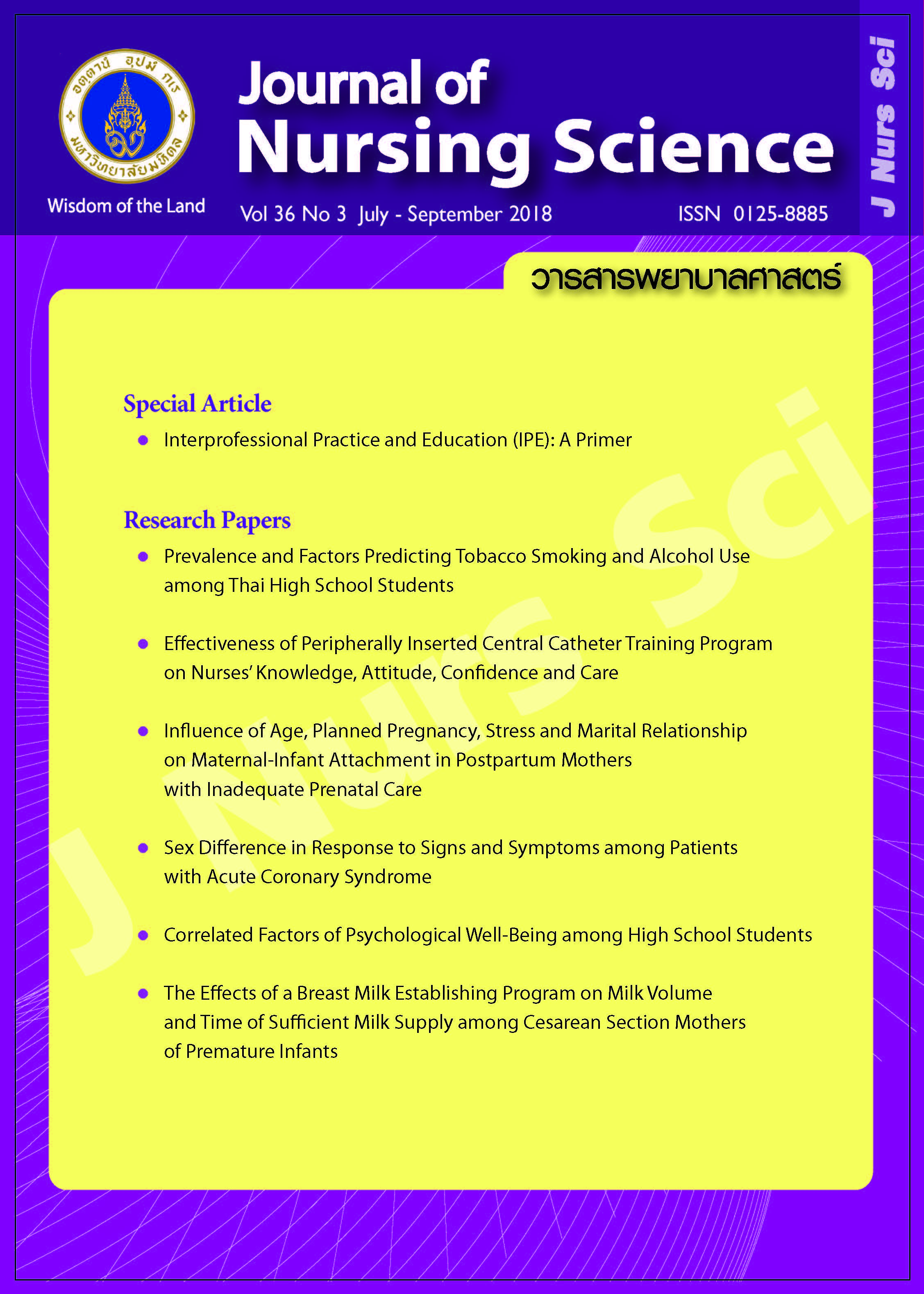
ประสิทธิผลของโปรแกรมการฝึกอบรมการดูแลผู้ป่วยที่ใส่สายสวนหลอดเลือดดำส่วนกลาง ต่อความรู้ ทัศนคติ ความมั่นใจ และการดูแลของพยาบาล
Article Sidebar
Main Article Content
บทคัดย่อ
วัตถุประสงค์: เพื่อศึกษาผลของโปรแกรมการฝึกอบรมการดูแลผู้ป่วยที่ใส่สายสวนหลอดเลือดดำส่วนกลาง (PICC line) ต่อความรู้ ทัศนคติ ความมั่นใจและความถี่ในการดูแลผู้ป่วยของพยาบาล
รูปแบบการวิจัย: การวิจัยครั้งนี้เป็นการวิจัยกึ่งทดลอง
วิธีดำเนินการวิจัย : กลุ่มตัวอย่างเป็นพยาบาลในโรงพยาบาลศิริราช จำนวน 60 คน ที่ปฏิบัติงานดูแลผู้ป่วยที่ใส่สายสวนหลอดเลือดดำส่วนกลาง แบ่งเป็นกลุ่มที่เข้ารับโปรแกรมการฝึกอบรมเรื่องการดูแลผู้ป่วยที่ใส่สายสวนหลอดเลือดดำส่วนกลางและไม่ได้รับการอบรม จำนวนกลุ่มละ 30 คน เก็บข้อมูลทั้งสองกลุ่มด้วยแบบสอบถามส่วนบุคคล ความรู้ ทัศนคติ ความมั่นใจ และความถี่ในการดูแลผู้ป่วยที่ใส่สายสวนหลอดเลือดดำส่วนกลาง วิเคราะห์ข้อมูลด้วยสถิติไคสแควร์และทดสอบค่าที
ผลการวิจัย: พบว่า ก่อนเข้ารับโปรแกรมการฝึกอบรม คะแนนความรู้ของกลุ่มที่ได้รับการอบรมและกลุ่มที่ไม่ได้รับการอบรมไม่แตกต่างกันที่นัยสำคัญ .05 ภายหลังได้รับโปรแกรมการฝึกอบรมและกลับไปปฏิบัติงานเป็นระยะเวลา 6 เดือน กลุ่มที่ได้รับการอบรมมีความรู้มากกว่าก่อนได้รับโปรแกรมการฝึกอบรมอย่างมีนัยสำคัญทางสถิติ (p < .01) คะแนนทัศนคติและความมั่นใจของกลุ่มที่ได้รับการอบรมมากกว่ากลุ่มที่ไม่ได้รับการอบอย่างมีนัยสำคัญทางสถิติ ( p < .05 และ p < .01 ตามลำดับ) และความถี่ในการดูแลผู้ป่วยที่ใส่สายสวนหลอดเลือดดำส่วนกลางพบว่าทั้งสองกลุ่มไม่แตกต่างที่ระดับนัยสำคัญ .05
สรุปและข้อเสนอแนะ: โปรแกรมการฝึกอบรมการดูแลผู้ป่วยที่ใส่สายสวนหลอดเลือดดำส่วนกลางส่งผลให้พยาบาลมีความรู้ ทัศนคติ และความมั่นใจเพิ่มขึ้น ดังนั้นควรจัดการอบรมอย่างต่อเนื่องเพื่อสร้างศักยภาพให้พยาบาลดูแลผู้ป่วยอย่างมีประสิทธิภาพ
Article Details
ลิขสิทธิ์: วารสารพยาบาลศาสตร์เป็นเจ้าของลิขสิทธิ์ในการเผยแพร่ผลงานที่ตีพิมพ์ ห้ามผู้ใดนำบทความที่ได้รับการตีพิมพ์ในวารสารพยาบาลศาสตร์ไปเผยแพร่ในลักษณะต่างๆ ดังต่อไปนี้ การส่งบทความไปตีพิมพ์เผยแพร่ที่อื่น การนำบทความเผยแพร่ออนไลน์ การถ่ายเอกสารบทความเพื่อกิจกรรมที่ไม่ใช่การเรียนการสอน ยกเว้นเสียแต่ได้รับอนุญาตจากวารสารพยาบาลศาสตร์

Disclaimer: เนื้อหาบทความหรือข้อคิดเห็นใดๆ ในวารสารพยาบาลศาสตร์ ถือเป็นความรับผิดชอบของผู้เขียน กองบรรณาธิการไม่จำเป็นต้องเห็นด้วยและไม่มีส่วนรับผิดชอบแต่อย่างใด
เอกสารอ้างอิง
2. Hershey CO, Tomford JW, Mclaren CE, Porter DK, Cohen DI. The natural history of intravenous catheter-associated phlebitis. Arch Intern Med. 1984;144(7):1373-5.
3. Khanchai W. The factors associated with infusion phlebitis in surgical patients. Bangkok: Department of Nursing Siriraj Hospital Printing; 2006. (in Thai).
4. Krongkaeo K, Sukhonthawit P, Hunsai Y, Pittayapan P. Incidence of phlebitis in patients admitted at Siriraj hospital. Bulletin of Nosocomial Infection Control Group of Thailand. 2007;17(1):30-8.
5. Infusion Nurses Society. Infusion nursing standards of practice. J Infus Nurs. 2006;19(1 Suppl):S1-92.
6. Sawaadiwipachai P. Peripherally inserted central catheter [abstract]. In: International basic PICC line training; 2016 October 19; Siriraj Hospital, Bangkok, Thailand. Bangkok: Faculty of Medicine Siriraj Hospital Printing;
[2016]: p.1. (in Thai).
7. Royer T, Lang E, Neuzil K, Beneda H. Peripherally inserted central catheter (PICC) bloodstream infection surveillance rates in medical intensive care, medical surgical wards, extended care, and out patients. Am J Infect Control. 2005;33(5):15-6.
8. Baiocco GG, da Silva JL. The use of the peripherally inserted central catheter (PICC) in the hospital environment.
Rev Lat Am Enfermagem. 2010;18(6):1131-7.
9. Wu Z, Zhao J. The problem with peripherally inserted central catheters in China. Pak J Med Sci. 2013;29(3):896.
10. Rongrungruang Y. Infection control and management for PICC line [abstract]. In: Nursing care for PICC line training; 2017 January 27; Siriraj Hospital, Bangkok, Thailand. Bangkok: Faculty of Medicine Siriraj Hospital Printing; [2017]: p.6. (in Thai).
11. Infusion Nurses Society. Infusion nursing standards of practice. J Infus Nurs. 2016;39(1 Suppl):S11-159.
12. Yap YS, Karapetis C, Lerose S, Iyer S, Koczwara B. Reducing the risk of peripherally inserted central catheter line complication in oncology setting. Eur J Cancer Care (Engl). 2006;15(4):342-7.
13. Ngamjarus C, Chongsuvivatwong V, McNeil E, Holling H. Enhancement of learning on sample size calculation with a smartphone application: a cluster randomized controlled trial. Southeast Asian J Trop Med Public Health. 2017;48(1):240-52.
14. Boonnuch C, Ketsumphan Y, Udompunthurak S, Pooliam J, Poltep P, CoP Research Members. Sample size
[Internet]. 2011 [cited 2017 Dec 30]. Available from: https://www1.si.mahidol.ac.th/km/sites/default/files/sample_
size_0.pdf. (in Thai).
15. Polit DF, Hungler BP. Nursing research: principles and methods. 3rd ed. Philadelphia: JB Lippincott; 1987.
16. Gagné RM, Briggs LJ, Wager WW. Principles of instructional design. 4th ed. Fort Worth, Texas: Harcourt Brace Jovanovich College Publishers; 1992.
17. Sukprasert P. Strategies for training. 2rd ed. Bangkok: Kasetsart University; 1998. (in Thai).
18. Deshmukh M, Shinde M. Impact of structured education on knowledge and practice regarding venous access device care among nurses. International Journal of Science and Research. 2014;3(5):895-910.
19. Schermerhorn JR, Hunt JG, Osborn RN. Organizational behavior. 11th ed. Hoboken, NJ: John Wiley and Sons; 2000.
20. Jonrod R. The training [Internet]. 2011 [cited 2017 Dec 31]. Available from: https://www.gotoknow.org/posts/189416. (in Thai).
21. Pinjai P, Wongchaiya P, Aroonroongrodjana P, Tachavises S. Knowledge, attitudes, expectation and practice primary health care service of health care workers. Nursing Public Health and Education Journal. 2014;15(3):23-30.
(in Thai).
22. Ridlurechai S. Effect of support group to self-esteem and self-confidence on single mothers [master’ thesis]. Khon Kaen: Khon Kaen University; 1998. 83 p. (in Thai).
23. Sriploy S. The effects of group dynamics training on delegation of first line supervisors in the Oriental Electronics
Co., Ltd. [master’ thesis]. Bangkok: Kasetsart University; 1999. 91 p. (in Thai).
24. Keleekai NL, Schuster CA, Murray CL, King MA, Stahl BR, Labrozzi LJ, et al. Improving nurses’ peripheral intravenous catheter insertion knowledge, confidence, and skills using a simulation-based blended learning program: a randomized trial. Simul Healthc. 2016;11(6):376-84.
