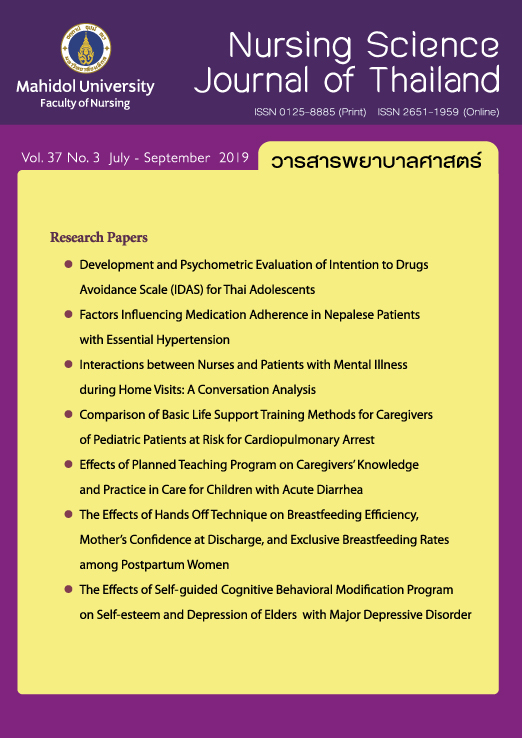
การศึกษาเปรียบเทียบวิธีการสอนช่วยชีวิตขั้นพื้นฐานสำหรับผู้ดูแลผู้ป่วยเด็กที่เสี่ยงต่อการเกิดภาวะหัวใจหยุดเต้น
Article Sidebar
Main Article Content
บทคัดย่อ
วัตถุประสงค์: เพื่อเปรียบเทียบผลวิธีการสอนช่วยชีวิตขั้นพื้นฐาน ระหว่างวิธีการสอนด้วยวีดิทัศน์และฝึกปฏิบัติกับพยาบาล และวิธีการสอนและฝึกปฏิบัติด้วยพยาบาล ต่อความรู้และการปฏิบัติในการช่วยชีวิตเด็กขั้นพื้นฐาน ของผู้ดูแลผู้ป่วยเด็กที่เสี่ยงต่อการเกิดภาวะหัวใจหยุดเต้น
รูปแบบการวิจัย: การวิจัยเชิงทดลอง
วิธีดำเนินการวิจัย: กลุ่มตัวอย่างเป็นผู้ดูแลหลักของผู้ป่วยเด็กที่เสี่ยงต่อการเกิดภาวะหัวใจหยุดเต้นในโรงพยาบาลศิริราช จำนวน 98 คน เก็บข้อมูลโดยใช้แบบสัมภาษณ์ข้อมูลทั่วไป แบบประเมินความรู้ และแบบประเมินการปฏิบัติในการช่วยชีวิตเด็กขั้นพื้นฐาน วิเคราะห์ข้อมูลโดยใช้สถิติเชิงพรรณนา การทดสอบแมน-วิทนีย์ ยู การทดสอบไคร์สแควร์ และการทดสอบฟิชเชอร์
ผลการวิจัย: ผู้ดูแลผู้ป่วยเด็กกลุ่มที่สอนด้วยวีดิทัศน์และฝึกปฏิบัติกับพยาบาลมีคะแนนรวมเฉลี่ยหลังเรียน และการปฏิบัติในภาพรวมของการช่วยชีวิตเด็กขั้นพื้นฐาน ไม่แตกต่างจากกลุ่มที่สอนและฝึกปฏิบัติด้วยพยาบาลอย่างมีนัยสำคัญ .05 (p > .05) แต่ใช้ระยะเวลาที่พยาบาลต้องสอนน้อยกว่ากลุ่มที่สอนและฝึกปฏิบัติโดยพยาบาลอย่างมีนัยสำคัญทางสถิติ (Z = -7.43, p < .05)
สรุปและข้อเสนอแนะ: วิธีการสอนเพื่อให้ความรู้และทักษะการปฏิบัติในการช่วยชีวิตเด็กขั้นพื้นฐานแก่ผู้ดูแล ไม่ว่าจะใช้วิธีสอนด้วยวีดิทัศน์และฝึกปฏิบัติกับพยาบาลหรือวิธีสอนโดยพยาบาลให้ผลไม่แตกต่างกัน ดังนั้น จึงควรสนับสนุนให้นำวิธีการสอนด้วยวีดิทัศน์และฝึกปฏิบัติกับพยาบาลมาใช้ในทางปฏิบัติเนื่องจากวิธีนี้ใช้เวลาของพยาบาลน้อยกว่า ยิ่งกว่านั้นควรให้วีดิทัศน์แก่ผู้ดูแลนำกลับไปทบทวนที่บ้านเพื่อให้ทักษะการช่วยเหลือคงทน
Article Details
ลิขสิทธิ์: วารสารพยาบาลศาสตร์เป็นเจ้าของลิขสิทธิ์ในการเผยแพร่ผลงานที่ตีพิมพ์ ห้ามผู้ใดนำบทความที่ได้รับการตีพิมพ์ในวารสารพยาบาลศาสตร์ไปเผยแพร่ในลักษณะต่างๆ ดังต่อไปนี้ การส่งบทความไปตีพิมพ์เผยแพร่ที่อื่น การนำบทความเผยแพร่ออนไลน์ การถ่ายเอกสารบทความเพื่อกิจกรรมที่ไม่ใช่การเรียนการสอน ยกเว้นเสียแต่ได้รับอนุญาตจากวารสารพยาบาลศาสตร์
Disclaimer: เนื้อหาบทความหรือข้อคิดเห็นใดๆ ในวารสารพยาบาลศาสตร์ ถือเป็นความรับผิดชอบของผู้เขียน กองบรรณาธิการไม่จำเป็นต้องเห็นด้วยและไม่มีส่วนรับผิดชอบแต่อย่างใด
เอกสารอ้างอิง
2. Kitamura T, Iwami T, Kawamura T, Nagao K, Tanaka H, Nadkarni VM, et al. Conventional and chest-compression-only cardiopulmonary resuscitation by bystanders for children who have out-of-hospital cardiac arrests: a prospective, nationwide, population-based cohort study. Lancet. 2010;375(9723):1347-54.
3. Waalewijn RA, Tijssen JG, Koster RW. Bystander initiated actions in out-of-hospital cardiopulmonary resuscitation: results from the Amsterdam Resuscitation Study (ARRESUST). Resuscitation. 2001;50(3):273-9.
4. Pierick TA, Van Waning N, Patel SS, Atkins DL. Self-instructional CPR training for parents of high risk infants. Resuscitation. 2012;83(9):1140-4.
5. Higgins SS, Hardy CE, Higashino SM. Should parents of children with congenital heart disease and life-threatening dysrhythmias be taught cardiopulmonary resuscitation? Pediatrics. 1989;84(6):1102-4.
6. Ubol L, Prasopkittikun T, Srichantaranit A, Vijarnsorn C. Basic life support training via Video CD for caregivers of pediatric patients at risk for cardiopulmonary arrest. Journal of Nursing Science. 2016;34(3):66-78. (in Thai).
7. Flint LS Jr, Billi JE, Kelly K, Mandel L, Newell L, Stapleton ER. Education in adult basic life support training programs. Ann Emerg Med. 1993;22(2 Pt 2):468-74.
8. Kaye W, Rallis SF, Mancini ME, Linhares KC, Angell ML, Donovan DS, et al. The problem of poor retention of cardiopulmonary resuscitation skills may lie with the instructor, not the learner or the curriculum. Resuscitation. 1991;21(1):67-87.
9. Chung C, Siu AY, Po LL, Lam C, Wong PC. Comparing the effectiveness of video self-instruction versus traditional classroom instruction targeted at cardiopulmonary resuscitation skills for laypersons: a prospective randomised controlled trial. Hong Kong Med J.2010;16(3):165-70.
10. Roppolo LP, Pepe PE, Campbell L, Ohman K, Kulkarni H, Miller R, et al. Prospective, randomized trial of the effectiveness and retention of 30-min layperson training for cardiopulmonary resuscitation and automated external defibrillator: The American Airlines Study. Resuscitation. 2007;74(2):276-85.
11. Batcheller AM, Brennan RT, Braslow A, Urrutia A, Kaye W. Cardiopulmonary resuscitation performance of subjects over forty is better following half-hour video self-instruction compared to traditional four-hour classroom training. Resuscitation. 2000;43(2):101-10.
12. Todd KH, Braslow A, Brennan RT, Lowery DW, Cox RJ, Lipscomb LE, et al. Randomized, controlled trial of video self-instruction versus traditional CPR training. Ann Emerg Med. 1999;34(6):730-7.
13. Braslow A, Brennan RT, Newman MM, Bircher NG, Batcheller AM, Kaye W. CPR training without an instructor: development and evaluation of a video self-instructional system for effective performance of cardiopulmonary resuscitation. Resuscitation. 1997;34(3):207-20.
14. Einspruch EL, Lynch B, Aufderheide TP, Nichol G, Becker L. Retention of CPR skills learned in a traditional AHA hartsaver course versus 30-min video self-training: a controlled randomized study. Resuscitation. 2007;74(3):476-86.
15. Lynch B, Einspruch EL, Nichol G, Becker LB, Aufderheide TP, Idris A. Effectiveness of a 30-min CPR self-instruction program for lay responders: a controlled randomized study. Resuscitation. 2005;67(1):31-43.
16. Dracup K, Moser DK, Doering LV, Guzy PM. Comparison of cardiopulmonary resuscitation training methods for parents of infants at high risk for cardiopulmonary arrest. Ann Emerg Med.1998;32(2):170-7.
17. Sakcharoen P. Adult learning theory and self-directed learning concept: learning process for promoting lifelong learning. Journal of The Royal Thai Army Nurses. 2015;16(1):8-13.
18. Atkins DL, Berger S, Duff JP, Gonzales JC, Hunt EA, Joyner BL, et al. Part 11: Pediatric basic life support and cardiopulmonary resuscitation quality: 2015 American Heart Association guidelines update for cardiopulmonary resuscitation and emergency cardiovascular care. Circulation. 2015;132(18 Suppl 2):S519-25.
19. Fleiss JL, Tytun A, Ury HK. A simple approximation for calculating sample sizes for comparing independent proportions. Biometrics. 1980;36(2):343-6.
20. Kouwenhoven WB, Jude JR, Knickerbocker GG. Closed-chest cardiac massage. JAMA. 1960;173:1064-7.
21. Srichantaranit A, Chungsomprasong P, Vijarnsorn C, Sukthongsa W, Udomponglukana N, Jaturachaidech C. Comparing the effects of teaching with VCD and teaching with flip chart on knowledge and anxiety of mothers in caring for children undergoing cardiac ctheterization. Journal of Nursing Science. 2014;32(2):41-51. (in Thai).
22. Brannon TS, White LA, Kilcrease JN, Richard LD, Spillers JG, Phelps CL. Use of instructional video to prepare parents for learning infant cardiopulmonary resuscitation. Proc (Bayl Univ Med Cent). 2009;22(2):133-7.
23. Mpotos N, Yde L, Calle P, Deschepper E, Valcke M, Peersman W, et al. Retraining basic life support skills using video, video feedback or both: a randomised controlled trial. Resuscitation. 2013;84(1):72-7.
