
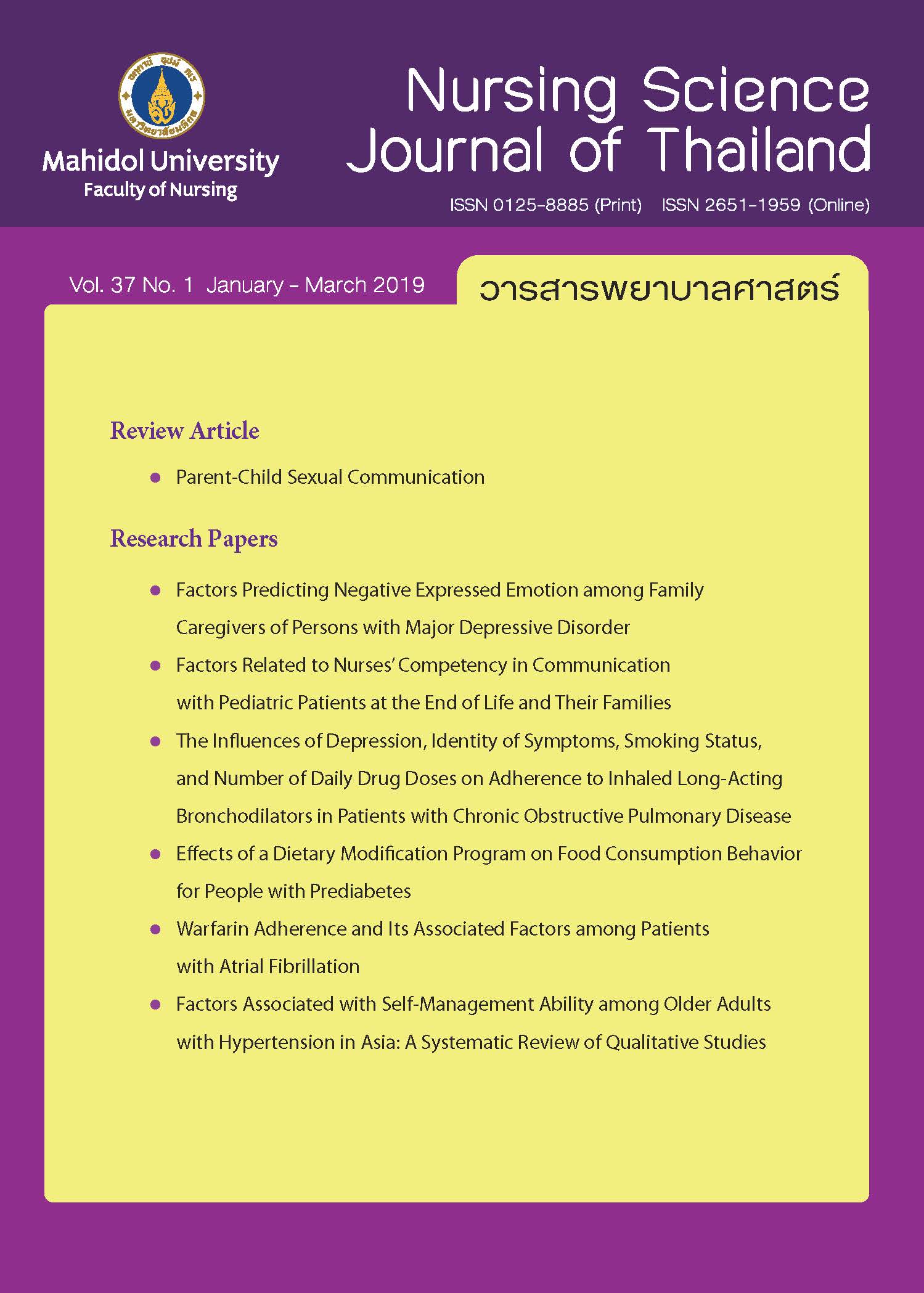
อิทธิพลของภาวะซึมเศร้า การรับรู้ลักษณะอาการ การสูบบุหรี่ และจำนวนครั้งต่อวันในการใช้ยาสูดต่อความร่วมมือในการใช้ยาสูดขยายหลอดลมชนิดออกฤทธิ์ยาวในผู้ป่วยโรคปอดอุดกั้นเรื้อรัง
Article Sidebar
Main Article Content
บทคัดย่อ
วัตถุประสงค์: เพื่อศึกษาอิทธิพลของภาวะซึมเศร้า การรับรู้ลักษณะอาการ การสูบบุหรี่ และจำนวนครั้งต่อวันในการใช้ยาสูดต่อความร่วมมือในการใช้ยาสูดขยายหลอดลมชนิดออกฤทธิ์ยาวในผู้ป่วยโรคปอดอุดกั้นเรื้อรัง
รูปแบบการวิจัย: การศึกษาความสัมพันธ์เชิงทำนาย
วิธีดำเนินการวิจัย: กลุ่มตัวอย่างเป็นผู้ป่วยโรคปอดอุดกั้นเรื้อรัง จำนวน 173 ราย ณ คลินิกโรคปอด โรงพยาบาลมหาวิทยาลัยแห่งหนึ่งในกรุงเทพมหานคร เก็บรวบรวมข้อมูลโดยใช้แบบสอบถามข้อมูลส่วนบุคคล แบบประเมินความร่วมมือในการใช้ยา แบบประเมินการรับรู้ความเจ็บป่วยฉบับย่อ และแบบประเมินภาวะซึมเศร้า วิเคราะห์ข้อมูลโดยใช้สถิติพรรณนา และการวิเคราะห์ถดถอยโลจิสติค
ผลการวิจัย: กลุ่มตัวอย่างเป็นเพศชาย ร้อยละ 93.6 อายุเฉลี่ย 73.32 ปี (SD = 9.27) มีความร่วมมือในการใช้ยาร้อยละ 74 ซึ่งภาวะซึมเศร้า การรับรู้ลักษณะอาการ การสูบบุหรี่ และจำนวนครั้งต่อวันในการใช้ยาสูดสามารถร่วมกันทำนายความร่วมมือในการใช้ยาสูดขยายหลอดลมชนิดออกฤทธิ์ยาวในผู้ป่วยโรคปอดอุดกั้นเรื้อรังได้ร้อยละ 15.1 โดยมีเพียงภาวะซึมเศร้าที่สามารถทำนายความร่วมมือในการใช้ยาสูดขยายหลอดลมชนิดออกฤทธิ์ยาวในผู้ป่วยโรคปอดอุดกั้นเรื้อรังได้อย่างมีนัยสำคัญทางสถิติ (OR = .91; 95%CI = .86, .95, p < .001)
สรุปและข้อเสนอแนะ: ภาวะซึมเศร้าส่งผลให้ความร่วมมือในการใช้ยาลดลง ดังนั้นพยาบาลควรให้ความสำคัญในการประเมินภาวะซึมเศร้าในผู้ป่วย พร้อมทั้งวางแผนการพยาบาลในการป้องกัน และจัดการกับอาการดังกล่าว เพื่อส่งเสริมให้เกิดความร่วมมือในการใช้ยาอย่างเหมาะสม
Article Details
ลิขสิทธิ์: วารสารพยาบาลศาสตร์เป็นเจ้าของลิขสิทธิ์ในการเผยแพร่ผลงานที่ตีพิมพ์ ห้ามผู้ใดนำบทความที่ได้รับการตีพิมพ์ในวารสารพยาบาลศาสตร์ไปเผยแพร่ในลักษณะต่างๆ ดังต่อไปนี้ การส่งบทความไปตีพิมพ์เผยแพร่ที่อื่น การนำบทความเผยแพร่ออนไลน์ การถ่ายเอกสารบทความเพื่อกิจกรรมที่ไม่ใช่การเรียนการสอน ยกเว้นเสียแต่ได้รับอนุญาตจากวารสารพยาบาลศาสตร์

Disclaimer: เนื้อหาบทความหรือข้อคิดเห็นใดๆ ในวารสารพยาบาลศาสตร์ ถือเป็นความรับผิดชอบของผู้เขียน กองบรรณาธิการไม่จำเป็นต้องเห็นด้วยและไม่มีส่วนรับผิดชอบแต่อย่างใด
เอกสารอ้างอิง
2. National Health Security Office. NHSO area 4 (Saraburi) collaborated with Khon Kaen University and Healthcare Accreditation Institute (Public Organisation) construct treatment mechanisms, prevent exacerbations in asthma and COPD [Internet]. Bangkok: NHSO; 2013 [cited 2017 Mar 26]: Available from: https://www.nhso.go.th/frontend/NewsInformationDetail.aspx?newsid=Njgy. (in Thai).
3. Toy EL, Beaulieu NU, McHale JM, Welland TR, Plauschinat CA, Swensen A, et al. Treatment of COPD: relationships between daily dosing frequency, adherence, resource use, and costs. Respir Med. 2011;105(3):435-41.
4. Nishi SPE, Maslonka M, Zhang W, Kuo YF, Sharma G. Pattern and adherence to maintenance medication use in medicare beneficiaries with chronic obstructive pulmonary disease: 2008-2013. Chronic Obstr Pulm Dis. 2018;5(1):16-26.
5. Wells K, Pladevall M, Peterson EL, Campbell J, Wang M, Lanfear DE, et al. Race-ethnic differences in factors associated with inhaled steroid adherence among adults with asthma. Am J Respir Crit Care Med. 2008;178(12):1194-201.
6. Albrecht JS, Khokhar B, Huang TY, Wei YJ, Harris I, Moyo P, et al. Adherence and healthcare utilization among older adults with COPD and depression. Respir Med. 2017;129:53-8.
7. Yohannes AM, Alexopoulos GS. Depression and anxiety in patients with COPD. Eur Respir Rev. 2014;23(133):345-9.
8. Broadbent E, Petrie KJ, Main J, Weinman J. The brief illness perception questionnaire. J Psychosom Res. 2006;60(6):631-7.
9. Tiemensma J, Gaab E, Voorhaar M, Asijee G, Kaptein AA. Illness perceptions and coping determine quality of life in COPD patients. Int J Chron Obstruct Pulmon Dis. 2016;11:2001-7.
10. Weldam SW, Lammers JW, Decates RL, Schuurmans MJ. Daily activities and health-related quality of life in patients with chronic obstructive pulmonary disease: psychological determinants: a cross-sectional study. Health Qual Life Outcomes. 2013;11:190. doi: 10.1186/1477-7525-11-190.
11. Koehorst-Ter Huurne K, Kort S, van der Palen J, van Beurden WJ, Movig KL, van der Valk P, et al. Quality of life and adherence to inhaled corticosteroids and tiotropium in COPD are related. Int J Chron Obstruct Pulmon Dis. 2016;11:1679-88.
12. Hayes-Watson C, Nuss H, Tseng TS, Parada N, Yu Q, Celestin M, et al. Self-management practices of smokers with asthma and/or chronic obstructive pulmonary disease: a cross-sectional survey. COPD Res Pract. 2017;3:3. doi: 10.1186/s40749-017-0022-0.
13. Toh MR, Teo V, Kwan YH, Raaj S, Tan SY, Tan JZ. Association between number of doses per day, number of medications and patient's non-compliance, and frequency of readmissions in a multi-ethnic Asian population. Prev Med Rep. 2014;1:43-7.
14. Horne R, Hankins M. The medication adherence report scale. Brighton, England: Center for Health Care Research; 2002.
15. Wiriyachot A, Wattanakitkrileart D, Charoenkitkarn V, Dejsomritrutai W. Influences of perceived medication necessity, medication concern, satisfaction with information received, and experience of exacerbation on adherence of inhaled combined bronchodilator and corticosteroid therapy in patients with chronic obstructive pulmonary disease. Journal of The Royal Thai Army Nurses. 2016;17(3):187-196. (in Thai).
16. Cohen JL, Mann DM, Wisnivesky JP, Horne R, Leventhal H, Musumeci-Szabó TJ, et al. Assessing the validity of self-reported medication adherence among inner-city asthmatic adults: the Medication Adherence Report Scale for Asthma. Ann Allergy Asthma Immunol. 2009;103(4):325-31.
17. Radloff LS. The CES-D scale: a self-report depression scale for research in the general population. Appl Psychol Meas. 1977;1(3):385-401.
18. Kuptniratsaikul V, Katumarn P. The study of the Center for Epidemiologic Studies-Depression scale (CES-D) in Thai People. Siriraj Medical Journal. 1997;49(5):442-8. (in Thai).
19. Smarr KL, Keefer AL. Measures of depression and depressive symptoms: Beck Depression Inventory-II (BDI-II), Center for Epidemiologic Studies Depression Scale (CES-D), Geriatric Depression Scale (GDS), Hospital Anxiety and Depression Scale (HADS), and Patient Health Questionnaire-9 (PHQ-9). Arthritis Care Res (Hoboken). 2011;63 Suppl 11:S454-66.
20. Polit DF, Beck CT. Essentials of nursing research: apraising evidence for nursing practice. 7th ed. Philadelphia: Lippincott Williams & Wilkins; 2010.
21. Oung AB, Kosirog E, Chavez B, Brunner J, Saseen JJ. Evaluation of medication adherence in chronic disease at a federally qualified health center. Ther Adv Chronic Dis. 2017;8(8-9):113-20.
22. Albrecht JS, Park Y, Hur P, Huang TY, Harris I, Netzer G, et al. Adherence to maintenance medications among older adults with chronic obstructive pulmonary disease. The role of depression. Ann Am Thorac Soc. 2016;13(9):1497-504.
23. Aujla N, Walker M, Sprigg N, Abrams K, Massey A, Vedhara K. Can illness beliefs, from the common-sense model, prospectively predict adherence to self-management behaviours? A systematic review and meta-analysis. Psychol Health. 2016;31(8):931-58.
24. Ágh T, Inotai A, Mészáros Á. Factors associated with medication adherence in patients with chronic obstructive pulmonary disease. Respiration. 2011;82(4):328-34.
