
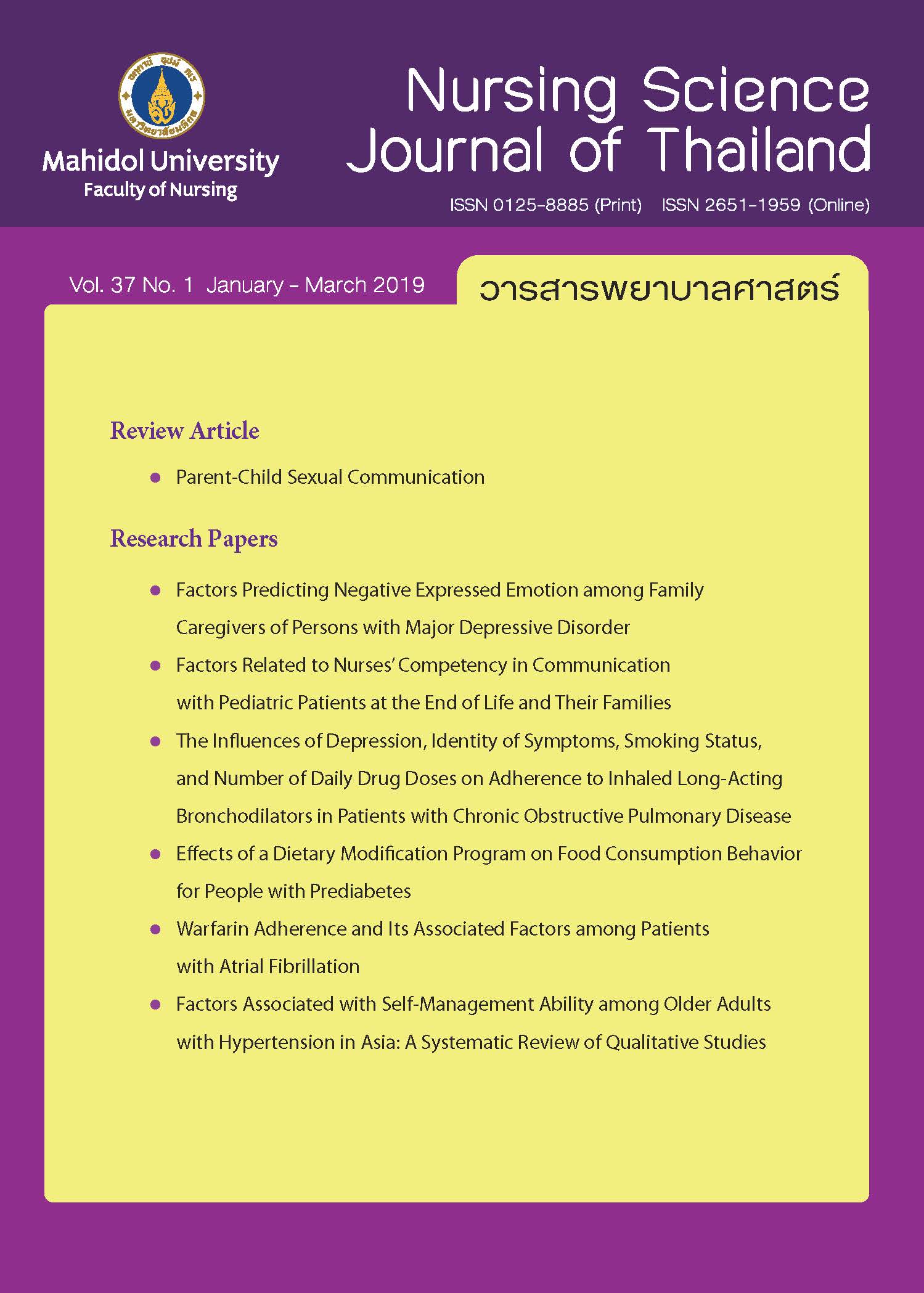
ความร่วมมือในการรับประทานยาวาร์ฟาริน และปัจจัยที่เกี่ยวข้องในผู้ป่วยภาวะหัวใจเต้นไม่เป็นจังหวะชนิดหัวใจห้องบนสั่นพลิ้ว
Article Sidebar
Main Article Content
บทคัดย่อ
วัตถุประสงค์: เพื่อศึกษาระดับความร่วมมือในการรับประทานยาวาร์ฟาริน และปัจจัยที่เกี่ยวข้องกับความร่วมมือในการรับประทานยาวาร์ฟารินในผู้ป่วยที่มีภาวะหัวใจเต้นไม่เป็นจังหวะชนิดหัวใจห้องบนสั่นพลิ้ว
รูปแบบการวิจัย: การศึกษาความสัมพันธ์เชิงทำนาย
วิธีดำเนินการวิจัย: การวิจัยครั้งนี้ศึกษาที่โรงพยาบาลมหาวิทยาลัยแห่งหนึ่งในประเทศไทย เก็บข้อมูลในผู้ป่วยภาวะหัวใจเต้นไม่เป็นจังหวะชนิดหัวใจห้องบนสั่นพลิ้วที่ได้รับยาวาร์ฟารินจำนวน 120 ราย เก็บรวบรวมข้อมูลโดยใช้แบบสอบถามความร่วมมือในการรับประทานยาต้านการแข็งตัวของเลือด ดัชนีชี้วัดความซับซ้อนของแผนการใช้ยา แบบสอบถามความรู้เท่าทันทางสุขภาพ แบบสอบถามความเชื่อเกี่ยวกับการใช้ยาต้านการแข็งตัวของเลือด ฉบับภาษาไทย วิเคราะห์ข้อมูลโดยใช้สถิติพรรณนา สหสัมพันธ์แบบลำดับที่ของสเปียร์แมน และสถิติถดถอยพหุคูณ
ผลการวิจัย: ผู้เข้าร่วมการวิจัยทุกรายมีความร่วมมือในการรับประทานยาวาร์ฟารินอยู่ในระดับสูง ( = 5.76, SD = .25) แต่มีเพียง 45.8% ที่มีค่าไอเอนอาร์ (INR) อยู่ในช่วงที่เหมาะสม ความซับซ้อนของแผนการใช้ยาวาร์ฟาริน ความรู้เท่าทันทางสุขภาพ การรับรู้ประโยชน์และการรับรู้อุปสรรคในการรับประทานยาวาร์ฟารินสามารถร่วมกันทำนายความร่วมมือในการรับประทานยาวาร์ฟารินได้ ร้อยละ 14 (R2 = .140, F(4,115) = 4.664, p = .002) และพบว่ากลุ่มตัวอย่างที่มีการรับรู้อุปสรรคในการรับประทานยาวาร์ฟารินน้อย มีความร่วมมือในการรับประทานยาวาร์ฟารินสูง (β = -.285, p = .002)
สรุปและข้อเสนอแนะ: ถึงแม้ว่าผู้เข้าร่วมการวิจัยทุกคนมีความร่วมมือในการรับประทานยาวาร์ฟารินแต่ยังคงมีความเสี่ยงต่อความผันแปรของค่า INR บุคลากรสุขภาพควรให้ความสนใจในการลดอุปสรรคของการรับประทานยาวาร์ฟาริน เพื่อเพิ่มความร่วมมือในการรับประทานยาและคงค่าไอเอนอาร์ (INR) ให้อยู่ในช่วงการรักษา
Article Details
ลิขสิทธิ์: วารสารพยาบาลศาสตร์เป็นเจ้าของลิขสิทธิ์ในการเผยแพร่ผลงานที่ตีพิมพ์ ห้ามผู้ใดนำบทความที่ได้รับการตีพิมพ์ในวารสารพยาบาลศาสตร์ไปเผยแพร่ในลักษณะต่างๆ ดังต่อไปนี้ การส่งบทความไปตีพิมพ์เผยแพร่ที่อื่น การนำบทความเผยแพร่ออนไลน์ การถ่ายเอกสารบทความเพื่อกิจกรรมที่ไม่ใช่การเรียนการสอน ยกเว้นเสียแต่ได้รับอนุญาตจากวารสารพยาบาลศาสตร์
Disclaimer: เนื้อหาบทความหรือข้อคิดเห็นใดๆ ในวารสารพยาบาลศาสตร์ ถือเป็นความรับผิดชอบของผู้เขียน กองบรรณาธิการไม่จำเป็นต้องเห็นด้วยและไม่มีส่วนรับผิดชอบแต่อย่างใด
เอกสารอ้างอิง
2. Camm AJ, Lip GY, De Caterina R, Savelieva I, Atar D, Hohnloser SH, et al. 2012 focused update of the ESC guidelines for the management of atrial fibrillation: an update of the 2010 ESC guidelines for the management of atrial fibrillation developed with the special contribution of the European Heart Rhythm Association. Eur Heart J. 2012;33(21):2719-47.
3. Wigle P, Hein B, Bloomfield HE, Tubb M, Doherty M. Updated guidelines on outpatient anticoagulation. Am Fam Physician. 2013;87(8):556-66.
4. Garkina SV, Vavilova TV, Lebedev DS, Mikhaylov EN. Compliance and adherence to oral anticoagulation therapy in elderly patients with atrial fibrillation in the era of direct oral anticoagulants. J Geriatr Cardiol. 2016;13(9):807-10.
5. Suzuki T, Shiga T, Omori H, Tatsumi F, Nishimura K, Hagiwara N. Adherence to medication and characteristics of Japanese patients with non-valvular atrial fibrillation. J Cardiol. 2017;70(3):238-43.
6. Balkhi B, Al-Rasheedi M, Elbur AI, Alghamadi A. Association between satisfaction with and adherence to warfarin therapy on the control of international normalized ratio: a hospital-based study in Saudi Arabia. Saudi Pharm J. 2018;26(1):145-9.
7. Kalatad T, Ua-Kit N. Selected factors related to anti-coagulant medication adherence in valvular replacement patients. Thai Journal of Cardio-Thoracic Nursing. 2010;22(2):2-14. (in Thai).
8. World Health Organization. Adherence to long-term therapies: evidence for action. Geneva, Switzerland: World Health Organization; 2003.
9. Aronis KN, Edgar B, Lin W, Martins MAP, Paasche-Orlow MK, Magnani JW. Health literacy and atrial fibrillation: relevance and future directions for patient-centred care. Eur Cardiol. 2017;12(1):52-7.
10. Zhang NJ, Terry A, McHorney CA. Impact of health literacy on medication adherence: a systematic review and meta-analysis. Ann Pharmacother. 2014;48(6):741-51.
11. Orensky IA, Holdford DA. Predictors of noncompliance with warfarin therapy in an outpatient anticoagulation clinic. Pharmacotherapy. 2005;25(12):1801-8.
12. Tepsuriyanont S, Jirapaet V, Luangmomlert S, Praditsuwan R. Relationship between regimen complexity and medication adherence behavior in Thai elderly with hypertension. Chulalongkorn Medical Journal. 2011;55(5):457-72. (in Thai).
13. Kumkrong C, Maneesriwongul W, Janpanich P. Relationships of health literacy and knowledge about antiretroviral therapy to medication adherence among people living with HIV. Kuakarun Journal of Nursing. 2014;21(2):211-28. (in Thai).
14. Institute of Geriatric Medicine, Department of Medical Service, Ministry of Public Health. Mini-mental state examination Thai version. Nonthaburi: Institute of Geriatric Medicine; 2002. (in Thai).
15. Faul F, Erdfelder E, Buchner A, Lang AG. Statistical power analyses using G*Power 3.1: tests for correlation and regression analyses. Behav Res Methods. 2009;41(4):1149-60.
16. George J, Phun YT, Bailey MJ, Kong DC, Stewart K. Development and validation of the medication regimen complexity index. Ann Pharmacother. 2004;38(9):1369-76.
17. Ishikawa H, Takeuchi T, Yano E. Measuring functional, communicative, and critical health literacy among diabetic patients. Diabetes Care. 2008;31(5):874-9.
18. Bennett SJ, Perkins SM, Lane KA, Forthofer MA, Brater DC, Murray MD. Reliability and validity of the compliance belief scales among patients with heart failure. Heart Lung. 2001;30(3):177-85.
19. Da Silva Carvalho AR, Dantas RA, Pelegrino FM, Corbi IS. Adaptation and validation of an oral anticoagulation measurement of treatment adherence instrument. Rev Lat Am Enfermagem. 2010;18(3):301-8.
20. Han WP, Hong SA, Tiraphat S. Factors related to medication adherence among essential hypertensive patients in tertiary hospitals in Yangon, Myanmar. Journal of Public Health and Development. 2015;13(2):57-70.
