
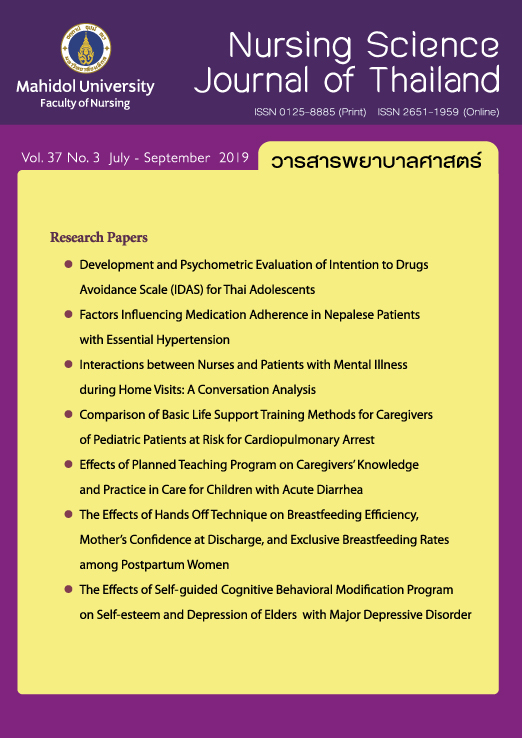
Development and Psychometric Evaluation of Intention to Drug Avoidance Scale (IDAS) for Thai Adolescents
Article Sidebar
Main Article Content
Abstract
Purpose: The purpose of this study was to develop and evaluate psychometric properties of
the Intention to Drugs Avoidance Scale (IDAS) for Thai adolescents.
Design: A methodological research was used to develop a newly intention to drug avoidance scale for Thai adolescents. Both qualitative and quantitative methods were used for data collection.
Methods: The development of the IDAS consisted of determination of content domains, items generation, and then psychometric evaluation regarding content validity, construct validities in terms of exploratory factor analysis (EFA) and known groups, and reliability. Three hundred and sixty-nine Thai adolescents with no history of drug use were stratified random sampling from high schools in every parts of Thailand as a sample for construct validity test of the scale. Another 60 Thai adolescents were recruited from drug treatment center (n = 30) and a high school (n = 30) in the south of Thailand for field testing and test-retest.
Main findings: The final version of the 22 items of the IDAS has 2 factors. The first factor, desire and commitment to avoid drugs, was comprised of 15 items that explained 42.26% of the variance with the factor loadings from .54 to .86. The second one was readiness to avoid drugs, which had 7 items with 10.73% of the variance and the factor loadings from .55 to .86. In addition, the construct validity of this instrument by using known groups indicated that there was a significant difference between adolescents who used and did not use drug. Alpha coefficient as indicating internal consistency reliability yielded the value of .94 and the stability which demonstrated by test-retest reliability has a high stability reliability (r = .77, p = < .01) over a two-week period.
Conclusion and recommendations: The result revealed that the IDAS for Thai adolescents
had 2 factors with a valid and reliable properties for evaluation of intention to drugs avoidance of Thai adolescents. It should be beneficial for researcher and health care providers in using this tool in the future.
Article Details
Copyright Notice: Nursing Science Journal of Thailand has exclusive rights to publish and distribute the manuscript and all contents therein. Without the journal’s permission, the dissemination of the manuscript in another journal or online, and the reproduction of the manuscript for non-educational purpose are prohibited.
Disclaimer: The opinion expressed and figures provided in this journal, NSJT, are the sole responsibility of the authors. The editorial board bears no responsibility in this regard.
References
2. World Health Organization (WHO). Global health observatory data repository: substance use and mental health [Internet]. Geneva: World Health Organization; 2015. [cited 2017 Feb 15]. Available from: https://apps.who.int/gho/data/node.main.SUBUSEMENTAL?lang=en.
3. UNICEF Thailand. A situation analysis of adolescents in Thailand 2015-2016 [Internet]. Bangkok, UNICEF Thailand; 2016 [cited 2019 Aug 3]. Available from: https://www.unicef.org/thailand/media/1021/file/A%20Situation%20Analysis%20of%20Adolescents%20in%20Thailand%202015-2016.pdf.
4. McKetin R, Dawe S, Burns RA, Hides L, Kavanagh DJ, Teesson M, et al. The profile of psychiatric
symptoms exacerbated by methamphetamine use. Drug Alcohol Depend. 2016;161:104-9.
5. Eslami AA, Jalilian F, Ataee M, Mirzaei-Alavijeh M, Mahboubi M, Afsar A, et al. Intention and willingness
in understanding Ritalin misuse among Iranian medical college students: a cross-sectional study. Glob J Health Sci. 2014;6(6):43-53.
6. Sinha R. New findings on biological factors predicting addiction relapse vulnerability. Curr Psychiatry Rep. 2011;13(5):398-405.
7. Panchabuse C, Saengduenchai S. The effectiveness of cognitivebehavioral therapy program on early
relapse prevention among methamphetamine-dependent patients. Journal of Nursing Division. 2014;40(1):24-38. (in Thai).
8. National Council for Behavioral Health (NCBH). Substance use, misuse, and addiction prevention [Internet]. Washington, DC: National Council for Behavioral Health; 2017 [cited 2017 Sep 20]. Available from: https://www.thenationalcouncil.org/wp-content/uploads/2017/05/Prevention-Paper-FINAL.pdf.
9. Allahverdipour H, Farhadinasab A, Galeeih A, Mirzaee E. Behavioral intention to avoid drug abuse works
as protective factor among adolescent. J Res Health Sci. 2007;7(1):6-12.
10. De Leon G, Jainchill N. Circumstance, motivation, readiness, and suitability as correlates of treatment tenure. J Psychoactive Drugs. 1986;18(3):203-8.
11. Kaminer Y, Ohannessian CM, McKay JR, Burke RH. The Adolescent Substance Abuse Goal Commitment
(ASAGC) questionnaire: an examination of clinical utility and psychometric properties. J Subs Abuse Treat. 2016;61:42-6.
12. Martin GW, Wilkinson DA, Poulos CX. The drug avoidance self efficacy scale. J Subst Abuse. 1995;7(2):151-63.
13. Miller WR, Tonigan JS. Assessing drinkers’ motivations for change: the Stages of Change Readiness And Treatment Eagerness Scale (SOCRATES). Psychol Addict Behav. 1996;10(2):81-9.
14. Qingxue L. Understanding different cultural patterns or orientations between east and west. Investigationes Linguisticae. 2003;9:21-30.
15. Sanchez-Burks J, Lee F, Choi I, Nisbett R, Zhao S, Koo J. Conversing across cultures: east-west
communication styles in work and non-work contexts. J Pers Soc Psychol. 2003;85(2):363-72.
16. Yuenyong J, Yuenyong C. Connecting between culture of learning in Thai contexts and developing students’ science learning in the formal setting. Procedia - Social and Behavioral Sciences. 2012;46:5371-8.
17. Suwanchinda P, Suttharangsee W, Kongsuwan V. Concept analysis: intention to drugs avoidance in
adolescents. J Alcohol Drug Depend. 2018;6(3). doi:10.4172/2329-6488.1000313.
18. Hinkin TR. A review of scale development practices in the study of organizations. J Manage. 1995;21(5):967-88.
19. Lynn MR. Determination and quantification of content validity. Nurs Res. 1986;35(6):382-5.
20. Davis LL. Instrument review: getting the most from a panel of experts. Appl Nurs Res. 1992;5(4):194-7.
21. Polit DF. Beck CT. The content validity index: are you sure you know what’s being reported? Critique and recommendations. Res Nurs Health. 2006;29(5):489-97.
22. Burns N, Grove SK. The practice of nursing research: conduct, critique and utilization. 2nd ed. Philadelphia: Saunders; 1993. 818 p.
23. Stevens J. Applied multivariate statistics for the social science. 3rd ed. Mahwah, NJ: Lawrence Erlbaum
Associate; 1996. 734 p.
24. Polit DF, Beck CT, Owen SV. Is the CVI an acceptable indicator of content validity? Appraisal and
recommendations. Res Nurs Health. 2007;30(4):459-67.
25. Waltz CF, Strickland OL, Lenz ER. Measurement in nursing and health research. 5th ed. New York: Springer Publishing; 2017. 634 p.
26. Scherer RF, Wiebe FA, Luther DC, Adams JS. Dimensionality of coping: factor stability using the ways of coping questionnaire. Psychol Rep. 1988;62(3):763-70.
27. Rubio DM, Rubin RS, Brennan DG. How well does the GRE work for your university? An empirical case study of the graduate record examination across multidiscipline. Coll Univ J. 2003;78(4):11-7.
28. DeVellis RF. Scale development: theory and applications. 4th ed. Chapel Hill, LA: SAGE Publications;
2016. 280 p.
