
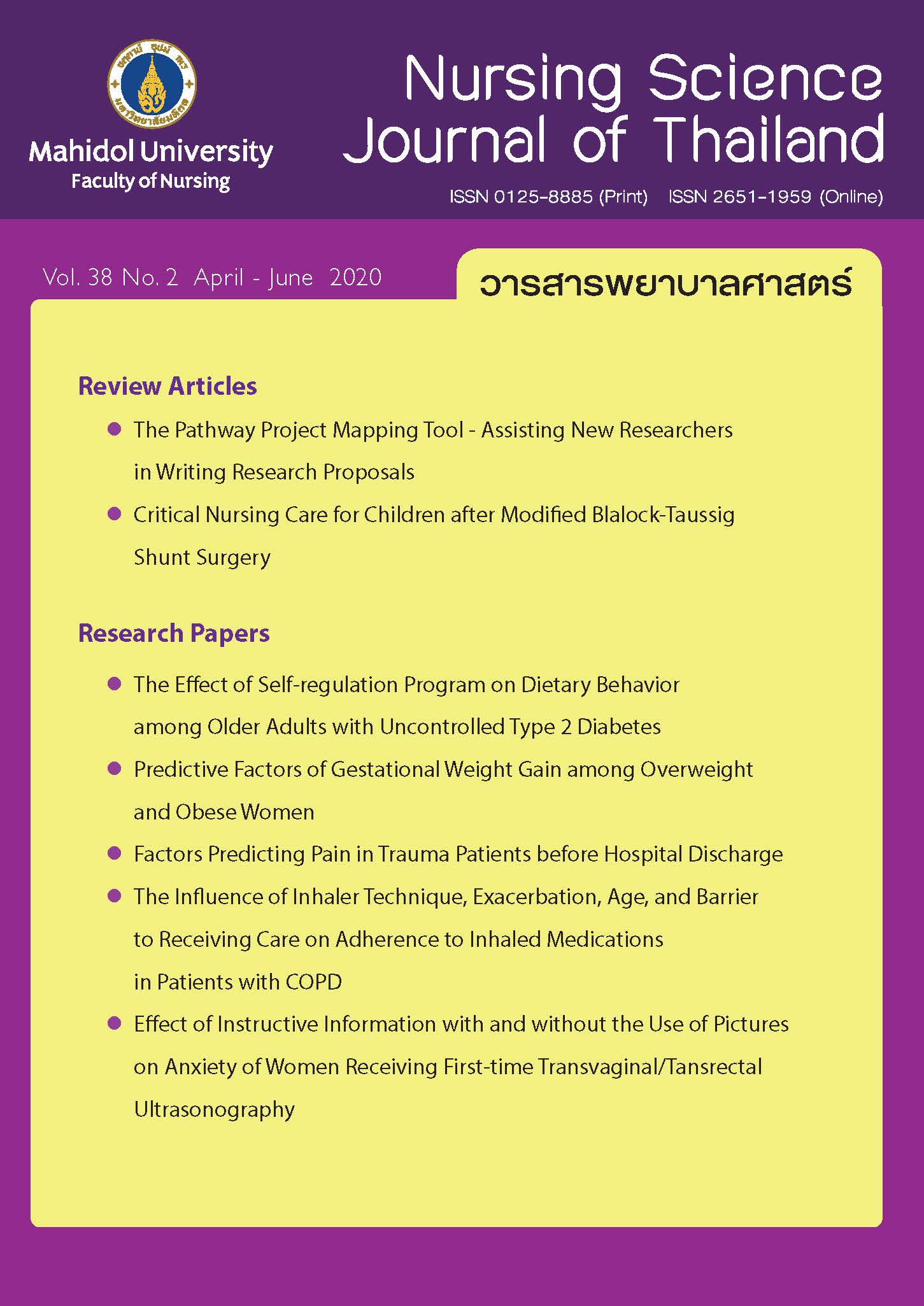
ปัจจัยทำนายความปวดในผู้ป่วยที่ได้รับบาดเจ็บก่อนจำหน่ายจากโรงพยาบาล
Article Sidebar
Main Article Content
บทคัดย่อ
วัตถุประสงค์: เพื่อศึกษาอำนาจการทำนายของความปวดแรกรับ ณ ห้องฉุกเฉิน ความรุนแรงของการบาดเจ็บ การใช้สารเสพติด และภาวะโรคร่วม ต่อความปวดในผู้ป่วยที่ได้รับบาดเจ็บก่อนจำหน่ายจากโรงพยาบาล
รูปแบบการวิจัย: การวิจัยความสัมพันธ์เชิงทำนาย
วิธีดำเนินการวิจัย: กลุ่มตัวอย่างเป็นผู้ป่วยที่ได้รับบาดเจ็บที่เข้ารับการรักษาในห้องฉุกเฉิน และหอผู้ป่วยศัลยกรรมของโรงพยาบาลระดับทุติยภูมิและตติยภูมิ ในจังหวัดสระบุรีและลพบุรี จำนวน 85 ราย เครื่องมือที่ใช้เก็บรวบรวมข้อมูล ได้แก่ แบบบันทึกข้อมูลส่วนบุคคล แบบประเมินข้อมูลการบาดเจ็บและการรักษา แบบประเมินความรุนแรงของการบาดเจ็บ แบบประเมินการใช้สารเสพติด แบบประเมินภาวะโรคร่วม และแบบประเมินความปวดแบบย่อ วิเคราะห์ข้อมูลโดยสถิติถดถอยพหุคูณแบบขั้นตอน กำหนดระดับนัยสำคัญทางสถิติที่ระดับ .05
ผลการวิจัย: ผลการศึกษาพบว่า กลุ่มตัวอย่างมีคะแนนความรุนแรงของความปวดก่อนจำหน่ายจากโรงพยาบาลระดับปานกลาง ( = 4.53, SD = 1.30) คะแนนการรบกวนของความปวดระดับปานกลาง (
= 5.42, SD = 1.52) ความปวดแรกรับ ณ ห้องฉุกเฉินระดับปานกลาง (
= 6.82, SD = 1.99) ความรุนแรงของการบาดเจ็บระดับปานกลาง (
= 12.46, SD = 4.84) มีการใช้สารเสพติดร้อยละ 55.30 มีภาวะโรคร่วมร้อยละ 18.80 ความรุนแรงของการบาดเจ็บและการใช้สารเสพติดสามารถทำนายความรุนแรงของความปวดในผู้ป่วยที่ได้รับบาดเจ็บก่อนจำหน่ายจากโรงพยาบาลอย่างมีนัยสำคัญทางสถิติ (
= .373, p < .001, and
= .304, p < .001 ตามลำดับ) แต่ความปวดแรกรับ ณ ห้องฉุกเฉิน และภาวะโรคร่วมไม่สามารถทำนายได้
สรุปและข้อเสนอแนะ: ผลการศึกษาครั้งนี้ชี้ให้เห็นว่า ความรุนแรงของการบาดเจ็บและการใช้สารเสพติดสามารถทำนายความปวดในผู้ป่วยที่ได้รับบาดเจ็บก่อนจำหน่ายจากโรงพยาบาล ดังนั้นพยาบาลควรตระหนักถึงความปวดเฉียบพลันและจัดการความปวดที่เหมาะสมในกลุ่มที่มีการบาดเจ็บรุนแรง และผู้ป่วยที่ใช้สารเสพติด
Article Details
ลิขสิทธิ์: วารสารพยาบาลศาสตร์เป็นเจ้าของลิขสิทธิ์ในการเผยแพร่ผลงานที่ตีพิมพ์ ห้ามผู้ใดนำบทความที่ได้รับการตีพิมพ์ในวารสารพยาบาลศาสตร์ไปเผยแพร่ในลักษณะต่างๆ ดังต่อไปนี้ การส่งบทความไปตีพิมพ์เผยแพร่ที่อื่น การนำบทความเผยแพร่ออนไลน์ การถ่ายเอกสารบทความเพื่อกิจกรรมที่ไม่ใช่การเรียนการสอน ยกเว้นเสียแต่ได้รับอนุญาตจากวารสารพยาบาลศาสตร์

Disclaimer: เนื้อหาบทความหรือข้อคิดเห็นใดๆ ในวารสารพยาบาลศาสตร์ ถือเป็นความรับผิดชอบของผู้เขียน กองบรรณาธิการไม่จำเป็นต้องเห็นด้วยและไม่มีส่วนรับผิดชอบแต่อย่างใด
เอกสารอ้างอิง
Bureau of Non Communicable Diseases, Ministry of Public Health. Annual report 2015. Bangkok: WVO Officer of Printing Mill; 2016. (in Thai).
McCaig LF, Nawar EW. National hospital ambulatory medical care survey: 2004 emergency department summary. Adv Data. 2006;23(372):1-29.
Berben SA, Schoonhoven L, Meijs TH, van Vugt AB, van Grunsven PM. Prevalence and relief of pain in trauma patients in emergency medical services. Clin J Pain. 2011;27(7):587-92. doi: 10.1097/AJP.0b013e3182169036.
Melzack R. From the gate to the neuromatrix. Pain. 1999;Suppl 6:S121-6. doi: 10.1016/S0304-3959(99)00145-1.
Mei W, Seeling M, Franck M, Radtke F, Brantner B, Wernecke KD, et al. Independent risk factors for postoperative pain in need of intervention early after awakening from general anaesthesia. Eur J Pain. 2010;14(2):149.e1-7. doi: 10.1016/j.ejpain.2009.03.009.
Gélinas C, Fillion L, Puntillo KA, Viens C, Fortier M. Validation of the critical-care pain observation tool in adult patients. Am J Crit Care. 2006;15(4):420-7.
Smeltzer SC, Bare BG, Hinkle JL, Cheever KH. Brunner & Suddarth’s textbook of medical-surgical nursing. 12th ed. Philadelphia: Lippincott Williams & Wikins; 2010. 2368 p.
Mondello S, Cantrell A, Italiano D, Fodale V, Mondello P, Ang D. Complications of trauma patients admitted to the ICU in level I academic trauma centers in the United States. BioMed Res Int. 2014;2014:473419. doi: 10.1155/2014/473419.
Goldsmith H, Curtis K, McCloughen A. Analgesic adherence in recently discharged trauma patients: an integrative literature review. Pain Manag Nurs. 2016;17(1):63-79. doi: 10.1016/j.pmn.2015.12.001.
Archer KR, Castillo RC, Wegener ST, Abraham CM, Obremskey WT. Pain and satisfaction in hospitalized trauma patients: the importance of self-efficacy and psychological distress. J Trauma Acute Care Surg. 2012;72(4):1068-77. doi: 10.1097/TA.0b013e3182452df5.
Goldsmith H, Curtis K, McCloughen A. Effective pain management in recently discharged adult trauma patients: identifying patient and system barriers, a prospective exploratory study. J Clin Nurs. 2017;26(23-24):4548-57. doi: 10.1111/jocn.13792.
Goldsmith H, Curtis K, McCloughen A. Incidence, intensity, and impact of pain in recently discharged adult trauma patients: an exploratory study. J Trauma Nurs. 2017;24(2):102-9. doi: 10.1097/JTN.0000000000000273.
Daoust R, Paquet J, Moore L, Emond M, Gossenlin S, Lavinge G, et al. Early factors associated with the development of chronic pain in trauma patients. Pain Res Manag. 2018;2018:7203218. doi: 10.1155/2018/7203218.
Trevino C, Harl F, Deroon-Cassini T, Brasel K, Litwack K. Predictors of chronic pain in traumatically injured hospitalized adult patients. J Trauma Nurs. 2014;21(2):50-6. doi: 10.1097/JTN.0000000000000032.
Starkweather A, Julian T, Ramesh D, Heineman A, Sturgill J, Dorsey SG, et al. Circulating lipids and acute pain sensitization: an exploratory analysis. Nurs Res. 2017;66(6):454-61. doi: 10.1097/NNR.0000000000000248.
Holmes A, Williamson O, Hogg M, Arnold C, Prosser A, Clement A, et al. Predictors of pain severity 3 months after serious injury. Pain Med. 2010;11(7):990-1000. doi: 10.1111/j.1526-4637.2010.00890.x.
Archer KR, Heins SR, Abraham CM, Obremskey WT Wegener ST, Castillo RC. Clinical significance of pain at hospital discharge following traumatic orthopaedic injury: general health, depression, and PTSD outcomes at 1 year. Clin J Pain. 2016;32(3):196-202. doi: 10.1097/AJP.0000000000000246.
Kao SC, Tsai HI, Cheng CW, Lin TW, Chen CC, Lin CS. The association between frequent alcohol drinking and opioid consumption after abdominal surgery: a retrospective analysis. PLoS One. 2017;12(3):e0171275. doi: 10.1371/journal.pone.0171275.
Salottolo K, Peck L, Carrick M, Tanner A 2nd, Madayag R, McGuire E, et al. High on drugs: multi-institutional pilot study examining the effects of substance use on acute pain management. Injury. 2019;50(5):1058-63. doi: 10.1016/j.injury.2019.01.003.
Kirshenbom D, Ben-Zaken Z, Albilya N, Niyibizi E, Bala M. Older age, comorbid Illnesses, and injury severity affect immediate outcome in elderly trauma patients. J Emerg Trauma Shock. 2017;10(3):146-50. doi: 10.4103/JETS.JETS_62_16.
Griffiths J, Putthioi S, Pongsuksri M. The General Practitioner Assessment of Cognition; GP-COG (Thai version): validity and reliability. In: 9th Pan-Pacific Conference on Rehabilitation cum 21st Annual Congress of Gerontology; 2014 Nov 29-30; Hong Kong. Kowloon: The Hong Kong Polytechnic University; [2014]. p.B65. (in Thai).
Baker SP, O'neill B, Haddon W Jr, Long WB. The injury score: a method for describing patient with multiple injury and evaluating emergency care. J Trauma. 1974;14(3):187-96.
Cleeland CS. The brief pain inventory user guide. Houstan, TX: The University of Texas MD Anderson Cancer Center; 2009. 65 p.
Zale EL, Stephen SA, Ditre JW. Interrelation between pain and alcohol: an intregrative review. Clin Psychol Rev. 2014;37:57-71. doi: 10.1016/j.cpr.2015.02.005
Hone AJ, McIntosh JM. Nicotinic acetylcholine receptors in neuropathic and inflammatory pain. FEBS Lett. 2018;592(7):1045-62. doi: 10.1002/1873-3468.12884.
Bán EG, Brassai A, Vizi ES. The role of the endogenous neurotransmitters associated with neuropathic pain and in the opioid crisis: the innate pain-releiving system. Brain Res Bull. 2020;155:129-36. doi: 10.1016/j.brainresbull.2019.12.001.
