
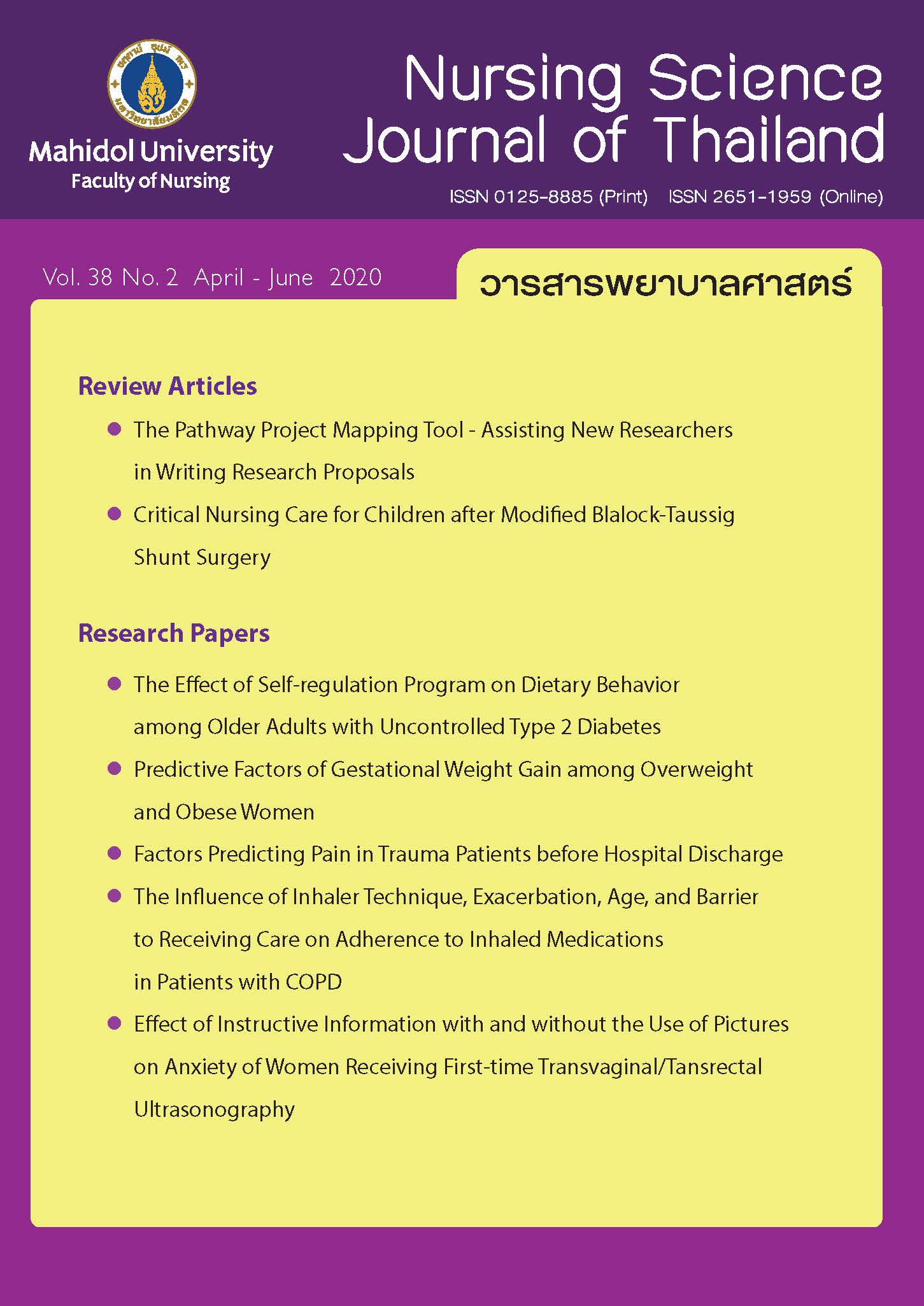
อิทธิพลของเทคนิคการใช้ยาชนิดสูด การเกิดอาการกำเริบ อายุ และอุปสรรคในการรับการดูแลต่อความร่วมมือในการใช้ยาชนิดสูดในผู้ป่วยโรคปอดอุดกั้นเรื้อรัง
Article Sidebar
Main Article Content
บทคัดย่อ
วัตถุประสงค์: เพื่อศึกษาอิทธิพลของเทคนิคการใช้ยาชนิดสูด การเกิดอาการกำเริบ อายุ และอุปสรรคในการรับการดูแลต่อความร่วมมือในการใช้ยาชนิดสูดในผู้ป่วยโรคปอดอุดกั้นเรื้อรัง
รูปแบบการวิจัย: การศึกษาความสัมพันธ์เชิงทำนาย
วิธีดำเนินการวิจัย: กลุ่มตัวอย่างเป็นผู้ป่วยโรคปอดอุดกั้นเรื้อรัง จำนวน 164 ราย ณ คลินิกโรคปอด โรงพยาบาลตติยภูมิแห่งหนึ่งในกรุงเทพมหานคร เก็บข้อมูลโดยใช้แบบสอบถามข้อมูลส่วนบุคคล แบบประเมินความร่วมมือในการใช้ยาสูด เทคนิคการใช้ยาชนิดสูด และอุปสรรคในการรับการดูแล วิเคราะห์ข้อมูลโดยใช้สถิติพรรณนา และการวิเคราะห์ถดถอยโลจิสติก
ผลการวิจัย: กลุ่มตัวอย่างเป็นเพศชายร้อยละ 93.3 อายุเฉลี่ย 73.20 ปี (SD = 9.27) มีความร่วมมือในการใช้ยาร้อยละ 73.8 เทคนิคการใช้ยาชนิดสูด การเกิดอาการกำเริบ อายุ และอุปสรรคในการรับการดูแล สามารถร่วมกันทำนายความร่วมมือในการใช้ยาชนิดสูด ในผู้ป่วยโรคปอดอุดกั้นเรื้อรังได้ร้อยละ 23 เทคนิคการใช้ยาชนิดสูดที่ถูกต้อง การไม่เกิดอาการกำเริบ และอายุในช่วง 70-79 ปี สามารถทำนายความร่วมมือในการใช้ยาชนิดสูดในผู้ป่วยโรคปอดอุดกั้นเรื้อรังได้อย่างมีนัยสำคัญทางสถิติ (OR = 2.93, 95%CI = 1.34, 6.43, p < .01; OR = 2.72, 95%CI = 1.23, 6.01, p < .01 และ OR = .29, 95%CI = .12, .75, p < .01 ตามลำดับ)
สรุปและข้อเสนอแนะ: การใช้ยาสูดถูกต้องทุกขั้นตอนจะทำให้ยาออกฤทธิ์อย่างมีประสิทธิภาพ พยาบาลควรตรวจสอบความถูกต้องของการใช้ยาสูดอย่างสม่ำเสมอ ให้ข้อมูลประโยชน์ของความร่วมมือในการใช้ยาเพื่อป้องกันการกำเริบ
Article Details
ลิขสิทธิ์: วารสารพยาบาลศาสตร์เป็นเจ้าของลิขสิทธิ์ในการเผยแพร่ผลงานที่ตีพิมพ์ ห้ามผู้ใดนำบทความที่ได้รับการตีพิมพ์ในวารสารพยาบาลศาสตร์ไปเผยแพร่ในลักษณะต่างๆ ดังต่อไปนี้ การส่งบทความไปตีพิมพ์เผยแพร่ที่อื่น การนำบทความเผยแพร่ออนไลน์ การถ่ายเอกสารบทความเพื่อกิจกรรมที่ไม่ใช่การเรียนการสอน ยกเว้นเสียแต่ได้รับอนุญาตจากวารสารพยาบาลศาสตร์

Disclaimer: เนื้อหาบทความหรือข้อคิดเห็นใดๆ ในวารสารพยาบาลศาสตร์ ถือเป็นความรับผิดชอบของผู้เขียน กองบรรณาธิการไม่จำเป็นต้องเห็นด้วยและไม่มีส่วนรับผิดชอบแต่อย่างใด
เอกสารอ้างอิง
Global Initiative for Chronic Obstructive Lung Disease (GOLD). Pocket guide to COPD diagnosis, management, and prevention: a guide for health care professionals 2019 edition [Internet]. Fontana, WI: GOLD; 2019 [cited 2019 Jul 5]. Available from: https://goldcopd.org/wp-content/uploads/2018/11/GOLD-2019-POCKET-GUIDE-DRAFT-v1.7-14Nov2018-WMS.pdf.
World Health Organization. Chronic Obstructive Pulmonary Disease (COPD) [Internet]. Geneva: WHO; 2017 [cited 2019 Jun 16]. Available from: https://www.who.int/news-room/fact-sheets/detail/chronic-obstructive-pulmonary-disease-(copd).
Strategy and Planning Division, Ministry of Public Health. Public health statistic A.C. 2018 [internet]. Nonthaburi: Ministry of Public Health; 2018 [cited 2020 Mar 3]. Available from: http://bps.moph.go.th/new_bps/sites/default/files/statistic%2061.pdf. (in Thai).
Horne R, Hankins M. The Medication Adherence Report Scale (MARS). Brighton, UK: University of Brighton; 2004.
World Health Organization. Adherence to long-term therapies: evidence for action. Geneva: WHO; 2003. 209 p.
Usmani OS. Choosing the right inhaler for your asthma or COPD patient. Ther Clin Risk Manag. 2019;15:461-72. doi: 10.2147/TCRM.S160365.
Sulaiman I, Cushen B, Greene G, Seheult J, Seow D, Rawat F, et al. Objective assessment of adherence to inhalers by patients with chronic obstructive pulmonary disease. Am J Respir Crit Care Med. 2017;195(10):1333-43. doi: 10.1164/rccm.201604-0733OC.
Price D, Keininger DL, Viswanad B, Gasser M, Walda S, Gutzwiller FS. Factors associated with appropriate inhaler use in patients with COPD - lessons from the REAL survey. Int J Chron Obstruct Pulmon Dis. 2018;13:695-702. doi: 10.2147/COPD.S149404.
Ngo CQ, Phan DM, Vu GV, Dao PN, Phan PT, Chu HT, et al. Inhaler Technique and Adherence to Inhaled Medications among Patients with Acute Exacerbation of Chronic Obstructive Pulmonary Disease in Vietnam. Int J Environ Res Public Health. 2019;16(2). pii: E185. doi: 10.3390/ijerph16020185.
Kessler R, Ståhl E, Vogelmeier C, Haughney J, Trudeau E, Löfdahl CG, et al. Patient understanding, detection, and experience of COPD exacerbations: an observational, interview-based study. Chest. 2006;130(1):133-42. doi: 10.1378/chest.130.1.133.
Jung E, Pickard AS, Salmon JW, Bartle B, Lee TA. Medication adherence and persistence in the last year of life in COPD patients. Respir Med. 2009;103(4):525-34. doi: 10.1016/j.rmed.2008.11.004.
Wiriyachot A, Wattanakitkrileart D, Charoenkitkarn V, Dejsomritrutai W. Influences of perceived medication necessity, medication concern, satisfaction with information received, and experience of exacerbation on adherence of inhaled combined bronchodilator and corticosteroid therapy in patients with chronic obstructive pulmonary disease. Journal of The Royal Thai Army Nurses. 2016;17(3):187-96. (in Thai).
Duarte-de-Araújo A, Teixeira P, Hespanhol V, Correia-de-Sousa J. COPD: understanding patients' adherence to inhaled medications. Int J Chron Obstruct Pulmon Dis. 2018;13:2767-73. doi: 10.2147/COPD.S160982.
Sriram KB, Percival M. Suboptimal inhaler medication adherence and incorrect technique are common among chronic obstructive pulmonary disease patients 2016 Suboptimal inhaler medication adherence and incorrect technique are common among chronic obstructive pulmonary disease patients. Chron Respir Dis. 2016;13(1):13-22. doi: 10.1177/1479972315606313.
Humenberger M, Horner A, Labek A, Kaiser B, Frechinger R, Brock C, et al. Adherence to inhaled therapy and its impact on chronic obstructive pulmonary disease (COPD). BMC Pulm Med. 2018;18(1):163. doi: 10.1186/s12890-018-0724-3.
Wells K, Pladevall M, Peterson EL, Campbell J, Wang M, Lanfear DE, et al. Race-ethnic differences in factors associated with inhaled steroid adherence among adults with asthma. Am J Respir Crit Care Med. 2008;178(12):1194-201. doi: 10.1164/rccm.200808-1233OC.
Restrepo RD, Alvarez MT, Wittnebel LD, Sorenson H, Wettstein R, Vines DL, et al. Medication adherence issues in patients treated for COPD. Int J Chron Obstruct Pulmon Dis. 2008;3(3):371-84. doi: 10.2147/copd.s3036.
Devine F, Edwards T, Feldman SR. Barriers to treatment: describing them from a different perspective. Patient Prefer Adherence. 2018;12:129-33. doi: 10.2147/PPA.S147420.
Koehorst-Ter Huurne K, Kort S, van der Palen J, van Beurden WJ, Movig KL, van der Valk P, et al. Quality of life and adherence to inhaled corticosteroids and tiotropium in COPD are related. Int J Chron Obstruct Pulmon Dis. 2016;11:1679-88. doi: 10.2147/COPD.S107303.
Brodaty H, Pond D, Kemp NM, Luscombe G, Harding L, Berman K, et al. The GPCOG: a new screening test for dementia designed for general practice. J Am Geriatr Soc. 2002;50(3):530-4. doi: 10.1046/j.1532-5415.2002.50122.x.
NHS Liverpool Clinical Commissioning Group. Inhaler technique checklist [Internet]. London: Pharmaceutical Services Negotiating Committee; 2016 [cited 2018 May 1]. Available from: http://psnc.org.uk/liverpool-lpc/wp-content/uploads/sites/117/2016/06/Inhaler_Technique_Checklist.pdf.
Polit DF, Beck CT. Essentials of nursing research: appraising evidence for nursing practice. 7th ed. Philadelphia: Lippincott Williams & Wilkins; 2010. 610 p.
López-Campos JL, Gallego EQ, Hernández LC. Status of and strategies for improving adherence to COPD treatment. Int J Chron Obstruct Pulmon Dis. 2019;14:1503‐15. doi: 10.2147/COPD.S170848.
Sanduzzi A, Balbo P, Candoli P, Catapano GA, Contini P, Mattei A, et al. COPD: adherence to therapy. Multidiscip Respir Med. 2014;9(1):60. doi: 10.1186/2049-6958-9-60.
Harb N, Foster JM, Dobler CC. Patient-perceived treatment burden of chronic obstructive pulmonary disease. Int J Chron Obstruct Pulmon Dis. 2017;12:1641-52. doi: 10.2147/COPD.S130353.
