
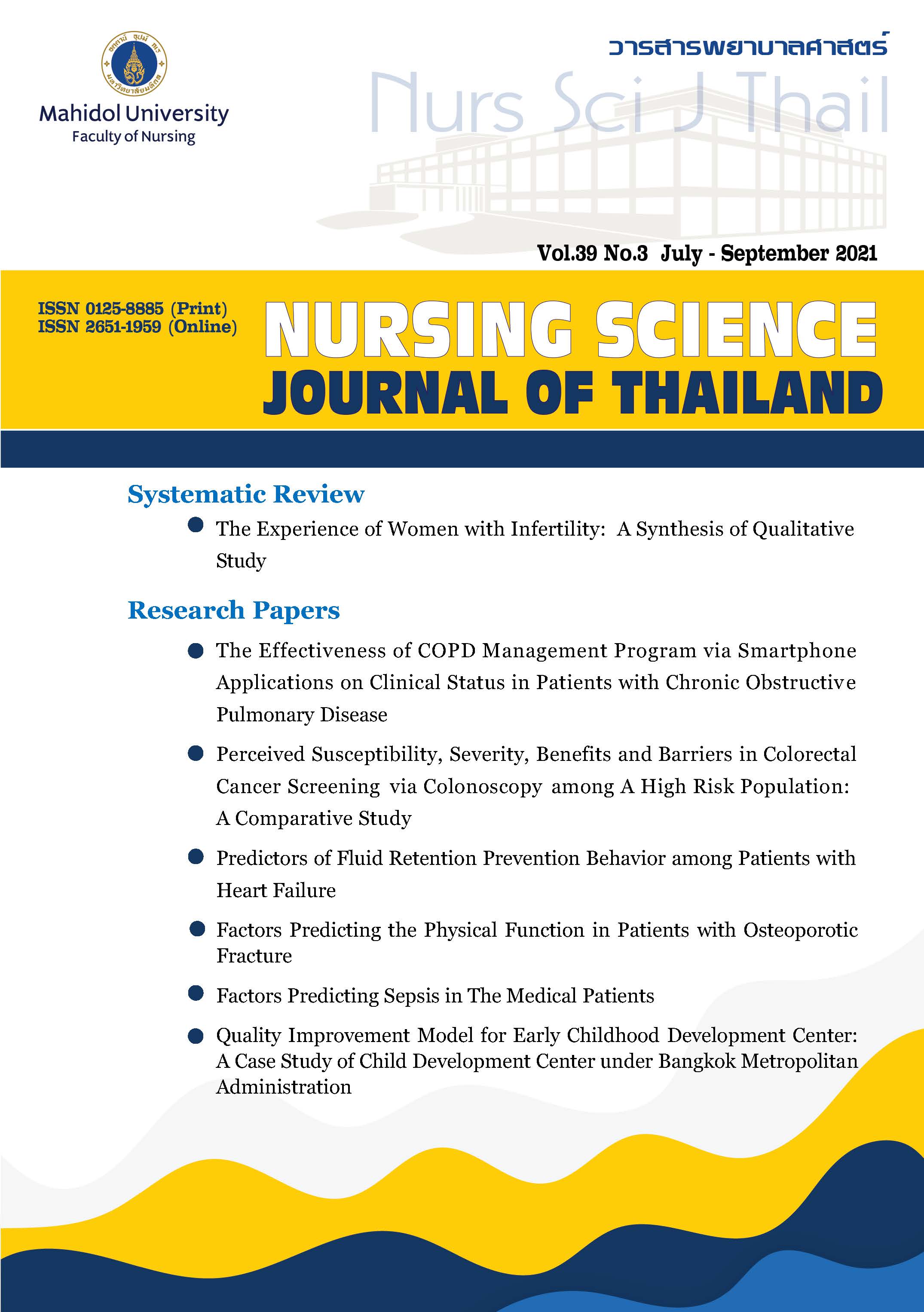
ประสิทธิผลของโปรแกรมการจัดการโรคปอดอุดกั้นเรื้อรังผ่านสมาร์ตโฟนแอปพลิเคชันต่อสถานะทางคลินิกในผู้ป่วยโรคปอดอุดกั้นเรื้อรัง
Article Sidebar
Main Article Content
บทคัดย่อ
วัตถุประสงค์: เพื่อศึกษาประสิทธิผลของโปรแกรมการจัดการโรคปอดอุดกั้นเรื้อรังผ่านสมาร์ตโฟนแอปพลิเคชันต่อสถานะทางคลินิกในผู้ป่วยโรคปอดอุดกั้นเรื้อรัง
รูปแบบการวิจัย: การวิจัยเชิงทดลองแบบสุ่มและมีกลุ่มควบคุม
วิธีดำเนินการวิจัย: กลุ่มตัวอย่างเป็นผู้ป่วยโรคปอดอุดกั้นเรื้อรังอายุ 40 ปีขึ้นไป จำนวน 60 รายที่เข้ารับการรักษาที่คลินิกโรคปอดอุดกั้นเรื้อรัง โรงพยาบาลตติยภูมิแห่งหนึ่งในจังหวัดกาญจนบุรี กลุ่มตัวอย่างได้รับการสุ่มโดยใช้โปรแกรมคอมพิวเตอร์เข้ากลุ่มทดลองและกลุ่มควบคุม กลุ่มละ 30 ราย กลุ่มควบคุมได้รับการพยาบาลตามปกติ กลุ่มทดลองได้รับการพยาบาลปกติร่วมกับโปรแกรมการจัดการโรคปอดอุดกั้นเรื้อรังผ่านสมาร์ตโฟนแอปพลิเคชัน ซึ่งพัฒนาขึ้นจากกรอบแนวคิด Information–Motivation–Behavioral Skills model ระยะเวลาในการทดลอง 6 สัปดาห์ ประเมินผลสถานะทางคลินิกโดยใช้แบบสอบถามทางคลินิกโรคปอดอุดกั้นเรื้อรัง วิเคราะห์ข้อมูลโดยใช้สถิติพรรณนา การทดสอบทีแบบสองกลุ่มอิสระและแบบสองกลุ่มสัมพันธ์กัน
ผลการวิจัย: ผลการวิจัยพบว่า กลุ่มทดลองและกลุ่มควบคุม ส่วนใหญ่เป็นเพศชายร้อยละ 93.3 และร้อยละ 83.3 ตามลำดับ กลุ่มทดลองมีอายุเฉลี่ย 64.63 ปี กลุ่มควบคุมอายุเฉลี่ย 62.70 ปี ก่อนการทดลองกลุ่มทดลองและกลุ่มควบคุมมีสถานะทางคลินิกไม่แตกต่างกัน (p > .05) หลังการทดลองกลุ่มทดลองมีสถานะทางคลินิกดีกว่าก่อนการทดลองอย่างมีนัยสำคัญทางสถิติ (p < .001) และดีกว่ากลุ่มควบคุมอย่างมีนัยสำคัญทางสถิติ (p < .05)
สรุปและข้อเสนอแนะ: โปรแกรมการจัดการโรคปอดอุดกั้นเรื้อรังผ่านสมาร์ตโฟนแอปพลิเคชันช่วยส่งเสริมให้ผู้ป่วยมีสถานะทางคลินิกที่ดีขึ้น พยาบาลควรนำโปรแกรมการจัดการโรคปอดอุดกั้นเรื้อรังผ่านสมาร์ตโฟนแอปพลิเคชันมาใช้ในการให้ความรู้ เสริมแรงจูงใจ และส่งเสริมทักษะและความสม่ำเสมอในการใช้ยาสูดในผู้ป่วยปอดอุดกั้นเรื้อรัง
Article Details
ลิขสิทธิ์: วารสารพยาบาลศาสตร์เป็นเจ้าของลิขสิทธิ์ในการเผยแพร่ผลงานที่ตีพิมพ์ ห้ามผู้ใดนำบทความที่ได้รับการตีพิมพ์ในวารสารพยาบาลศาสตร์ไปเผยแพร่ในลักษณะต่างๆ ดังต่อไปนี้ การส่งบทความไปตีพิมพ์เผยแพร่ที่อื่น การนำบทความเผยแพร่ออนไลน์ การถ่ายเอกสารบทความเพื่อกิจกรรมที่ไม่ใช่การเรียนการสอน ยกเว้นเสียแต่ได้รับอนุญาตจากวารสารพยาบาลศาสตร์

Disclaimer: เนื้อหาบทความหรือข้อคิดเห็นใดๆ ในวารสารพยาบาลศาสตร์ ถือเป็นความรับผิดชอบของผู้เขียน กองบรรณาธิการไม่จำเป็นต้องเห็นด้วยและไม่มีส่วนรับผิดชอบแต่อย่างใด
เอกสารอ้างอิง
World Health Organization. Chronic obstructive pulmonary disease (COPD) [Internet]. Geneva, Switzerland: World Health Organization; 2017 [cited 2019 Jun 3]. Available from: https://www.who.int/news-room/fact-sheets/detail/chronic-obstructive-pulmonary-disease-(copd)
Global Initiative for Chronic Obstructive Lung Disease. Pocket to COPD diagnosis, management, and prevention: a guide for health care professionals 2019 edition [Internet]. Fontana, WI: Global Initiative for Chronic Obstructive Lung Disease; 2019 [cited 2019 Jul 5]. Available from: https://goldcopd.org/wp-content/uploads/2018/11/GOLD-2019-POCKET-GUIDE-FINAL_WMS.pdf.
World Health Organization. The top 10 causes of death [internet]. Geneva, Switzerland: World Health Organization; 2018 [cited 2019 Jun 3]. Available from: https://www.who.int/news-room/fact-sheets/detail/the-top-10-causes-of-death.
Samarnkongsak T, Thavorncharoensap M, Kawamatawong T, Pattanaprateep O, Chanjaruporn F, Sunantiwat M. Treatment of COPD in one university hospital setting in Thailand: the real-life prescribing patterns and treatment expenditures. Pharmaceutical Sciences Asia. 2019;46(3):175-83. doi: 10.29090/psa.2019.03.018.0006.
Bureau of Non-Communicable Disease. Five-year national NCDs prevention and control strategic and action plan (2017-2021) [Internet]. Nonthaburi: Bureau of Non-Communicable Disease; 2017 [cited 2019 Jul 5]. Available from: https://www.who.int/docs/default-source/thailand/ncds/national-ncd-prevention-and-control-plan-2017-2021-eng.pdf.
Halding AG, Aarsheim EI, Dolmen NM, Jensen AJ, Stavostrand S, Grov EK. COPD transitions in health and self-management: service users’ experiences from everyday life. Int J Chron Obstruct Pulmon Dis. 2018;13:2075-88. doi: 10.2147/COPD.S158058.
Duarte-de-Araujo A, Teixeira P, Hespanhol V, Correia-de-Sousa J. COPD: misuse of inhaler devices in clinical practice. Int J Chron Obstruct Pulmon Dis. 2019;14:1209-17. doi: 10.2147/COPD.S178040.
Arfe A, Nicotra F, Cerveri I, de Marco R, Vaghi A, Merlino L, et al. Incidence, predictors, and clinical implications of discontinuing therapy with inhaled long-acting bronchodilators among patients with chronic obstructive pulmonary disease. COPD. 2016;13(5):540-6. doi: 10.3109/15412555.2016.1141877.
Mueller S, Wilke T, Bechtel B, Punekar YS, Mitzner K, Virchow JC. Non-persistence and non-adherence to long-acting COPD medication therapy: a retrospective cohort study based on a large German claims dataset. Respir Med. 2017;122:1-11. doi: 10.1016/j.rmed.2016.11.008.
Cambach W, Chadwick-Straver RV, Wagenaar RC, van Keimpema AR, Kemper HC. The effects of a community-based pulmonary rehabilitation programme on exercise tolerance and quality of life: a randomized controlled trial. Eur Respir J. 1997;10(1):104-13. doi: 10.1183/09031936.97.10010104.
Wood-Baker R, McGlone S, Venn A, Walters EH. Written action plans in chronic obstructive pulmonary disease increase appropriate treatment for acute exacerbations. Respirology. 2006;11(5):619-26. doi: 10.1111/j.1440-1843.2006.00902.x.
Akinci AC, Olgun N. The effectiveness of nurse-led, home-based pulmonary rehabilitation in patients with COPD in Turkey. Rehabil Nurs. 2011;36(4):159-65. doi: 10.1002/j.2048-7940.2011.tb00084.x.
Barakat S, Michele G, George P, Nicole V, Guy A. Outpatient pulmonary rehabilitation in patients with chronic obstructive pulmonary disease. Int J Chron Obstruct Pulmon Dis. 2008;3(1):155-62. doi: 10.2147/copd.s2126.
Monninkhof E, van der Valk P, van der Palen J, van Herwaarden C, Zielhuis G. Effects of a comprehensive self-management programme in patients with chronic obstructive pulmonary disease. Eur Respir J. 2003;22(5):815-20. doi: 10.1183/09031936.03.00047003.
Thanthitithanakul B, Ua-Kit N. The effect of inhaler use combined with a telephone nursing care program on dyspnea among chronic obstructive pulmonary disease patients. Thai Journal of Cardio-Thoracic Nursing. 2017;28(2):97-110. (in Thai).
Tippala W. The effects of education, motivation, and inhaler skills program through Line application on clinical control in patients with chronic obstructive pulmonary disease [master’s thesis]. Bangkok: Mahidol University; 2020. 189 p. (in Thai).
Fisher JD, Fisher WA. Changing AIDS-risk behavior. Psychol Bull. 1992;111(3):455-74. doi: 10.1037/0033-2909.111.3.455.
Jehn M, Donaldson G, Kiran B, Liebers U, Mueller K, Scherer D, et al. Tele-monitoring reduces exacerbation of COPD in the context of climate change--a randomized controlled trial. Environ Health. 2013;12:99. doi: 10.1186/1476-069X-12-99.
Borson S, Scanlan J, Brush M, Vitaliano P, Dokmak A. The mini-cog: a cognitive ‘vital signs’ measure for dementia screening in multi-lingual elderly. Int J Geriatr Psychiatry. 2000;15(11):1021-7. doi: 10.1002/1099-1166(200011)15:11<1021::aid-gps234>3.0.co;2-6.
Trongsakul S, Lambert R, Clark A, Wongpakaran N, Cross J. Development of the Thai version of Mini-Cog, a brief cognitive screening test. Geriatr Gerontol Int. 2015;15(5):594-600. doi: 10.1111/ggi.12318.
NHS Liverpool Clinical Commissioning Group. Inhaler technique checklist [Internet]. England: NHS Liverpool Clinical Commissioning Group; 2013 [cited 2019 Jul 5]. Available from: http://psnc.org.uk/liverpoollpc/wpcontent/uploads/sites/117/2016/06/InhalerTechnique
_Checklist.pdf
White R, Walker P, Roberts S, Kalisky S, White P. Bristol COPD knowledge questionnaire
(BCKQ): testing what we teach patients about COPD. Chron Respir Dis. 2006;3(3):123-31.
doi: 10.1191/1479972306cd117oa.
van der Molen T, Willemse BW, Schokker S, ten Hacken NH, Postma DS, Juniper EF. Development, validity and responsiveness of the Clinical COPD Questionnaire. Health Qual Life Outcomes. 2003;1:13. doi: 10.1186/1477-7525-1-13.
Mapi Research Trust. Clinical COPD Questionnaire (CCQ) [Internet]. Lyon, France: Mapi Research Trust; 2019 [cited 2019 Jul 5]. Available from: https://eprovide.mapi-trust.org/instruments/clinical-copd-questionnaire#languages
Polhan B, Wattanakitkrileart D, Pongthavornkamol K. The effects of education and inhaler skills program through Line application on symptom control among asthmatic patients. Journal of the Royal Thai Army Nurses. 2019;20(3):93-103. (in Thai).
Alwashmi M, Hawboldt J, Davis E, Marra C, Gamble JM, Abu Ashour W. The effect of smartphone interventions on patients with chronic obstructive pulmonary disease exacerbations: a systematic review and meta-analysis. JMIR Mhealth Uhealth. 2016;4(3):e105. doi: 10.2196/mhealth.5921.
