
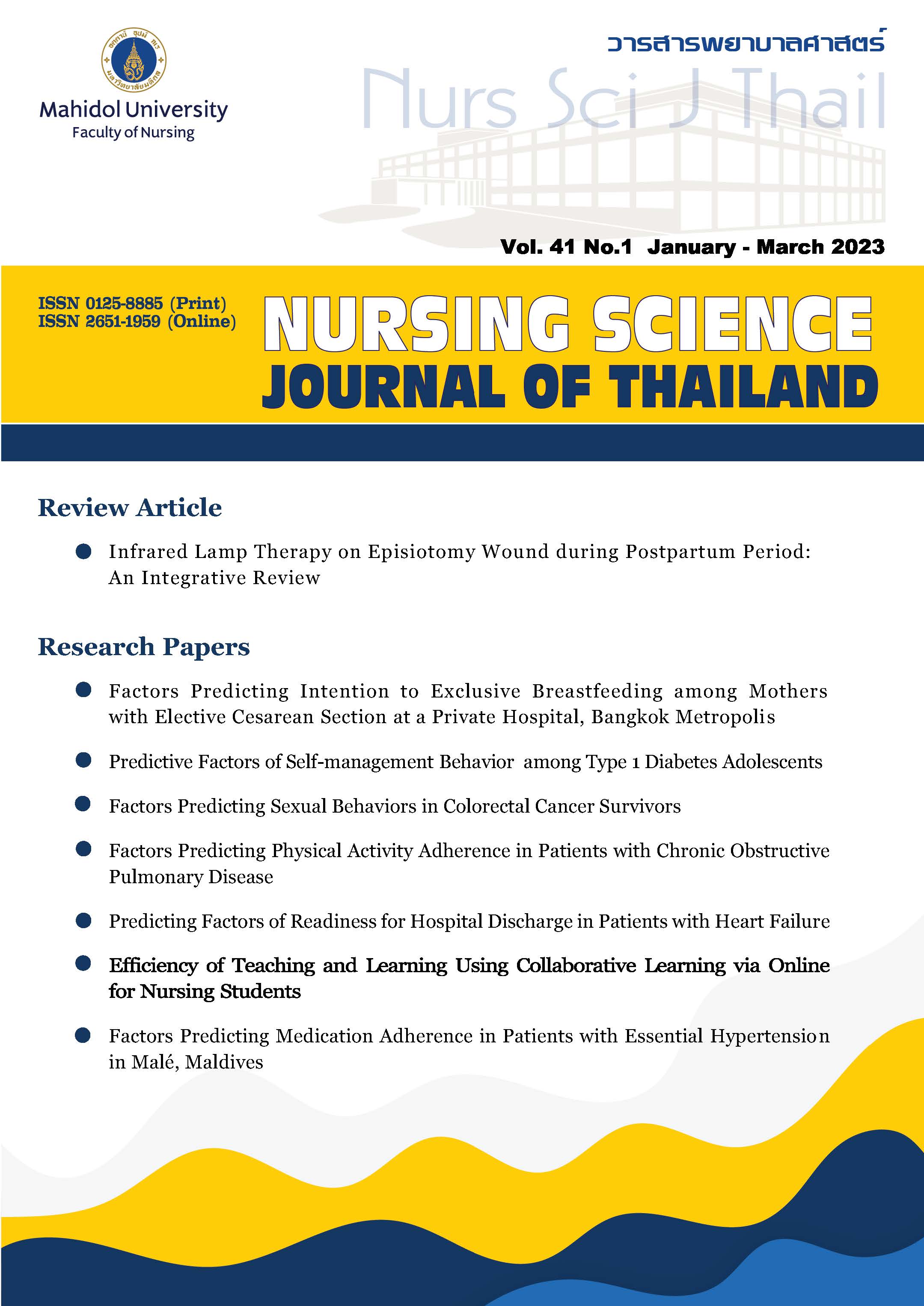
ปัจจัยทำนายความร่วมมือในการใช้ยาของผู้ป่วยโรคความดันโลหิตสูงชนิดไม่ทราบสาเหตุ ในเมืองมาเล ประเทศมัลดีฟส์
Article Sidebar
Main Article Content
บทคัดย่อ
วัตถุประสงค์: เพื่อศึกษาอิทธิพลของความซับซ้อนของแบบแผนการใช้ยา ความรอบรู้ด้านสุขภาพ สัมพันธภาพระหว่างผู้ป่วยกับแพทย์ การสนับสนุนจากครอบครัว และระยะเวลาของการใช้ยาลดความดันโลหิต ต่อความร่วมมือในการใช้ยาลดความดันโลหิตของผู้ป่วยโรคความดันโลหิตสูงชนิดไม่ทราบสาเหตุ ในเมืองมาเล ประเทศมัลดีฟส์
รูปแบบการวิจัย: การวิจัยความสัมพันธ์เชิงทำนาย
วิธีดำเนินการวิจัย: กลุ่มตัวอย่างเป็นผู้ป่วยโรคความดันโลหิตสูงชนิดไม่ทราบสาเหตุ จำนวน 172 คน ในเมืองมาเล ประเทศมัลดีฟส์ โดยวิธีการเลือกแบบสะดวก เก็บรวบรวมข้อมูลโดยใช้แบบสอบถามข้อมูลส่วนบุคคล แบบวัดความร่วมมือในการใช้ยา แบบวัดความซับซ้อนของแบบแผนการใช้ยา แบบสอบถามความรอบรู้ด้านสุขภาพ แบบสอบถามสัมพันธภาพระหว่างผู้ป่วยกับแพทย์ และแบบสอบถามการสนับสนุนจากครอบครัว วิเคราะห์ข้อมูลโดยใช้สถิติเชิงพรรณนา และการวิเคราะห์ถดถอยโลจิสติก
ผลการวิจัย: กลุ่มตัวอย่าง 172 คน เป็นเพศชายร้อยละ 61 อายุเฉลี่ย 55.21 ปี (SD = 10.66) มีความร่วมมือในการใช้ยาร้อยละ 54.7 โดยความซับซ้อนของแบบแผนการใช้ยา ความรอบรู้ด้านสุขภาพ สัมพันธภาพระหว่างผู้ป่วยกับแพทย์ การสนับสนุนจากครอบครัว และระยะเวลาของการใช้ยาลดความดันโลหิต สามารถร่วมกันทำนายความร่วมมือในการใช้ยาได้ร้อยละ 36.1 (Nagelkerke R2 = .36) ซึ่งความซับซ้อนของแบบแผนการใช้ยา ความรอบรู้ด้านสุขภาพที่เพียงพอและระดับดีมาก และสัมพันธภาพระหว่างผู้ป่วยกับแพทย์ที่ดี สามารถทำนายความร่วมมือในการใช้ยาอย่างมีนัยสำคัญทางสถิติ (OR = .91, 95%CI [ .85, .97], p = .01; OR = 4.83, 95%CI [1.59, 14.62], p = .01; OR = 3.43, 95%CI [1.02, 11.56], p = .05 และ OR = 10.52, 95%CI [3.05, 36.19], p = .01 ตามลำดับ)
สรุปและข้อเสนอแนะ: การศึกษานี้ให้ความเข้าใจเกี่ยวกับการให้ความร่วมมือในการใช้ยาลดความดันโลหิตในผู้ป่วยโรคความดันโลหิตสูงชนิดไม่ทราบสาเหตุ ในเมืองมาเล ประเทศมัลดีฟส์ และปัจจัยที่มีผลต่อความร่วมมือในการใช้ยา อย่างไรก็ตาม จำเป็นต้องมีการวิจัยเพิ่มเติมเกี่ยวกับปัจจัยที่ส่งผลต่อการรับประทานยาอย่างต่อเนื่องในผู้ป่วยเหล่านี้ และพยาบาลจะสามารถจัดการกับปัจจัยเหล่านี้อย่างไร เพื่อปรับปรุงความร่วมมือในการรับประทานยาลดความดันโลหิตได้อย่างต่อเนื่อง
Article Details

อนุญาตภายใต้เงื่อนไข Creative Commons Attribution-NonCommercial-NoDerivatives 4.0 International License.
ลิขสิทธิ์: วารสารพยาบาลศาสตร์เป็นเจ้าของลิขสิทธิ์ในการเผยแพร่ผลงานที่ตีพิมพ์ ห้ามผู้ใดนำบทความที่ได้รับการตีพิมพ์ในวารสารพยาบาลศาสตร์ไปเผยแพร่ในลักษณะต่างๆ ดังต่อไปนี้ การส่งบทความไปตีพิมพ์เผยแพร่ที่อื่น การนำบทความเผยแพร่ออนไลน์ การถ่ายเอกสารบทความเพื่อกิจกรรมที่ไม่ใช่การเรียนการสอน ยกเว้นเสียแต่ได้รับอนุญาตจากวารสารพยาบาลศาสตร์
Disclaimer: เนื้อหาบทความหรือข้อคิดเห็นใดๆ ในวารสารพยาบาลศาสตร์ ถือเป็นความรับผิดชอบของผู้เขียน กองบรรณาธิการไม่จำเป็นต้องเห็นด้วยและไม่มีส่วนรับผิดชอบแต่อย่างใด
เอกสารอ้างอิง
World Health Organization. Hypertension [Internet]. Geneva: WHO; 2021 [cited 2022 Feb 13]. Available from: https://www.who.int/news-room/fact-sheets/detail/hypertension.
Ministry of Health. Maldives health statistics 2014 [Internet]. Malé: Ministry of Health, Republic of Maldives; 2017 [cited 2019 Aug 2]. Available from: http://health.gov.mv/Uploads/Downloads//Informations/Informations(82).pdf.
Wang G, Zhou X, Zhuo X, Zhang P. Annual total medical expenditures associated with hypertension by diabetes status in U.S. adults. Am J Prev Med. 2017;53(6 Suppl 2):S 182-9. doi: 10.1016/j.amepre.2017.07.018.
Ma C. A cross-sectional survey of medication adherence and associated factors for rural patients with hypertension. Appl Nurs Res. 2016;31:94-9. doi: 10.1016/j.apnr.2016.01.004.
World Health Organization. Adherence to long-term therapies: evidence for action [Internet]. Geneva, World Health Organization; 2003 [cited 2019 Aug 19]. Available from: https://www.who.int/chp/knowledge/publications/adherence_full_report.pdf.
Mekonnen HS, Gebrie MH, Eyasu KH, Gelagay AA. Drug adherence for antihypertensive medications and its determinants among adult hypertensive patients attending in chronic clinics of referral hospitals in Northwest Ethiopia. BMC Pharmacol Toxicol. 2017;18(1):27. doi: 10.1186/s40360-017-0134-9.
Pan J, Hu B, Wu L, Li Y. The effect of social support on treatment adherence in hypertension in china. Patient Prefer Adherence. 2021;15:1953-61. doi: 10.2147/PPA.S325793.
Du S, Zhou Y, Fu C, Wang Y, Du X, Xie R. Health literacy and health outcomes in hypertension: an integrative review. Int J Nurs Sci. 2018;5(3):301-9. doi: 10.1016/j.ijnss.2018.06.001.
Pan J, Wu L, Wang H, Lei T, Hu B, Xue X, et al. Determinants of hypertension treatment adherence among a Chinese population using the therapeutic adherence scale for hypertensive patients. Medicine (Baltimore). 2019;98(27):e16116. doi: 10.1097/MD.0000000000016116.
Faul F, Erdfelder E, Buchner A, Lang A-G. Statistical power analyses using G*Power 3.1: tests for correlation and regression analyses. Behav Res Methods. 2009;41(4):1149-60. doi: 10.3758/BRM.41.4.1149.
Yue Z, Bin W, Weilin Q, Aifang Y. Effect of medication adherence on blood pressure control and risk factors for antihypertensive medication adherence. J Eval Clin Pract. 2015;21(1):166-72. doi: 10.1111/jep.12268.
Brodaty H, Pond D, Kemp NM, Luscombe G, Harding L, Berman K, et al. The GPCOG: a new screening test for dementia designed for general practice. J Am Geriatr Soc. 2002;50(3):530-4. doi: 10.1046/j.1532-5415.2002.50122.x.
Song Y, Han H-R, Song H-J, Nam S, Nguyen T, Kim MT. Psychometric evaluation of hill-bone medication adherence subscale. Asian Nurs Res (Korean Soc Nurs Sci). 2011;5(3):183-8. doi: 10.1016/j.anr.2011.09.007.
George J, Phun Y-T, Bailey MJ, Kong DCM, Stewart K. Development and validation of the medication regimen complexity index. Ann Pharmacother. 2004;38(9):1369-76. doi: 10.1345/aph.1D479.
Sørensen K, Van den Broucke S, Fullam J, Doyle G, Pelikan J, Slonska Z, et al. Health literacy and public health: a systematic review and integration of definitions and models. BMC Public Health. 2012;12:80. doi: 10.1186/1471-2458-12-80.
Van der Feltz-Cornelis CM, Van Oppen P, Van Marwijk HWJ, De Beurs E, Van Dyck R. A patient-doctor relationship questionnaire (PDRQ-9) in primary care: development and psychometric evaluation. Gen Hosp Psychiatry. 2004;26(2):115-20. doi: 10.1016/j.genhosppsych.2003.08.010.
Sofulu F, Avdal EU, Arkan B. Validity and reliability of the diabetes family support and conflict scale in Turkish. Acta Medica Mediterranea. 2017;33:107-14. doi: 10.19193/0393-6384_2017_1_071.
Paddison C. Family support and conflict among adults with type 2 diabetes. European Diabetes Nursing. 2010;7(1):29-33. doi: 10.1002/edn.152.
Abegaz TM, Shehab A, Gebreyohannes EA, Bhagavathula AS, Elnour AA. Nonadherence to antihypertensive drugs: a systematic review and meta-analysis. Medicine (Baltimore). 2017;96(4):e5641. doi: 10.1097/MD.0000000000005641.
Li YT, Wang HHX, Liu KQL, Lee GKY, Chan WM, Griffiths SM, Chen RL. Medication adherence and blood pressure control among hypertensive patients with coexisting long-term conditions in primary care settings: a cross-sectional analysis. Medicine (Baltimore). 2016;95(20):e3572. doi: 10.1097/MD.0000000000003572.
Buford TW. Hypertension and aging. Ageing Res Rev. 2016;26:96-111. doi: 10.1016/j.arr.2016.01.007.
Timothy M. Hughes, Kaycee M. Sink, Hypertension and its role in cognitive function: current evidence and challenges for the future. Am J of Hypertens. 2016;29(2):149-57. doi: 10.1093/ajh/hpv180.
Oluwole EO, Osibogun O, Adegoke O, Adejimi AA, Adewole AM, Osibogun A. Medication adherence and patient satisfaction among hypertensive patients attending outpatient clinic in Lagos University Teaching Hospital, Nigeria. Niger Postgrad Med J. 2019;26(2):129-37. doi: 10.4103/npmj.npmj_48_19.
Cuffee YL, Hargraves L, Rosal M, Briesacher BA, Allison JJ, Hullett S. An examination of John Henryism, trust, and medication adherence among African Americans with hypertension. Health Educ Behav. 2020;47(1):162-9. doi: 10.1177/1090198119878778.
Lee Y-M, Yu HY, You M-A, Son Y-J. Impact of health literacy on medication adherence in older people with chronic diseases. Collegian. 2017;24(1):11-8. doi: 10.1016/j.colegn.2015.08.003.
Pantuzza LL, Ceccato MdGB, Silveira MR, Junqueira LMR, Reis AMM. Association between medication regimen complexity and pharmacotherapy adherence: a systematic review. Eur J Clin Pharmacol. 2017;73(11):1475-89. doi: 10.1007/s00228-017-2315-2.
Asgedom, SW, Atey TM, Desse TA. Antihypertensive medication adherence and associated factors among adult hypertensive patients at Jimma University Specialized Hospital, southwest Ethiopia. BMC Res Notes. 2018;11(1):27. doi: 10.1186/s13104-018-3139-6.
Shen Y, Peng X, Wang M. Zheng X, Xu G, Lü L, et al. Family member-based supervision of patients with hypertension: a cluster randomized trial in rural China. J Hum Hypertens. 2017;31(1):29-36. doi: 10.1038/jhh.2016.8.
