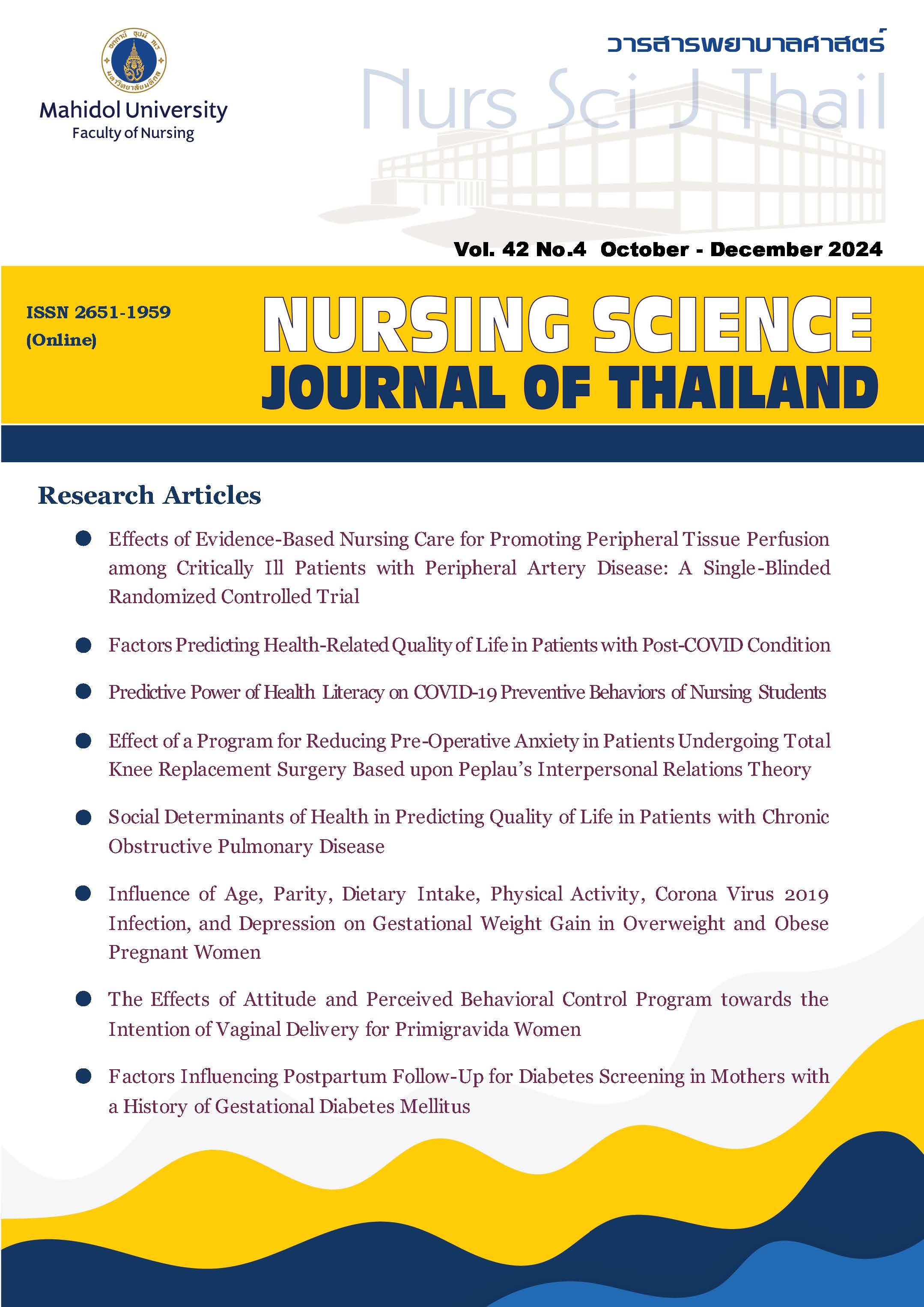
ผลของโปรแกรมลดความวิตกกังวลก่อนผ่าตัดในผู้ป่วยผ่าตัดเปลี่ยนข้อเข่าตามกรอบแนวคิดทฤษฎีสัมพันธภาพระหว่างบุคคลของเพบพลาว
Article Sidebar
Main Article Content
บทคัดย่อ
วัตถุประสงค์: เพื่อศึกษาผลของโปรแกรมที่พัฒนาตามกรอบแนวคิดทฤษฎีสัมพันธภาพระหว่างบุคคลของเพบพลาวในการลดความวิตกกังวลของผู้ป่วยก่อนได้รับการผ่าตัดเปลี่ยนข้อเข่า
รูปแบบการวิจัย: การวิจัยกึ่งทดลอง แบบหนึ่งกลุ่ม โดยทำการวัดผลก่อนและหลังการทดลอง
วิธีดำเนินการวิจัย: กลุ่มตัวอย่างเป็นผู้ป่วยข้อเข่าเสื่อมที่รอเข้ารับการผ่าตัดเปลี่ยนข้อเข่าเทียมจำนวน 27 คน กลุ่มตัวอย่างได้รับโปรแกรมลดความวิตกกังวลก่อนการผ่าตัดซึ่งสร้างขึ้นตามกรอบทฤษฎีของเพบพลาว ประกอบด้วย 3 ระยะ ดังนี้ ระยะการสร้างสัมพันธภาพ ระยะดำเนินการแก้ไขปัญหา และระยะยุติสัมพันธภาพ ผู้วิจัยมีบทบาทเป็นผู้ให้คำปรึกษา ผู้สอน ผู้ให้ความรู้ และผู้บำบัด เครื่องมือที่ใช้ในการทดลองคือ แบบสอบถามความวิตกกังวลขณะเผชิญ โดยวัดผลก่อนและหลังการทดลอง
ผลการวิจัย: กลุ่มตัวอย่างก่อนได้รับโปรแกรมฯ มีคะแนนความวิตกกังวลเฉลี่ยเท่ากับ 64.3 คะแนน (SD = 3.23) และคะแนนความวิตกกังวลเฉลี่ยที่วัดทันทีหลังได้รับโปรแกรมฯ เท่ากับ 27.7 คะแนน (SD = 2.81) ผลการวิเคราะห์พบว่า ความวิตกกังวลลดลงอย่างมีนัยสำคัญทางสถิติ (Z = -4.55, p < .001)
สรุปและข้อเสนอแนะ: โปรแกรมลดความวิตกกังวลก่อนการผ่าตัดสามารถลดความวิตกกังวลของผู้ป่วยที่รอการผ่าตัดเปลี่ยนข้อเข่าเทียมได้ ดังนั้นผู้ป่วยก่อนผ่าตัดทุกรายควรได้รับการประเมินความวิตกกังวลและได้รับโปรแกรมลดความวิตกกังวล นอกจากนี้ควรมีการศึกษาในกลุ่มตัวอย่างที่มีขนาดใหญ่ขึ้น ศึกษาในโรงพยาบาลหลากหลายระดับ และหลากหลายภูมิภาคเพื่อสามารถอ้างอิงผลการวิจัยได้ครอบคลุมกลุ่มประชากร รวมทั้งควรมีการศึกษาโดยใช้กลุ่มทดลองเปรียบเทียบกับกลุ่มควบคุมด้วยเพื่อยืนยันประสิทธิผลของโปรแกรม
Article Details

อนุญาตภายใต้เงื่อนไข Creative Commons Attribution-NonCommercial-NoDerivatives 4.0 International License.
ลิขสิทธิ์: วารสารพยาบาลศาสตร์เป็นเจ้าของลิขสิทธิ์ในการเผยแพร่ผลงานที่ตีพิมพ์ ห้ามผู้ใดนำบทความที่ได้รับการตีพิมพ์ในวารสารพยาบาลศาสตร์ไปเผยแพร่ในลักษณะต่างๆ ดังต่อไปนี้ การส่งบทความไปตีพิมพ์เผยแพร่ที่อื่น การนำบทความเผยแพร่ออนไลน์ การถ่ายเอกสารบทความเพื่อกิจกรรมที่ไม่ใช่การเรียนการสอน ยกเว้นเสียแต่ได้รับอนุญาตจากวารสารพยาบาลศาสตร์

Disclaimer: เนื้อหาบทความหรือข้อคิดเห็นใดๆ ในวารสารพยาบาลศาสตร์ ถือเป็นความรับผิดชอบของผู้เขียน กองบรรณาธิการไม่จำเป็นต้องเห็นด้วยและไม่มีส่วนรับผิดชอบแต่อย่างใด
เอกสารอ้างอิง
Kankayant C, Charoennukul A, Wayo W. Delaying Knee osteoarthritis prior to advancing age. Ramathibodi Nursing Journal. 2020;26(1):5-17. (in Thai).
World Health Organization. Rheumatiod arthritis [Internet]. Geneva: WHO; 2020 [cited 2022 Feb 12]. Available from: https://www.who.int/news-room/fact-sheets/detail/rheumatoid-arthritis.
Sroisong S, Rueankon A, Fuongtong P, Srathong P. Nursing care for elderly people with knee osteoarthritis. Region 11 Medicine Journal. 2019;33(2):197-210. (in Thai).
Alattas SA, Smith T, Bhatti M, Wilson-Nunn D, Donell S. Greater pre-operative anxiety, pain and poorer function predict a worse outcome of a total knee arthroplasty. Knee Surg Sports Traumatol Arthrosc. 2017;25(11):3403–10. doi: 10.1007/s00167-016-4314-8.
Duivenvoorden T, Vissers MM, Verhaar JAN, Busschbach JJV, Gosens T, Bloem RM, et al. Anxiety and depressive symptoms before and after total hip and knee arthroplasty: a prospective multicentre study. Osteoarthritis Cartilage. 2013;21(12):1834–40. doi: 10.1016/j.joca.2013.08.022.
Bierke S, Petersen W. Influence of anxiety and pain catastrophizing on the course of pain within the first year after uncomplicated total knee replacement: a prospective study. Arch Orthop Trauma Surg. 2017;137(12):1735–42. doi: 10.1007/s00402-017-2797-5.
Meesomboon S. Factors related to anxiety in conscious patients during orthopedic surgery [master’s thesis]. Chonburi: Burapha University; 2014. 106 p. (in Thai).
Ho CJ, Chen YT, Wu HL, Huang HT, Lin SY. The effects of a patient-specific integrated education program on pain, perioperative anxiety, and functional recovery following total knee replacement. J Pers Med. 2022;12(5):719. doi: 10.3390/jpm12050719.
Senn JF. Peplau’s theory of interpersonal relations: application in emergency and rural nursing. Nurs Sci Q. 2012;26(1):31–5. doi: 10.1177/0894318412466744.
Britteon P, Cullum N, Sutton M. Association between psychological health and wound complications after surgery. Br J Surg. 2017;104(6):769–76. doi: 10.1002/bjs.10474.
Pongsaisopon N, Promsaka Na Sakolnakorn P. Effectiveness of a brief intervention on anxiety relief in patients preparing for surgery at counseling unit, Udon Thani Hospital. Udonthani Hospital Medical Journal. 2022;30(2):207-15. (in Thai).
Polkaew J, Rodpal J. A result of preparation program of knee replacement surgery to an anxiety of the elderly patients with knee osteoarthritis. Journal of Preventive Medicine Association of Thailand. 2017;7(3):251-61. (in Thai).
Deukhuntod C, Somanusorn S, Kangchai W. Effect of promoting relaxation program by using dharma music and aromatheraphy for sleep quality of elderly in social welfare development center for older persons. Journal of Boromarajonani College of Nursing, Bangkok. 2016;32(1):15-30. (in Thai).
Nargiz Koşucu S, Şelimen D. Effects of music and preoperative education on coronary artery bypass graft surgery patients’ anxiety. J Perianesth Nurs. 2022;37(6):807-14. doi: 10.1016/j.jopan.2021.12.002.
Iemphong L, Chaiyakit P. The effects of preoperative program on anxiety and postoperative recovery of total knee arthroplasty patients. Vajira Nursing Journal. 2018;20(2):33-41. (in Thai).
Jung K-H, Park J-H, Ahn J-W, Park K-B. Surgery-related anxiety on geriatric patients undergoing total knee arthroplasty: a retrospective observational study. BMC Musculoskelet Disord. 2023;24(1):161. doi: 10.1186/s12891-023-06252-w.
Train the Brain Forum Committee. Thai Mental State Examination (TMSE). Siriraj Hospital Gazette. 1993;45(6):359-74. (in Thai).
Spielberger CD. State-trait anxiety inventory for adultsTM. Menlo Park, CA: Mind Garden, Inc.; 1983 [cited 2022 Mar 1]. Available from: https://www.mindgarden.com/145-state-trait-anxiety-inventory-for-adults.
Thapinta D. Reducing the anxiety of staff nurses who care for AIDS patients by changing their mindset and mindfulness practice [master’s thesis]. Bangkok: Chulalongkorn University; 1992. 109 p. (in Thai).
