
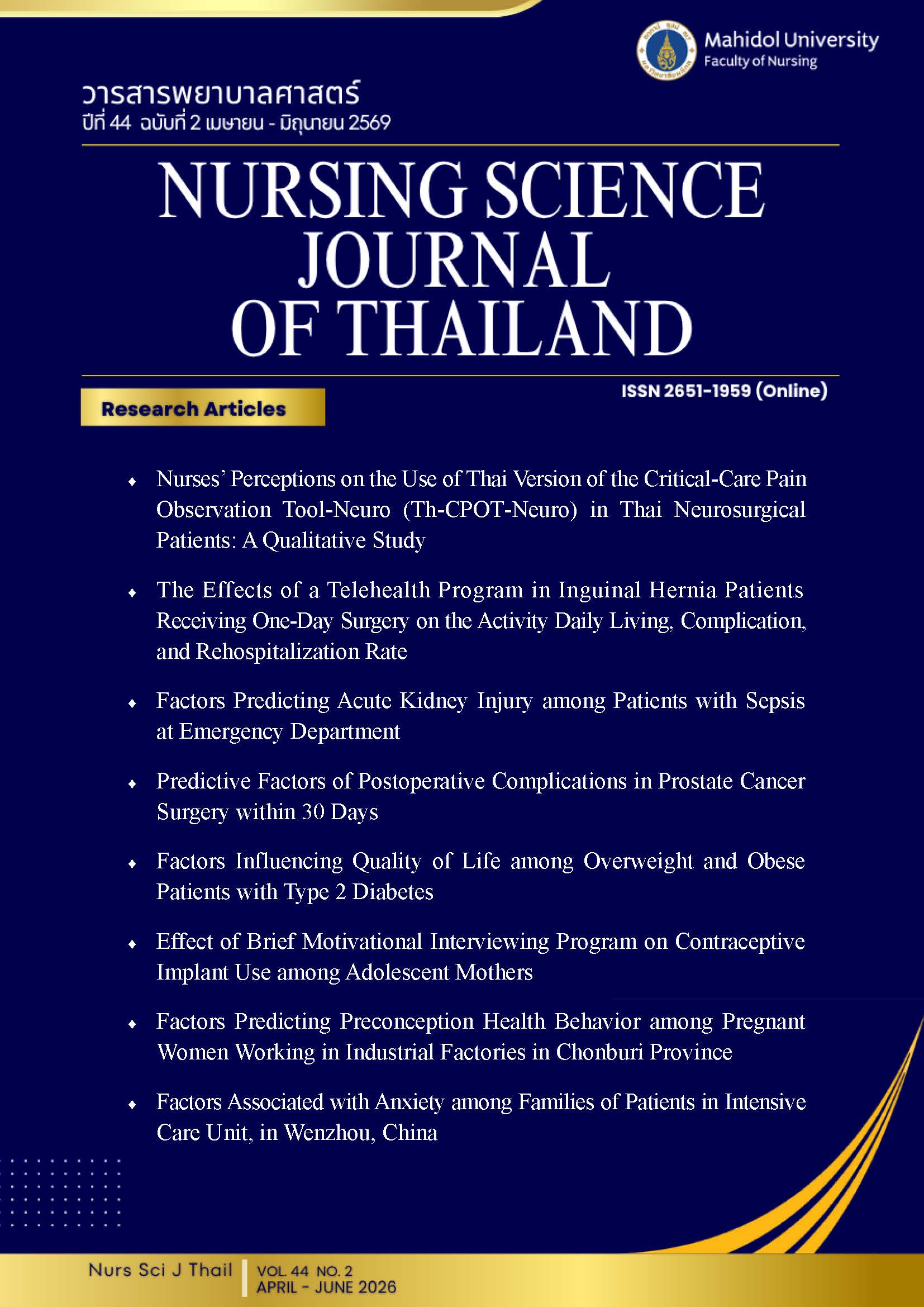
ปัจจัยที่เกี่ยวข้องกับความวิตกกังวลของครอบครัวของผู้ป่วยในหออภิบาลผู้ป่วยวิกฤต เมืองเวินโจว ประเทศจีน
Article Sidebar
Main Article Content
บทคัดย่อ
วัตถุประสงค์: การศึกษานี้มีจุดมุ่งหมายเพื่อประเมินระดับความวิตกกังวลของสมาชิกครอบครัวของผู้ป่วยในหออภิบาลผู้ป่วยวิกฤต และศึกษาความสัมพันธ์ระหว่างความรุนแรงของโรค การสนับสนุนทางสังคม ความเข้มแข็งทางใจ และความวิตกกังวล
รูปแบบการวิจัย: แบบการวิจัยเชิงบรรยายแบบหาความสัมพันธ์
วิธีดำเนินการวิจัย: การศึกษาวิจัยนี้ ดำเนินการที่โรงพยาบาลในสังกัดของมหาวิทยาลัยการแพทย์เวินโจว ประเทศจีน โดยมีผู้เข้าร่วมวิจัยเป็นญาติของผู้ป่วยที่เข้ารับการรักษาในหออภิบาลผู้ป่วยวิกฤตมาอย่างน้อย 24 ชั่วโมง จำนวน 101 ราย เกณฑ์การคัดเลือก ประกอบด้วย การเป็นผู้ดูแลหลัก อายุมากกว่า 18 ปี ไม่มีประวัติความผิดปกติทางจิตที่ได้รับการวินิจฉัย และอ่านเขียนภาษาจีนกลางได้ เครื่องมือที่ใช้ในการเก็บรวบรวมข้อมูล ประกอบด้วย แบบสอบถามข้อมูลประชากร แบบวัดความวิตกกังวลด้วยตนเอง แบบวัดการสร้างความเข้มแข็งทางใจ แบบวัดการสนับสนุนทางสังคม และแบบประเมินความรุนแรงของโรค วิเคราะห์ข้อมูลโดยใช้สัมประสิทธิ์สหสัมพันธ์ของเพียร์สัน เพื่อศึกษาความสัมพันธ์ระหว่างความวิตกกังวลกับตัวแปรอิสระ
ผลการวิจัย: สมาชิกในครอบครัวมีระดับความวิตกกังวลในระดับน้อย ปานกลาง และรุนแรง รวม 50.5% กลุ่มตัวอย่างเพศหญิงมีความวิตกกังวลสูงกว่าเพศชายอย่างมีนัยสำคัญ ความรุนแรงของโรคมีความสัมพันธ์ทางบวกกับความวิตกกังวล (r = .40, p < .001) ในขณะที่ความเข้มแข็งทางใจ (r = - .70, p < .001) และการสนับสนุนทางสังคม (r = - .62, p < .001) มีความสัมพันธ์ทางลบกับความวิตกกังวล
สรุปและข้อเสนอแนะ: ความวิตกกังวลของสมาชิกครอบครัวของผู้ป่วยในหออภิบาลผู้ป่วยวิกฤตมีความสัมพันธ์กับความรุนแรงของโรค การสนับสนุทางสังคม และความเข้มแข็งทางใจ ผลการศึกษาเหล่านี้เน้นถึงความจำเป็นของการจัดกิจกรรมการดูแลสุขภาพที่ช่วยเสริมความเข้มแข็งทางใจและการสนับสนุนทางสังคม เพื่อลดความวิตกกังวลและปรับปรุงสุขภาวะทางอารมณ์ของสมาชิกครอบครัวของผู้ป่วยในหออภิบาลผู้ป่วยวิกฤต
Article Details

อนุญาตภายใต้เงื่อนไข Creative Commons Attribution-NonCommercial-NoDerivatives 4.0 International License.
ลิขสิทธิ์: วารสารพยาบาลศาสตร์เป็นเจ้าของลิขสิทธิ์ในการเผยแพร่ผลงานที่ตีพิมพ์ ห้ามผู้ใดนำบทความที่ได้รับการตีพิมพ์ในวารสารพยาบาลศาสตร์ไปเผยแพร่ในลักษณะต่างๆ ดังต่อไปนี้ การส่งบทความไปตีพิมพ์เผยแพร่ที่อื่น การนำบทความเผยแพร่ออนไลน์ การถ่ายเอกสารบทความเพื่อกิจกรรมที่ไม่ใช่การเรียนการสอน ยกเว้นเสียแต่ได้รับอนุญาตจากวารสารพยาบาลศาสตร์
Disclaimer: เนื้อหาบทความหรือข้อคิดเห็นใดๆ ในวารสารพยาบาลศาสตร์ ถือเป็นความรับผิดชอบของผู้เขียน กองบรรณาธิการไม่จำเป็นต้องเห็นด้วยและไม่มีส่วนรับผิดชอบแต่อย่างใด
เอกสารอ้างอิง
Haugdahl HS, Eide R, Alexandersen I, Paulsby TE, Stjern B, Lund SB, et al. From breaking point to breakthrough during the ICU stay: a qualitative study of family members’ experiences of long‐term intensive care patients’ pathways towards survival. J Clin Nurs. 2018;27(19-20):3630-40. doi: 10.1111/jocn.14523.
Brinkman S, Jonge ED, Abu-Hanna A, Arbous MS, Lange DD, Keizer ND. Mortality after hospital discharge in ICU patients. Crit Care Med. 2013;41(5):1229-36. doi: 10.1097/CCM.0b013e31827ca4e1.
Davidson JE, Aslakson RA, Long AC, Puntillo KA, Kross EK, Hart J, et al. Guidelines for family-centered care in the neonatal, pediatric, and adult ICU. Crit Care Med. 2017;45(1):103-28. doi: 10.1097/CCM.0000000000002169.
Schmidt M, Azoulay E. Having a loved one in the ICU: the forgotten family. Curr Opin Crit Care. 2012;18(5):540-7. doi: 10.1097/MCC.0b013e328357f141.
Lv S, Mi J. Analysis on influence factors of anxiety occurrence in family members of ICU patients. J Mod Med Health. 2018;34(6):842-4. doi: 10.3969/j.issn.1009-5519.2018.06.013.
Kang J. Being devastated by critical illness journey in the family: a grounded theory approach of post-intensive care syndrome-family. Intensive Crit Care Nurs. 2023;78:103448. doi: 10.1016/j.iccn.2023.103448.
Bolosi M, Peritogiannis V, Tzimas P, Margaritis A, Milios K, Rizos DV. Depressive and anxiety symptoms in relatives of intensive care unit patients and the perceived need for support. J Neurosci Rural Pract. 2018;9(04):522-8. doi: 10.4103/jnrp.jnrp_112_18.
Fumis R, Ranzani OT, Faria PP, Schettino G. Anxiety, depression, and satisfaction in close relatives of patients in an open visiting policy intensive care unit in Brazil. J Crit Care. 2015;30(2):440.e1-6. doi: 10.1016/j.jcrc.2014.11.022.
Bandari R, Heravi-Karimooi M, Rejeh N, Montazeri A, Zayeri F, Mirmohammadkhani M, et al. Psychometric properties of the Persian version of the critical care family needs inventory. J Nurs Res. 2014;22(4):259-67. doi: 10.1097/jnr.0000000000000057.
Kang J. Being devastated by critical illness journey in the family: a grounded theory approach of post-intensive care syndrome-family. Intensive Crit Care Nurs. 2023;78:103448. doi: 10.1016/j.iccn.2023.103448.
Day A, Haj-Bakri S, Lubchansky S, Mehta S. Sleep, anxiety and fatigue in family members of patients admitted to the intensive care unit: a questionnaire study. Crit Care. 2013;17(3):R91. doi: 10.1186/cc12736.
Fumis RRL, Deheinzelin D. Family members of critically ill cancer patients: assessing the symptoms of anxiety and depression. Intensive Care Med. 2009;35(5):899-902. doi: 10.1007/s00134-009-1406-7.
Yilmaz M, Cakir U, Tuman TC, Oncul S, Gaygusuz EA, Esen O, et al. Depression, posttraumatic stress and correlates among the relatives of the patients in the intensive care unit. Psychiatry Behav Sci. 2016;6(4):196-201. doi: 10.5455/jmood.20161226104332.
Maley JH, Rogan J, Mikkelsen ME. Life after the ICU: post-intensive care syndrome in family members. In: Netzer G, editor. Families in the intensive care unit. New York, NY: Springer; 2018. p.119-31.
Bonanno GA. Loss, trauma, and human resilience: have we underestimated the human capacity to thrive after extremely aversive events? Am Psychol. 2004;59(1):20. doi: 10.1037/0003-066X.59.1.20.
Sottile PD, Lynch Y, Mealer M, Moss M. Association between resilience and family member psychologic symptoms in critical illness. Crit Care Med. 2016;44(8):e721-e7. doi: 10.1097/CCM.0000000000001673.
Lester EG, Silverman IH, Gates MV, Lin A, Vranceanu AM. Associations between gender, resiliency factors, and anxiety in neuro-ICU caregivers: a prospective study. Int J Behav Med. 2020;27:677-86. doi: 10.1007/s12529-020-09907-3.
House JS, Landis KR, Umberson D. Social relationships and health. Science. 1988;241(4865):540-5. doi: 10.1126/science.3399889.
Casarini KA, Gorayeb R, Basile Filho A. Coping by relatives of critical care patients. Heart Lung. 2009;38(3):217-27. doi: 10.1016/j.hrtlng.2008.05.003.
Wong P, Liamputtong P, Koch S, Rawson H. The impact of social support networks on family resilience in an Australian intensive care unit: a constructivist grounded theory. J Nurs Scholarsh. 2019;51(5):68-80. doi: 10.1111/jnu.12443.
Lin B. Medical individualism or medical familism? A critical analysis of China’s new guidelines for informed consent: the basic norms of the documentation of the medical record. J Med Philos. 2015;40(4):371-86. doi: 10.1093/jmp/jhv016.
Faul F, Erdfelder E, Lang A-G, Buchner A. G*Power 3: a flexible statistical power analysis program for the social, behavioral, and biomedical sciences. Behav Res Methods. 2007;39(2):175-91. doi: 10.3758/bf03193146.
Knaus WA, Zimmerman JE, Wagner DP, Draper EA, Lawrence DE. APACHE-acute physiology and chronic health evaluation: a physiologically based classification system. Crit Care Med. 1981;9(8):591. doi: 10.1097/00003246-198108000-00008.
Dunstan DA, Scott N. Assigning clinical significance and symptom severity using the Zung scales: levels of misclassification arising from confusion between index and raw scores. Depress Res Treat. 2018;2018(1):9250972. doi: 10.1155/2018/9250972.
Yu Y, Yang JP, Shiu CS, Simoni JM, Xiao S, Chen WT, et al. Psychometric testing of the Chinese version of the medical outcomes study social support survey among people living with HIV/AIDS in China. Appl Nurs Res. 2015;28:328-33. doi: 10.1016/j.apnr.2015.03.006.
Ni Q, Tian J. Evaluation on reliability and validity of 14-Item Resilience Scale. Chinese Journal of Public Health. 2013;29(10):1524-7. doi: 10.11847/zgggws2013-29-10-38.
Plinke W, Buchbinder S, Brumback L, Longstreth W, Holloway R, Engelberg R, et al. Palliative care needs and outcomes after severe acute brain injury: a prospective cohort study (RP422). J Pain Symptom Manage. 2022;63(6):1095. doi: 10.1016/j.jpainsymman.2022.04.063.
Gurbuz H, Demir N. Anxiety and depression symptoms of family members of intensive care unit patients: a prospective observational study and the lived experiences of the family members. Avicenna J Med. 2023;13(2):89-96. doi: 10.1055/s-0043-1769933.
Pochard F, Azoulay E, Chevret S, Lemaire FO, Hubert P, Canoui P, et al. Symptoms of anxiety and depression in family members of intensive care unit patients: ethical hypothesis regarding decision-making capacity. Crit Care Med. 2001;29(10):1893. doi: 10.1097/00003246-200110000-00007.
Curtis JR, Treece PD, Nielsen EL, Gold J, Engelberg RA. Randomized trial of communication facilitators to reduce family distress and intensity of end-of-life care. Am J Respir Crit Care Med. 2016;193(2):154-62. doi: 10.1164/rccm.201505-0900OC.
Avc M, Ayaz-Alkaya S. Anxiety, social support and satisfaction of patients' families in intensive care units: a descriptive-correlational study. J Clin Nurs. 2022;31(19-20):2765-73. doi: 10.1111/jocn.16094.
Bao J, Wang X, Chen C, Zou L. Relationship between primary caregivers’ social support function, anxiety, and depression after interventional therapy for acute myocardial infarction patients. World J Psychiatry. 2023;13(11):919. doi: 10.5498/wjp.v13.i11.919.
Kim HS, Sherman DK, Taylor SE. Culture and social support. Pers Soc Psychol Bull. 2008;63(1):518-26. doi: 10.1037/0003-066X.
