
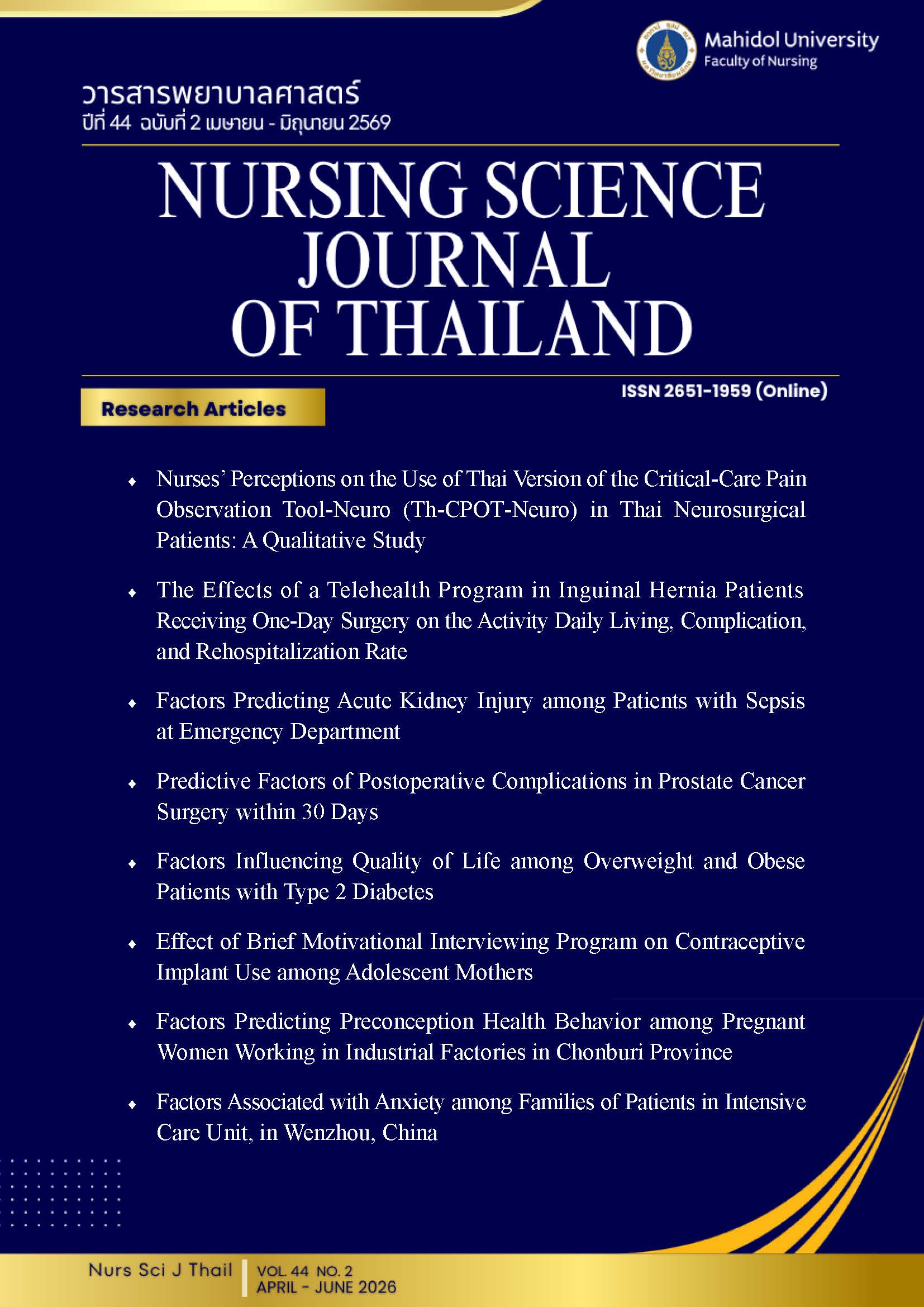
ผลของโปรแกรมการดูแลสุขภาพผ่านสื่อทางไกลในผู้ป่วยที่ได้รับการผ่าตัดไส้เลื่อนขาหนีบแบบวันเดียวกลับ ต่อความสามารถในการทำกิจวัตรประจำวัน ภาวะแทรกซ้อน และอัตราการกลับมาโรงพยาบาลก่อนวันนัด
Article Sidebar
Main Article Content
บทคัดย่อ
วัตถุประสงค์: เพื่อประเมินประสิทธิผลของโปรแกรมการดูแลสุขภาพผ่านสื่อทางไกล ต่อความสามารถในการทำกิจวัตรประจำวัน ภาวะแทรกซ้อนหลังผ่าตัด และอัตราการกลับมาโรงพยาบาลก่อนวันนัดของผู้ป่วยที่เข้ารับการผ่าตัดไส้เลื่อนขาหนีบแบบวันเดียวกลับ
รูปแบบการวิจัย: การวิจัยทดลอง ชนิดสองกลุ่ม วัดผลก่อนและหลังการได้รับโปรแกรมการดูแลสุขภาพผ่านสื่อทางไกล
วิธีดำเนินการวิจัย: การศึกษานี้ดำเนินการในโรงพยาบาลตติยภูมิแห่งหนึ่งในประเทศไทย กลุ่มตัวอย่าง คือ ผู้ป่วยที่อายุ 18 ปีขึ้นไป ที่ได้รับการนัดหมายผ่าตัดไส้เลื่อนขาหนีบแบบวันเดียวกลับล่วงหน้าที่หน่วยตรวจโรคศัลยกรรม และเข้ารับการผ่าตัดแบบวันเดียวกลับที่ห้องผ่าตัดศัลยกรรมรวม คัดเลือกตัวอย่างแบบสะดวกตามเกณฑ์คัดเข้า จำนวน 52 ราย และสุ่มเข้ากลุ่มที่ศึกษาโดยใช้การสุ่มด้วยคอมพิวเตอร์ ได้แก่ กลุ่มควบคุมที่ได้รับการดูแลตามปกติ 26 ราย และกลุ่มทดลองที่ได้รับโปรแกรมการดูแลสุขภาพผ่านสื่อทางไกลร่วมกับการดูแลตามปกติ 26 ราย ซึ่งเครื่องมือที่ใช้ในการเก็บรวบรวมข้อมูลประกอบด้วย แบบสอบถามข้อมูลทั่วไป แบบประเมินความสามารถในการทำกิจวัตรประจำวัน แบบประเมินภาวะแทรกซ้อนหลังผ่าตัด และแบบบันทึกการกลับมาโรงพยาบาลก่อนวันนัด
ผลการวิจัย: พบว่ากลุ่มทดลองมีค่าเฉลี่ยคะแนนความสามารถในการทำกิจวัตรประจำวันดีกว่ากลุ่มควบคุมอย่างมีนัยสำคัญทางสถิติ นอกจากนี้ กลุ่มทดลองยังมีอัตราการเกิดภาวะแทรกซ้อนหลังผ่าตัดต่ำกว่ากลุ่มควบคุมอย่างมีนัยสำคัญทางสถิติ อย่างไรก็ตาม ไม่พบความแตกต่างระหว่างอัตราการกลับมาโรงพยาบาลก่อนวันนัด
สรุปและข้อเสนอแนะ: โปรแกรมการดูแลสุขภาพผ่านสื่อทางไกลมีประสิทธิผลในการส่งเสริมการฟื้นฟูสมรรถภาพหลังผ่าตัดในกิจวัตรประจำวัน และลดอัตราการเกิดภาวะแทรกซ้อนในผู้ป่วยที่เข้ารับการผ่าตัดไส้เลื่อนขาหนีบแบบวันเดียวกลับ จึงควรส่งเสริมให้นำโปรแกรมการดูแลสุขภาพผ่านสื่อทางไกลมาพัฒนาต่อยอดในการดูแลผู้ป่วยที่ได้รับการผ่าตัดแบบวันเดียวกลับในโรงพยาบาลต่อไป
Article Details

อนุญาตภายใต้เงื่อนไข Creative Commons Attribution-NonCommercial-NoDerivatives 4.0 International License.
ลิขสิทธิ์: วารสารพยาบาลศาสตร์เป็นเจ้าของลิขสิทธิ์ในการเผยแพร่ผลงานที่ตีพิมพ์ ห้ามผู้ใดนำบทความที่ได้รับการตีพิมพ์ในวารสารพยาบาลศาสตร์ไปเผยแพร่ในลักษณะต่างๆ ดังต่อไปนี้ การส่งบทความไปตีพิมพ์เผยแพร่ที่อื่น การนำบทความเผยแพร่ออนไลน์ การถ่ายเอกสารบทความเพื่อกิจกรรมที่ไม่ใช่การเรียนการสอน ยกเว้นเสียแต่ได้รับอนุญาตจากวารสารพยาบาลศาสตร์

Disclaimer: เนื้อหาบทความหรือข้อคิดเห็นใดๆ ในวารสารพยาบาลศาสตร์ ถือเป็นความรับผิดชอบของผู้เขียน กองบรรณาธิการไม่จำเป็นต้องเห็นด้วยและไม่มีส่วนรับผิดชอบแต่อย่างใด
เอกสารอ้างอิง
Stabilini C, Van Veenendaal N, Aasvang E, Agresta F, Aufenacker T, Berrevoet F, et al. Update of the international HerniaSurge guidelines for groin hernia management. BJS Open. 2023;7(5):zrad080. doi: 10.1093/bjsopen/zrad080.
Liu X, Ma B, Ma Q, Wang F, Shen Y. Trends and cross-country inequalities in the global burden of inguinal, femoral, and abdominal hernia from 1990 to 2021, with projections from 2022 to 2035: a cross-sectional study. Hernia. 2025;29(1):91. doi: 10.1007/s10029-025-03282-2.
Abebe MS, Tareke AA, Alem A, Debebe W, Beyene A. Worldwide magnitude of inguinal hernia: systematic review and meta-analysis of population-based studies. SAGE Open Med. 2022;10:20503121221139150. doi: 10.1177/20503121221139150.
Yeow M, Wijerathne S, Gossetti F, Munegato G, Stabilini C, Imamura K, et al. Evaluation and management of mesh infection after inguinal hernia repair: a Delphi consensus guided by systematic review. Surgery. 2025;187:109652. doi: 10.1016/j.surg.2025.109652.
Department of Medical Services. Hernia surgery statistics and management guidelines. Bangkok: Ministry of Public Health; 2021. 156 p. (in Thai).
Tantinam T, Treeratanawikran T, Kamoncharoen P, Srimaneerak E, Siripoonsap M, Phoonkaew T. A retrospective non-inferiority study of laparoscopic inguinal hernia repair feasibility for recently graduated surgeons in Thailand. J Minim Invasive Surg. 2024;27(2):85-94. doi: 10.7602/jmis.2024.27.2.85.
Van den Dop LM, Van Egmond S, Heijne J, van Rosmalen J, de Goede B, Wijsmuller AR, et al. Twelve-year outcomes of watchful waiting versus surgery of mildly symptomatic or asymptomatic inguinal hernia in men aged 50 years and older: a randomised controlled trial. EClinicalMedicine. 2023;64:102207. doi: 10.1016/j.eclinm.2023.102207.
Reistrup H, Fonnes S, Rosenberg J. Watchful waiting vs repair for asymptomatic or minimally symptomatic inguinal hernia in men: a systematic review. Hernia. 2021;25(5):1121-8. doi: 10.1007/s10029-020-02295-3.
National Health Security Office. Annual report on surgical waiting times [Internet]. Bangkok: NHSO; 2021 [cited 2024 Jan 10]. Available from: https://e-library.nhso.go.th/assets/portals/1/ebookcategory/193_Annual_Report_2564/ (in Thai).
Arunnart M. Cost-analysis of inguinal herniorrhaphy under general anesthesia in same-day surgery. The Thai Journal of Surgery. 2023;44(1):1-6. (in Thai).
Felix Z, Salgado-Garza G, Porter CG, Nouboussi N, O'Connor AL, Bazarian A, et al. Postoperative outcomes among patients evaluated via telemedicine-based preoperative consultations for inguinal hernia care. Hernia. 2024;28(6):2151-7. doi: 10.1007/s10029-024-03095-9.
HerniaSurge Group. International guidelines for groin hernia management. Hernia. 2018;22(1):1-165. doi: 10.1007/s10029-017-1668-x.
Lorenz WR, Holland AM, Adams AS, Mead BS, Scarola GT, Kercher KW, et al. Open versus laparoscopic versus robotic inguinal hernia repair: a propensity-matched outcome analysis. Surgery. 2025;179:108895. doi: 10.1016/j.surg.2024.08.054.
Abbitt D, Choy K, Castle R, Jones TS, Wikiel KJ, Barnett CC, et al. Telehealth follow-up after inguinal hernia repair in veterans. J Surg Res. 2023;287:186-92. doi: 10.1016/j.jss.2023.02.030.
World Health Organization. Global strategy on digital health 2020-2025 [Internet]. Geneva: WHO; 2021 [cited 2024 Jan 12]. Available from: https://www.who.int/publications/i/item/9789240020924.
Naylor MD, Shaid EC, Carpenter D, Gass B, Levine C, Li J, et al. Components of comprehensive and effective transitional care. J Am Geriatr Soc. 2017;65(6):1119-25. doi: 10.1111/jgs.14782.
Faul F, Erdfelder E, Lang A-G, Buchner A. G*Power 3: a flexible statistical power analysis program for the social, behavioral, and biomedical sciences. Behav Res Methods. 2007;39(2):175-91. doi: 10.3758/BF03193146.
Ali EA, Ragab II, Mohammed MAS, Mohamed RF. Effect of preoperative nursing protocol on pain and daily activities for post inguinal hernia repair patients. Minia Scientific Nursing Journal. 2020;8(1):130-8. doi: 10.21608/msnj.2020.188053.
Cohen J. Statistical power analysis for the behavioral sciences. 2nd ed. Hillsdale, NJ: Lawrence Erlbaum Associates; 1988. 579 p.
Mahoney FI, Barthel DW. Functional evaluation: the Barthel Index. Md State Med J. 1965;14:61-5.
Neurological Institute of Thailand, Department of Medical Services, Ministry of Public Health. Clinical nursing practice guidelines for stroke [Internet]. Bangkok: Neurological Institute of Thailand; 2023 [cited 2023 Mar 30]. Available from: https://neuronetworks.org/wp-content/uploads/2025/06/CNPGStroke23.pdf. (in Thai).
Robin F, Roy M, Kuftedjian A, Desrosiers M-E, Lavoie F, Pomey M-P, et al. Medico-economic evaluation of a telehealth platform for elective outpatient surgeries: randomized controlled trial. J Med Internet Res. 2025;27:e76730. doi: 10.2196/76730.
Abbitt D, Choy K, Castle R, Bollinger D, Jones TS, Wikiel KJ, et al. Telehealth for general surgery postoperative care. Am J Surg. 2024;229:156-61. doi: 10.1016/j.amjsurg.2023.12.025.
Oudbier SJ, Souget-Ruff SP, Chen BSJ, Ziesemer KA, Meij HJ, Smets EMA. Implementation barriers and facilitators of remote monitoring, remote consultation and digital care platforms through the eyes of healthcare professionals: a review of reviews. BMJ Open. 2024;14(6):e075833. doi: 10.1136/bmjopen-2023-075833.
